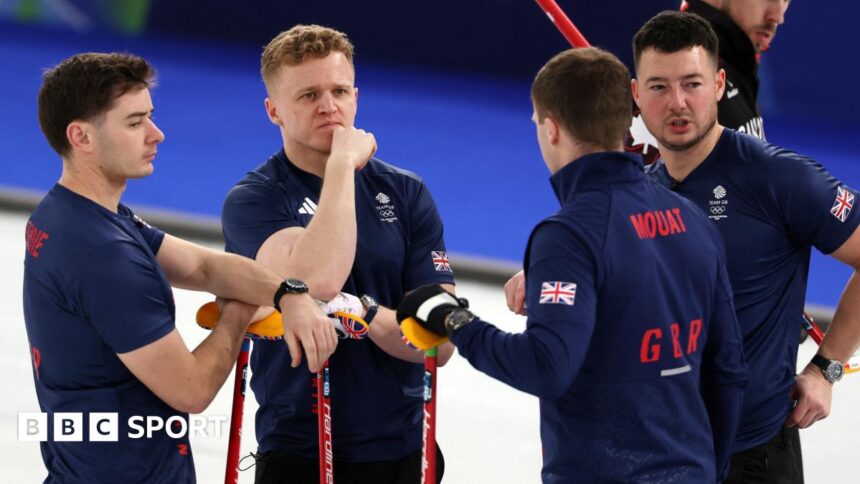
Team GB’s Curling Comeback Falls Short as Italy Capitalizes on Shocking Start
The roar inside the Cortina Curling Stadium was deafening, a wall of sound built on horns, bells, and unbridled Italian passion. In the eye of this storm, the Great Britain men’s curling team, the world’s top-ranked rink, found themselves in a nightmare scenario. A disastrous opening end had left them staring into a four-point abyss against the host nation. What followed was a masterclass in resilience and a stubborn fightback that epitomized their champion status, but the mountain they built for themselves proved just too steep to climb. In a pulsating encounter that went to the final stone, Team GB’s perfect Olympic start was shattered by a 10-9 defeat to a nerveless Italian quartet.
A Nightmare Unfolds: The Costly First End
All the momentum from two impressive opening victories, including a statement win against the Swedish team that denied them gold in PyeongChang, evaporated in a single, torturous end. Curling is a game of millimeters and meticulous strategy, where a two-point steal is considered a significant blow. What happened to Bruce Mouat, Grant Hardie, Bobby Lammie, and Hammy McMillan was of a different magnitude entirely.
The first end disaster was a perfect storm of slight British misjudgments and impeccable Italian execution. A few GB stones slid a fraction too deep, leaving precarious positions. Italy’s skip, Joel Retornaz, seized the opportunity with clinical precision. His team set up a fortress of stones in the house, and when Mouat’s final attempt to clear danger rubbed a guard, the stadium erupted. The scoreboard flashed a devastating number: a four-point steal for Italy. In a sport where games are often won by single points, it was a body blow that left the British rink visibly stunned, their early tournament confidence replaced by a grim reality.
- Strategic Shock: Giving up a four-point steal at any level is rare; at the Olympic Games, against a charged home team, it’s catastrophic.
- Momentum Shift: The raucous home crowd, already electric, became a tangible sixth player, sensing a monumental upset.
- Psychological Battle: Immediately, the game dynamic shifted from controlled strategy to desperate chase for Team GB.
The Champion’s Response: A Gritty Fightback
This is where the character of the world number one team revealed itself. Lesser rinks might have folded under the weight of the deficit and the decibel level. Instead, Team GB began the long, arduous process of chipping away. There was no panic, no reckless attempt to reclaim four points in a single end. They returned to their process, winning the second end to get on the board, then stealing a point back in the third to steady the ship.
The middle ends became a tense, tactical war. The British shot-making precision, particularly from Hardie and Lammie at lead and second, began to force errors from an Italian team trying to protect their colossal lead. Mouat, a skip renowned for his calm demeanor, navigated the increasing pressure with skill, clawing back points end by end. The critical moment came in the ninth, with Britain trailing by two. Mouat played a sublime double takeout with his final stone, sitting two and forcing Retornaz into a difficult draw for a single. The Italian’s stone was heavy, and Britain scored two to tie the game at 9-9, completing a comeback that had seemed impossible just over an hour earlier.
Key to the Comeback:
- Discipline: They ignored the scoreboard and focused on winning each end individually.
- Front-End Dominance: Hardie and Lammie’s accuracy in the middle stages turned the ice in Britain’s favor.
- Skip’s Steady Hand: Bruce Mouat’s decision-making under extreme pressure was a testament to his world-class status.
The Final End: Nerve, Ice, and a Heartbreaking Result
Level pegging going into the tenth and final end, without the last-stone advantage (hammer), was still a precarious position for GB. The comeback was complete, but the job was not. The end was set up with typical tension, with both teams maneuvering for the optimal position. Italy held the crucial advantage of the hammer, and Retornaz’s team executed a near-perfect protective setup.
When Mouat’s final stone, a difficult raise attempt, didn’t curl quite enough, it left a narrow port for Retornaz. The Italian skip, with the hopes of a host nation resting on his shoulders, needed only to draw his stone into the eight-foot circle to win. In the cauldron of noise, his stone glided down the sheet, clearing guards by a whisper, and came to rest perfectly positioned. The Italian victory was sealed, a 10-9 win that sent the stadium into absolute delirium. For Team GB, it was a crushing end to a heroic effort, their fate sealed by the shocking opening they spent the entire game recovering from.
Analysis and Path Forward for Team GB
This loss, while damaging, is not fatal in the round-robin format. The nature of the defeat, however, provides crucial lessons. The slow start vulnerability is now a glaring concern that other opponents will look to exploit. The immense pressure and unique atmosphere of an Olympic Games, particularly in a venue pulsing with home support, created a scenario they failed to navigate in the first end.
Yet, the positive takeaways are significant. Their ability to compartmentalize the early disaster and methodically fight back against a team riding a wave of emotion shows a championship mentality. They outplayed the Italians for the vast majority of the match after the first-end catastrophe. This proves their technical superiority and mental fortitude remain intact.
Predictions for the Remainder of the Tournament:
- Immediate Response: Expect a fiercely focused and sharp GB team in their next match. This defeat will likely eradicate any complacency and sharpen their intensity from the first stone.
- Round-Robin Resilience: They remain one of the strongest rinks in the competition. This loss serves as a brutal wake-up call, but they are more than capable of winning their remaining games to secure a top-tier playoff position.
- Long-Term Effect: The experience of digging themselves out of such a deep hole under extreme pressure could become a source of strength. They know now, unequivocally, that no deficit is insurmountable, which is a powerful belief to carry into the medal rounds.
Conclusion: A Lesson Learned in the Cortina Cauldron
The story of this match will be etched as a tale of two extremes: one catastrophic end and nine ends of brilliant, defiant curling. For Italy, it is a landmark victory that energizes their Olympic campaign and a nation. For Great Britain, it is a harsh lesson in the unforgiving nature of the Olympic stage, where a single lapse in concentration can define an entire game.
While they will rightly rue the shocking first end, they should also take profound confidence from their response. They did not lose this game in the tenth end; they lost it in the first. The fightback demonstrated every quality that made them world number one. As the tournament progresses, the memory of the Italian horns and that four-point steal will serve as a potent motivator. The gold medal dream is very much alive, but the path just got narrower, and the margin for error has completely disappeared. The champions have been bloodied, but the true test of their gold-medal credentials will be how they now respond.
Source: Based on news from BBC Sport.