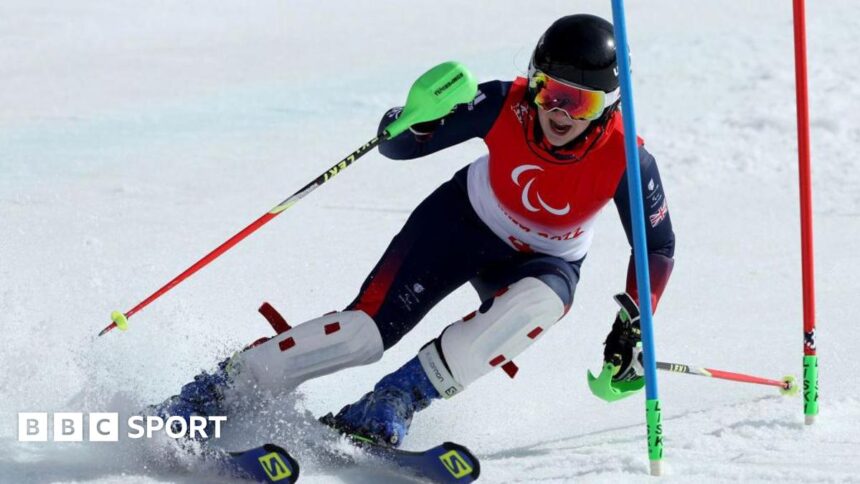
GB’s Golden Girl Fitzpatrick Faces Race Against Time After Devastating Knee Injury
The icy slopes of Milan-Cortina 2026 suddenly feel a world away for Menna Fitzpatrick. In a cruel twist of fate, Britain’s most decorated Winter Paralympian has been dealt a severe blow just three months before she was set to chase more glory. The Para-alpine skiing star, a beacon of resilience and success, has suffered a significant knee injury in training, throwing her participation in the upcoming Winter Games into serious doubt. The sporting world now watches, holding its breath, as one of its brightest stars embarks on a desperate race against the clock.
A Legacy Forged in Ice and Adversity
To understand the magnitude of this setback, one must first appreciate the towering legacy Fitzpatrick has already built. At just 27 years old, she is not just a successful athlete; she is a paradigm of excellence in British winter sport. With six Paralympic medals to her name, her career is a highlight reel of precision and courage. Her golden moment came at PyeongChang 2018, where she triumphed in the visually impaired slalom with her then-guide, Jennifer Kehoe. That victory was part of a historic four-medal haul, a British Winter Paralympic record.
She carried that formidable form to Beijing 2022, adding two more medals—a silver and a bronze—to her collection, further cementing her status as a national sporting icon. Fitzpatrick’s career has been defined by her symbiotic partnership with her guides and her fearless approach to the mountain. This context makes the timing of her injury, sustained in a training session earlier in December, all the more heartbreaking. It is a stark reminder of the razor-thin margins and inherent risks that define elite alpine sport.
The Critical Decision: Rehab Over the Surgeon’s Knife
In the immediate aftermath of such an injury, the path forward is fraught with difficult choices. BBC Sport reports that Fitzpatrick has made a pivotal and daring decision: to forgo surgery in favor of an intensive rehabilitation program. This choice is the central drama of her road to Milan-Cortina. It is a high-stakes gamble that speaks volumes about her determination and the calculated advice of her medical team.
Opting against surgical intervention suggests the injury, while significant, may not involve certain catastrophic ligament tears that would mandate an immediate operation. This path prioritizes time—the most precious and dwindling resource. A surgery now would almost certainly end her 2026 hopes, with recovery and rehab timelines stretching well beyond March. Rehabilitation, however, is an arduous and uncertain path. The key questions now are:
- Structural Stability: Can the knee be made strong and stable enough to withstand the immense G-forces of World Cup-level skiing without surgical repair?
- Pain Management: Can pain and inflammation be controlled to allow for peak performance?
- Muscle Retention: Can she maintain the explosive power and fine muscle control essential for skiing during a prolonged period off snow?
The plan to remain off snow throughout January is a necessary but costly sacrifice. It eliminates crucial on-snow technical tuning and speed work, compressing her preparation window into a frantic few weeks in February, should her rehab stay on track.
Expert Analysis: The Uphill Battle to the Start Gate
From a sports science and high-performance perspective, Fitzpatrick’s challenge is monumental. “The decision to rehab rather than operate is a clear signal that the goal is Milan, not long-term health—at least in the immediate term,” analyses a leading sports physiotherapist familiar with alpine injuries. “It’s a calculated risk. The focus will be on aggressive physio—building dynamic stability around the joint, proprioceptive re-education, and managing load meticulously.”
The psychological component is equally critical. Remaining in “good spirits,” as reported, is a positive sign, but the mental grind of daily rehab without a guaranteed payoff is relentless. Furthermore, her partnership with her guide, Katie Guest, is paramount. Their communication and trust are built through thousands of runs together; every day lost on snow is a day that synergy cannot be honed. The injury also disrupts the typical peaking process—the carefully orchestrated build-up of volume and intensity designed to have an athlete physically and mentally razor-sharp on the precise days of competition.
Even if she makes it to the start gate, questions will linger about her ability to push to the absolute limit. In Paralympic skiing, where medals are often decided by hundredths of a second, holding back even 1% can be the difference between the podium and anonymity.
Predictions for Milan-Cortina and Beyond
The landscape of the women’s visually impaired alpine skiing events at the 2026 Games shifts with this news. Rivals from nations like Slovakia, China, and Italy will see an opportunity with the British champion potentially compromised. For Team GB, Fitzpatrick is not just a medal hope but a team leader and standard-bearer; her absence or diminished capacity would be a profound blow to the entire delegation’s morale and profile.
Realistically, her participation hangs in the balance. The most optimistic scenario sees a race-fit Fitzpatrick arriving in Italy, perhaps lacking the fine-tuning of a perfect season but armed with unparalleled Paralympic experience and a champion’s heart. In this case, writing her off would be foolish. She could still challenge for medals, particularly in the technical events like slalom, where her tactical genius can sometimes offset a slight physical deficit.
The more cautious prediction is that this season becomes one of survival rather than optimization. Making the team and competing courageously would be a victory in itself. Regardless of the outcome in March, this episode underscores the fragility of an athlete’s window of opportunity. It may also prompt a longer-term view. At 27, Fitzpatrick could target the 2030 Games, making a full surgical repair and recovery after Milan a potential pathway, turning this setback into a pause rather than an end.
A Test of a Champion’s True Mettle
Menna Fitzpatrick’s career has always been about navigating challenges—both the visible and the unseen. This injury is perhaps her greatest test yet. It is no longer about beating the clock on the course, but about beating the clock of the calendar. Her decision to rehab is a bold declaration of intent, a refusal to surrender without a fight.
The coming weeks will be a private battle of pain, perseverance, and profound hope. The entire nation that has celebrated her victories will now be willing her through each small milestone in the gym and on the physio’s table. Whether she stands in the start gate in Cortina d’Ampezzo or not, this chapter is cementing her legacy in a new way. It is no longer defined solely by gold, silver, and bronze, but by the raw courage and resilience that underpin them. The story of Menna Fitzpatrick and the 2026 Winter Games is still being written, and its most inspiring page may yet be about the journey to the start line, not the finish.
Source: Based on news from BBC Sport.