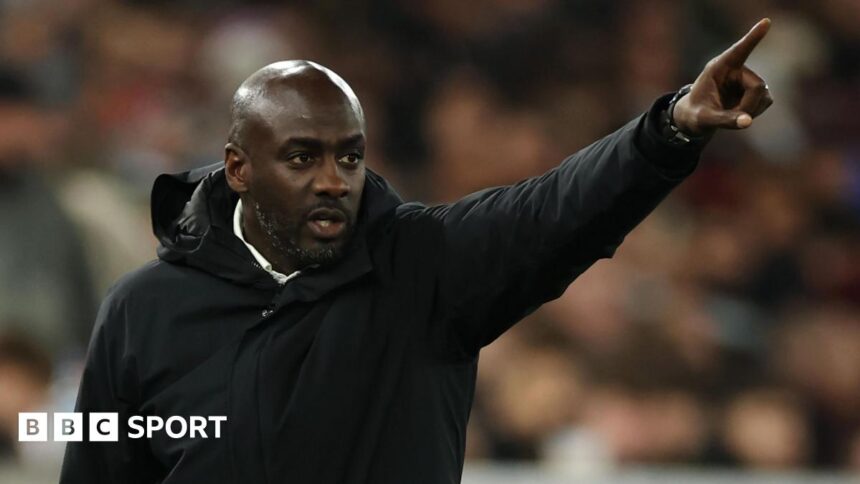
Ghana in Crisis: Black Stars Sack Otto Addo 72 Days From World Cup Kickoff
The Ghana Football Association (GFA) has pulled the emergency cord on a runaway train. In a stunning move that sends shockwaves through African football and the global World Cup landscape, the GFA has terminated the contract of head coach Otto Addo with a mere 72 days remaining until the Black Stars’ opening match in the 2026 FIFA World Cup. This drastic decision, coming on the heels of a humiliating international window and a failed continental qualification campaign, plunges Ghana’s World Cup preparations into unprecedented chaos just as the tournament looms on the horizon.
A Swift and Inevitable Fall From Grace
Otto Addo’s departure, announced as “effective immediately” following a 2-1 friendly defeat to Germany in Stuttgart, was the culmination of a catastrophic downward spiral. Hired on a permanent basis in March 2024 after a previous interim stint that saw Ghana qualify for the 2022 World Cup, Addo’s second reign promised stability. Instead, it unraveled with alarming speed. The seeds of this crisis were sown months earlier with Ghana’s shocking failure to qualify for the 2025 Africa Cup of Nations (AFCON), a cardinal sin for a nation of Ghana’s footballing stature.
However, the true catalyst for his dismissal was a disastrous pair of June friendlies that exposed deep tactical and psychological flaws within the squad:
- A 5-1 demolition by Austria in Vienna last Friday, a scoreline that flattered Ghana and represented one of the heaviest defeats in recent memory.
- A 2-1 loss to Germany, a match where a late Ghanaian consolation goal did little to mask another concerning performance.
These results extended Ghana’s losing streak to four matches, a run devoid of cohesion or fight. The GFA’s statement, citing a mutual parting of ways, could not obscure the reality: this was a panic-fired sacking born of pure necessity.
Diagnosing the Black Stars’ Collapse Under Addo
How did a team featuring Premier League talents like Mohammed Kudus (Tottenham) and Antoine Semenyo (Manchester City) become so dysfunctional? Expert analysis points to a perfect storm of systemic failures.
First and foremost was Addo’s tactical indecision. The team lacked a clear, identifiable style of play. Shifts between formations and personnel were frequent and often seemed reactive rather than strategic. This left a gifted attacking unit, capable of moments of individual brilliance, looking disjointed and unable to build sustained pressure. The defensive organization was even more calamitous, as evidenced by the five goals conceded to Austria—a team that did not qualify for the upcoming World Cup.
Secondly, the failure to qualify for AFCON 2025 cannot be overstated. It was more than a missed tournament; it was a national embarrassment that severed the team’s connection with a furious fanbase and created a cloud of negativity that Addo could not dispel. The friendlies against Austria and Germany were meant to be a fresh start for World Cup preparation. Instead, they confirmed the worst fears about the team’s trajectory.
Finally, there appeared to be a significant leadership vacuum. On the pitch, the team’s body language during heavy defeats spoke of a group lacking belief and resilience. Off it, Addo’s calm demeanor, once an asset, began to be perceived as passivity in the face of a growing crisis. The GFA, witnessing the complete erosion of competitive integrity, was left with no choice but to act.
The World Cup Crucible and the Search for a Savior
Ghana’s World Cup group is a daunting one: they face England, Denmark, and Chile in Group C. The prospect of entering this gauntlet with a new manager installed during a brutally short pre-tournament camp is a nightmare scenario. The immediate question is, who would possibly take this job?
The GFA’s shortlist will be a mix of the desperate and the daring. Candidates will fall into three categories:
- The Firefighter: An experienced, often itinerant manager specializing in short-term crisis management and quick defensive organization. Think of names like Hector Cuper or even a return for Milovan Rajevac.
- The Nostalgic Pick: A former Black Stars hero like Asamoah Gyan (in a technical role with an experienced coach) or Stephen Appiah, whose appointment would be a popular, emotion-driven gamble.
- The Domestic Solution: Turning to a respected Ghana Premier League coach who understands the local player pool and could unite the squad through shared cultural identity, though this option carries immense risk at the World Cup level.
Whoever accepts the role inherits a monumental task. Their first job will be psychological repair—restoring shattered confidence and forging a siege mentality. Tactically, they must implement a simple, robust system that maximizes the strengths of key players like Kudus and Semenyo while patching up a leaky defense. They have perhaps one or two friendly windows to instill these principles before the world watches them face England.
Predictions and the Path Forward for Ghana
The fallout from this decision will define Ghanaian football for years. The immediate World Cup prediction is grim. A squad in this much turmoil, with this little time to adapt to a new manager’s ideas, is highly likely to underperform. The minimum expectation will be competitive showings, but a group-stage exit is the most probable outcome. The hope is that a new manager can at least restore pride and a semblance of structure.
Looking beyond the 2026 tournament, this episode must serve as a watershed moment for the Ghana Football Association. The cycle of hiring and firing, often without a long-term vision, has proven unsustainable. The failure runs deeper than the head coach; it touches on talent development, domestic league health, and administrative planning.
The sacking of Otto Addo is not just a change of personnel; it is a stark admission of a profound failure at the worst possible time. It is a Hail Mary pass with 72 seconds on the clock, not 72 days. The new manager will not merely be a tactician, but a trauma surgeon operating in the emergency room of global football.
Conclusion: Ghana’s decision to sack Otto Addo is a breathtaking gamble born of absolute desperation. While his tenure had clearly run its course, the timing creates a crisis of unprecedented scale so close to the World Cup. The Black Stars’ campaign now hinges on finding a managerial miracle worker—a figure who can perform a rapid cultural reset, tactical overhaul, and psychological revival in the blink of an eye. The world will be watching to see if this dramatic intervention saves Ghana’s World Cup, or if it simply accelerates a downfall that has been months in the making. The only certainty is that Ghana’s path to the World Cup has just become the most compelling and precarious story of the tournament.
Source: Based on news from BBC Sport.