Gianni Infantino’s Unwavering Stance: Iran to Play in World Cup Amidst Geopolitical Firestorm
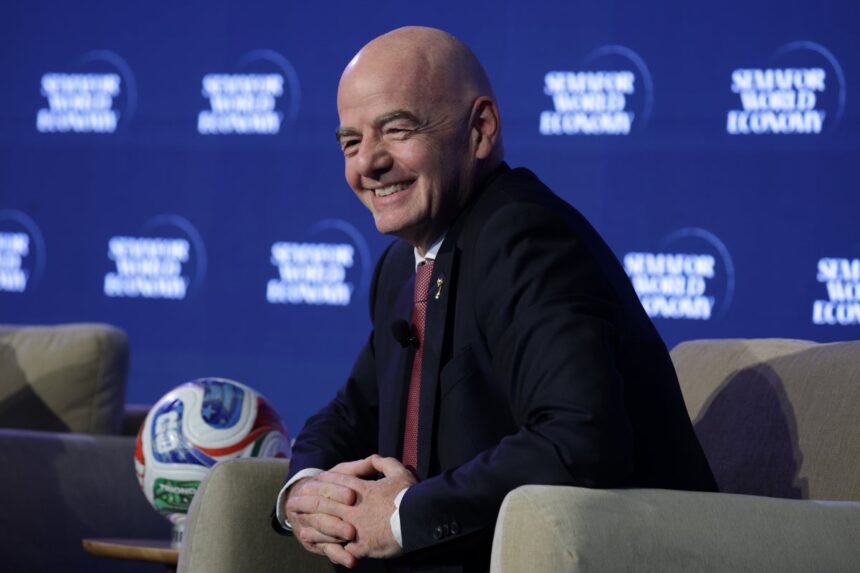
The beautiful game has always existed in the tense space between global unity and political division, but rarely has that tension been as palpable as it is today. As the world prepares for the next FIFA World Cup, a shadow war between nations threatens to spill onto the pitch. In a definitive statement cutting through the fog of geopolitical uncertainty, FIFA President Gianni Infantino has declared that Iran will “for sure” participate in the tournament, despite the nation being in a state of open war with fellow qualifier, the United States. This announcement, made at CNBC’s Invest in America Forum, is more than a logistical update; it is a high-stakes gamble on the power of sport in a fractured world.
- A President’s Pronouncement: “Sports Should Be Outside of Politics”
- Navigating the Impossible: Logistics, Security, and the Specter of Protest
- Historical Precedent and the Weight of a World Cup
- Expert Analysis: The Stakes for FIFA, Football, and Global Politics
- Conclusion: The Final Whistle Has Yet to Blow
A President’s Pronouncement: “Sports Should Be Outside of Politics”
Infantino’s comments were both firm and hopeful. Addressing concerns stemming from recent U.S. and Israeli airstrikes on Iranian territory, he left no room for ambiguity regarding Iran’s footballing future. “The Iranian team is coming for sure, yes,” Infantino stated, before immediately pivoting to a diplomatic hope: “We hope that by then, of course, the situation will be a peaceful situation.” His rationale was built on twin pillars of sporting principle and human spirit. He emphasized that the team represents its people, has earned its place through qualification, and, most importantly, the players themselves are desperate to compete.
To underscore this point, Infantino revealed a personal pilgrimage of sorts. Just a fortnight prior, he met with the Iranian national team during their training camp in Antalya, Turkey. “I went to see them. They are actually quite a good team as well,” he remarked, offering a rare footballing assessment amidst the political discourse. This firsthand encounter clearly shaped his resolve. “And they really want to play and they should play. Sports should be outside of politics now.” This final, repeated mantra is the core of Infantino’s argument—and its greatest vulnerability.
Navigating the Impossible: Logistics, Security, and the Specter of Protest
While the decree from FIFA’s helm is clear, the path to Iran’s participation is fraught with unprecedented challenges. Infantino’s hope for peace is the primary, all-encompassing variable. A continuation or escalation of hostilities would create a security nightmare for tournament organizers, host nations, and the teams themselves. The logistical hurdles are immense:
- Team Travel & Security: How will the Iranian delegation safely travel to and from the host nation? They would likely require diplomatic escorts and unprecedented security protocols, potentially creating friction in host cities.
- Fixture Diplomacy: While a direct Iran-U.S. group stage match is not guaranteed, the possibility looms large. Organizing such a fixture would be one of the most politically charged sporting events in history, requiring a security bubble unlike any seen before at a World Cup.
- Player & Fan Safety: The well-being of Iranian players and the thousands of passionate Iranian fans traveling to support them becomes a paramount concern. They could become targets for protest or worse, turning stadiums into potential flashpoints.
- Protests and Propaganda: The Iranian team has historically been a conduit for political expression, both for and against the regime. Every goal, celebration, or gesture will be scrutinized and could ignite reactions far beyond the stadium walls.
Infantino’s vision of apolitical sport collides head-on with the reality that, for Iran, their very presence is a political act. The team carries the flag of a nation at war, and their performances will be framed by that context, regardless of FIFA’s wishes.
Historical Precedent and the Weight of a World Cup
This is not FIFA’s first dance with diplomacy. The organization has a checkered history of attempting to separate sport from state, with mixed results. The 2018 World Cup in Russia proceeded despite international tensions, and Qatar 2022 was played under a cloud of human rights criticisms. However, a direct military conflict between participant nations is a new frontier.
Historically, sport has occasionally succeeded as a temporary bridge. The famous “Ping Pong Diplomacy” between the U.S. and China in the 1970s thawed relations. Yet, the World Cup is a global spectacle of a different magnitude, and the Iran-U.S. rivalry is already deeply entrenched in football lore. Their 1998 World Cup match, won 2-1 by Iran, remains one of the tournament’s most politically symbolic games. The stakes in a potential 2026 meeting would be exponentially higher, layered with the raw reality of ongoing military engagement.
Infantino is betting that the universal language of football can mute the drums of war, if only for 90 minutes at a time. He is positioning FIFA not just as a governing body, but as a reluctant peace broker, using the tournament’s schedule as a forced ceasefire. It is an idealistic vision, but one that ignores how modern conflict and propaganda operate in the digital age, where every moment can be weaponized.
Expert Analysis: The Stakes for FIFA, Football, and Global Politics
Sports analysts and geopolitical experts are divided on Infantino’s move. Some laud it as a courageous stand for sporting integrity, arguing that punishing athletes for the actions of their governments is unjust. They point to the transformative power of sport to humanize “the other” and build people-to-people connections that politicians cannot.
Others see it as dangerously naive. “Declaring sports outside of politics is itself a political statement,” says Dr. Anya Bergman, a professor of sport and geopolitics. “By insisting Iran plays, Infantino is making a monumental political calculation. He is gambling that the spectacle will not be violently disrupted and that FIFA has the operational capacity to manage what could be the most complex security environment in sporting history. If it backfires, the consequences could be tragic.”
The pressure on the Iranian players will be astronomical. They will carry the hopes of their nation not just for footballing glory, but for a form of national validation on the world’s biggest stage. Their every move will be parsed for meaning, and they will be pulled between the desires of their people, the expectations of their government, and their own personal safety.
Conclusion: The Final Whistle Has Yet to Blow
Gianni Infantino has drawn a line in the sand. Iran will play. In doing so, he has set the stage for what could be either FIFA’s finest hour or its most catastrophic miscalculation. The 2026 World Cup is now irrevocably tied to the trajectory of a distant war. The beautiful game finds itself in the unenviable position of being both a potential sanctuary from conflict and a potential amplifier of it.
The coming months will test the core ideals of international sport. Can a football match truly exist as an island of neutrality in a sea of hostility? Infantino, and indeed the world, hopes so. But hope is not a security plan. The unwavering desire of the Iranian players to compete is a powerful testament to sport’s pull, but their presence will be a lightning rod. As the tournament approaches, all eyes will be on the geopolitical horizon, waiting to see if peace, or at least a stable pause, can be achieved in time for kickoff. One thing is certain: when Iran takes the field, it will be more than a game. It will be a moment of profound global significance, where the outcome on the scoreboard may be secondary to the message sent to the world.
Source: Based on news from Yahoo Sports.