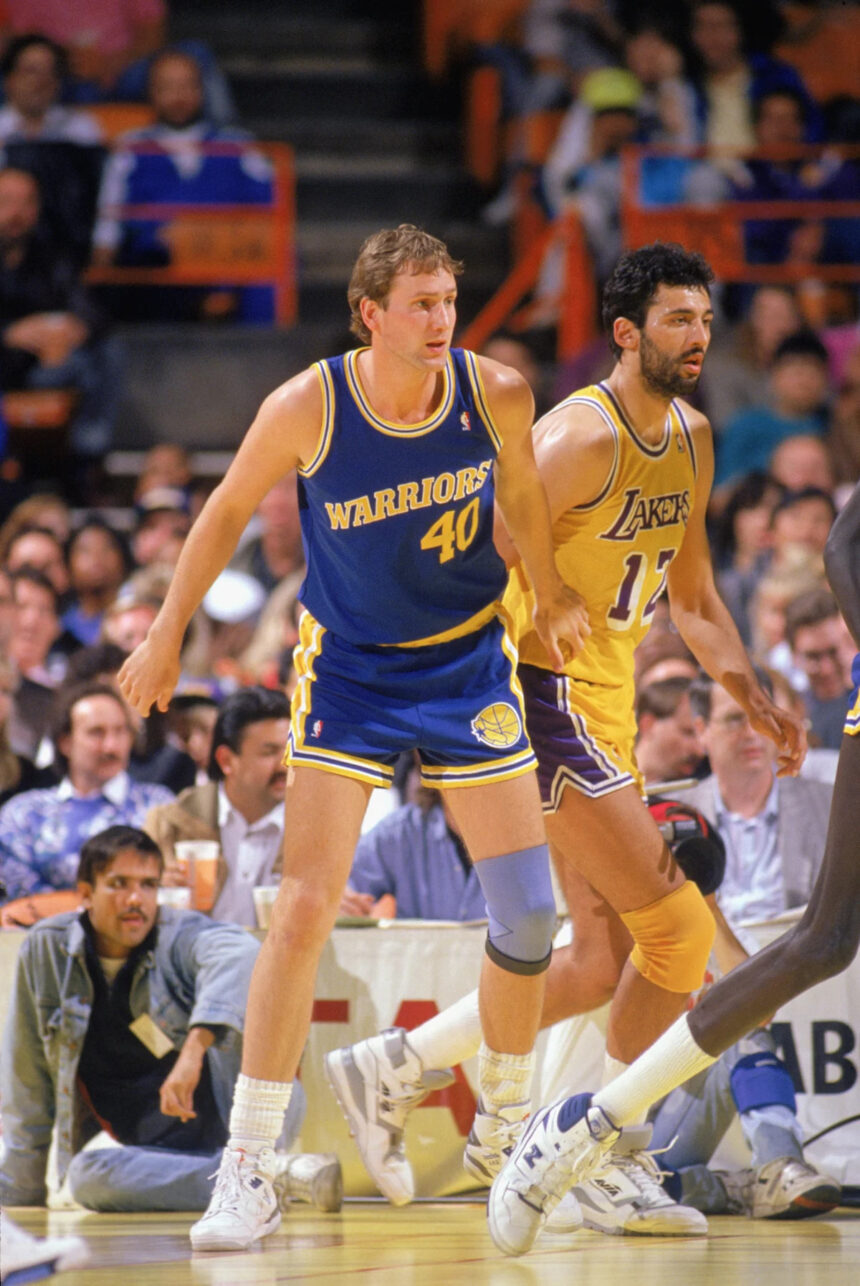
Beyond the Numbers: The Transatlantic Journey of Chris Welp and Warriors Jersey No. 40
In the vast, echoing halls of Golden State Warriors history, where the jerseys of Chamberlain, Barry, and Curry hang with immortal reverence, there exists a quieter, more transient space. It’s a space occupied by the journeymen, the brief tenants of a franchise’s long narrative. The Warriors, with over 600 players spanning more than 75 years from Philadelphia to the Bay, have a story in every number. Jersey No. 40, worn by 11 different players, is a tapestry of these fleeting contributions. And in 1990, its threads were briefly woven by a 7-foot center from Delmenhorst, Germany: Chris Welp. His single season in Golden State represents not a celebrated chapter, but a poignant footnote—a tale of transatlantic ambition, injury, and the unglamorous reality of professional sports’ periphery.
A European Pioneer’s Path to the NBA
Long before the NBA became a global phenomenon with a steady pipeline of international stars, Chris Welp was a pioneer. Hailing from West Germany, he ventured to the University of Washington, where he became a collegiate force. A three-time All-Pac-10 selection and the 1986 conference Player of the Year, Welp left as the Huskies’ all-time leading shot-blocker and scorer—records that stood for decades. His success made him a coveted prospect in an era where skilled seven-footers were rare, and European big men were rarer still.
The Philadelphia 76ers selected Welp with the 16th overall pick in the star-studded 1987 NBA Draft. His arrival was part of a post-Moses Malone transition. However, his rookie season was marred by a severe knee injury—a fractured patella—suffered just 19 games in. This injury would cast a long shadow over his entire career. He showed flashes in Philadelphia and a brief stint in San Antonio, but the promise of his college days was tempered by the physical demands and accelerated pace of the NBA. By 1990, he was a player in need of a fresh start, and the Warriors were a team in a state of flux.
The 1990 Warriors: A Franchise in Transition
To understand Chris Welp’s context, one must understand the Warriors of 1990. This was the bridge era between the “Run TMC” excitement that was just igniting and the solid, defensive-minded teams of the early 90s. Coach Don Nelson was implementing his revolutionary, pace-and-space system, which relied on versatility and skill over traditional positional rigidity.
Welp was acquired by the Warriors in a trade that sent him from San Antonio to Golden State. His role was clearly defined: provide size and depth behind starting center Alton Lister and a young, raw rookie named Tim Hardaway was finding his footing. The Warriors’ identity was being forged on the run, and Welp was a spare part in that complex machine.
Key Realities of Welp’s 1990 Season:
- Limited Role: Welp appeared in only 28 games for the Warriors, averaging 2.6 points and 1.9 rebounds in just over 7 minutes per contest.
- A System Mismatch: Nellie’s system prized mobility and passing from big men. While skilled, Welp’s game was more traditional back-to-the-basket, and his mobility was compromised by his past knee issues.
- Depth Chart Crowd: Beyond Lister, the frontcourt minutes were dispersed among Jim Petersen, Uwe Blab, and the emerging Chris Mullin and Mitch Richmond, who often played bigger in small-ball lineups.
His most memorable performance in a Warriors uniform likely came on March 16, 1990, in a blowout loss to Phoenix, where he scored a season-high 10 points. It was a modest highlight in an otherwise quiet tenure.
Expert Analysis: The “What If” of Health and Timing
Analyzing Chris Welp’s career through a modern lens requires a dose of historical empathy. Today, a skilled 7-footer with European training and a college pedigree would enter a league perfectly tailored to exploit his skills. In the late 80s and early 90s, the NBA was still a league of bangers and low-post wars. Welp’s finesse was an asset, but his lack of elite athleticism and, crucially, his fragile knees were profound liabilities.
The pivotal “what if” of his career will always be that rookie-year knee injury. A healthy Welp may have developed into a reliable rotational center, a poor man’s Bill Wennington or Joe Kleine. But the injury robbed him of the foundational athleticism he needed to compete. Furthermore, his arrival in Golden State, while a chance at redemption, was perhaps the worst possible fit stylistically. Don Nelson was the NBA’s most avant-garde coach, and Welp was a conventional big man trying to rediscover his legs. It was a partnership destined for minimal impact.
Welp’s legacy, therefore, is twofold. In the macro sense, he is part of the first wave of European players who helped pave the way for the Dirk Nowitzkis and Giannis Antetokounmpos. On a micro level, his Warriors tenure exemplifies the countless players who move through franchises—briefly wearing the number, contributing in practice, and being a footnote in media guides—who are essential to the ecosystem of an 82-game season, even if their on-court statistics are forgotten.
Jersey No. 40: A Symbol of the Collective Whole
The story of Chris Welp is inextricably linked to the story of Warriors jersey No. 40. This number has never been retired by the franchise; it is a working number, passed from one role player to the next. Before Welp, it was worn by defensive stalwart Larry Smith. After Welp, it would be worn by others like Adonal Foyle, a fan-favorite shot-blocker, and more recently, by Alen Smailagić, a project pick in the modern era.
This lineage is crucial to a franchise’s identity. While the retired numbers celebrate the constellation of stars, the numbers in rotation like No. 40 tell the story of the supporting cast—the grinders, the prospects, the veterans on their last legs. They represent the organizational depth and transient nature of professional sports. Chris Welp’s chapter is a quiet one, but it is a necessary verse in the epic poem of a team’s history. It reminds us that for every iconic superstar, there are dozens of players whose journeys, though less celebrated, are equally human and filled with their own triumphs and setbacks.
Conclusion: A Footnote with Resonance
Chris Welp’s time with the Golden State Warriors was not marked by glory or lasting on-court legacy. It was a final, brief stop in a career hampered by injury. Yet, within the exhaustive history of this franchise, his story holds resonance. It speaks to the internationalization of the game before it was trendy, the cruel impact of injury on potential, and the reality of fitting into a complex system. The Warriors of 1990 were on the cusp of something electric, and Welp was a quiet bystander to that ignition.
As we chronicle the history of every Warriors jersey number, players like Chris Welp are why. Their stories complete the picture. They ensure the history is not just a highlight reel of championships and All-Stars, but a full-color portrait of every man who ever checked into a game, who ever wore the uniform. The value of Chris Welp’s season in No. 40 isn’t found in a box score; it’s found in the understanding that the rich, storied history of the Golden State Warriors is built, in part, upon the brief tenures of players whose dreams and efforts, however fleeting, are woven permanently into the fabric of the franchise.
Source: Based on news from Yahoo Sports.