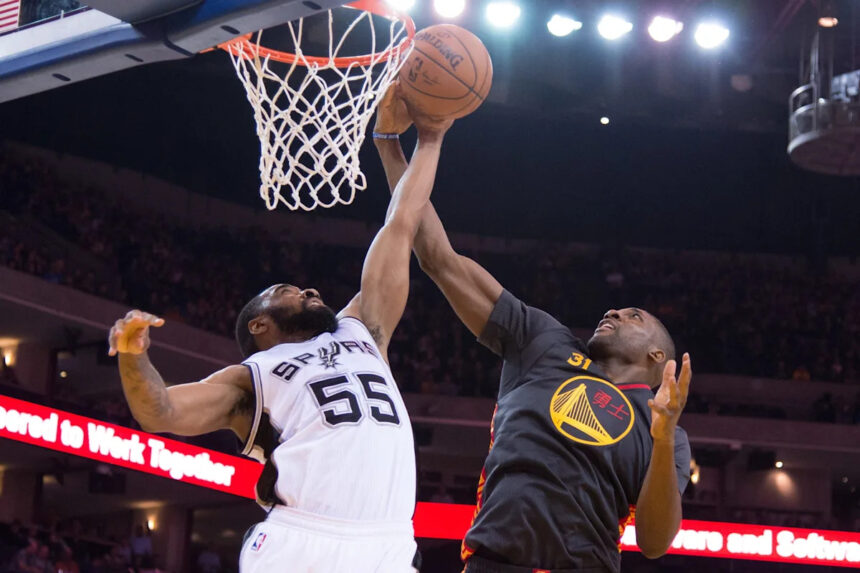
The Forgotten 55: Reggie Williams’ Brief but Brilliant Golden State Warriors Stint
In the vast, echoing halls of Golden State Warriors history, where the jerseys of Curry, Barry, and Mullin hang with reverence, countless numbers tell quieter tales. The story of jersey No. 55 is one such narrative—a digit worn by nine different players, often by big men and role players. But for a fleeting 18-month period at the dawn of this franchise’s modern revolution, the number 55 was claimed by an undrafted scoring savant who embodied the “We Believe” era’s chaotic, offensive-final spirit. This is the story of Reggie Williams, the Virginia Military Institute gunner who, for a moment, looked like the greatest secret in the NBA.
From VMI Legend to NBA Afterthought: An Unlikely Path
Reggie Williams’ journey to the Bay Area was anything but conventional. At Virginia Military Institute, he wasn’t just a star; he was a historic force, leading the nation in scoring as a senior with a staggering 28.1 points per game. He left as the NCAA’s active career scoring leader, a two-time Southern Conference Player of the Year, and a cult hero in Lexington. Yet, the NBA draft came and went in 2008 without his name being called. The knocks were predictable: a tweener at 6’6″, a defender who faced lesser competition in a military college system. His professional career began in France, then the NBA D-League with the Sioux Falls Skyforce. It was there, in the crucible of minor-league basketball, that Williams reignited his scoring touch, averaging 26.4 points on elite efficiency. The right team, with the right philosophy, was watching.
That team was the 2009-10 Golden State Warriors, a franchise defined by Don Nelson’s “pace-and-space” system long before it was a league-wide mantra. Nelson’s Warriors were a haven for offensive-minded players overlooked elsewhere. In March 2010, with the team ravaged by injuries, they offered Williams a 10-day contract. It was a perfect storm of opportunity and need.
The 10-Day Contract That Shook the Bay
What happened next was the stuff of instant legend. Reggie Williams didn’t just fill a roster spot; he exploded onto the scene. He scored a then-career-high 18 points in his second game. By his third, he dropped 28. The Warriors, recognizing they had struck gold, signed him for the remainder of the season. Williams finished that initial 24-game stint with averages of 15.2 points, 4.6 rebounds, and 2.8 assists, shooting a blistering 49.5% from the field and 41.5% from three-point range. He wasn’t just productive; he was sublimely smooth—a lefty with a knack for crafty finishes, a reliable three-ball, and an innate understanding of how to thrive in Nellie’s free-flowing offense.
His signature performance came on April 12, 2010, against the Minnesota Timberwolves. Starting alongside fellow D-League call-up Chris Hunter, Williams authored a masterpiece: 31 points, 7 rebounds, and 5 assists. He was efficient, confident, and utterly fearless. For Warriors fans enduring a losing season, Williams became an undeniable bright spot—a testament to the franchise’s ability to unearth hidden gems. The No. 55 jersey, often associated with the likes of center Erick Dampier, suddenly represented undrafted, offensive lightning in a bottle.
- Instant Offense: Williams possessed a rare, NBA-ready scoring toolkit from day one, needing no adjustment period to contribute at a high level.
- System Synergy: Don Nelson’s system, which prioritized spacing, ball movement, and quick decisions, was the ideal incubator for Williams’ versatile skills.
- Cultural Fit: He embodied the “We Believe” underdog ethos that still permeated the franchise, becoming an instant fan favorite.
The Sophomore Season and a Changing Landscape
Williams returned for the 2010-11 season, now with expectations. He played in 80 games, starting 23, and posted solid averages of 9.2 points and 3.0 rebounds. However, the context had shifted dramatically. Don Nelson, his ideal coach, was gone. New coach Keith Smart implemented a more structured system. The Warriors also drafted a promising young guard named Stephen Curry a year prior, and a dynamic scoring forward in Monta Ellis was the established star. Williams’ role, while still significant, became more defined and less explosive.
Despite the changes, Williams had moments that reminded everyone of his unique talent. He scored 25 or more points four times that season, including a 28-point outburst against the Sacramento Kings. Yet, as the season concluded, the Warriors’ new ownership group, led by Joe Lacob and Peter Guber, was preparing for a philosophical overhaul. The era of high-octane, defensively-optional basketball was ending. The focus shifted toward building a sustainable contender, a process that would soon yield the drafting of Klay Thompson and the hiring of Mark Jackson.
In the 2011 NBA lockout-shortened offseason, Williams, now a restricted free agent, signed an offer sheet with the Charlotte Bobcats. The Warriors, at a crossroads and prioritizing a new direction, chose not to match. Reggie Williams’ tenure as the Warriors’ No. 55 was over after just 112 games.
Legacy of No. 55: A “What If” in Warriors Lore
So, what is Reggie Williams’ place in the grand tapestry of the Warriors? He is not a franchise icon, but he is a quintessential and beloved cult hero. His story represents a specific, chaotic, and thrilling period in team history—the final gasp of the Nellieball era. He is a poignant “what if” for a certain segment of the fanbase: What if he had entered the league earlier? What if he had been drafted and developed systematically? What if he had arrived just a few years later, to play alongside Curry and Thompson in Steve Kerr’s motion offense?
Expert analysis suggests Williams was a player born slightly out of his ideal time. His skill set—a secondary ball-handler who could shoot, pass, and score efficiently without elite athleticism—is precisely the prototype of the modern NBA wing. In today’s game, he would be a coveted commodity. In 2010, he was a fascinating anomaly.
As for the future of jersey No. 55 with the Warriors, it remains a number of transition. Since Williams, it has been worn briefly by others, but never with the same offensive flair. It likely awaits another player with something to prove, perhaps another diamond in the rough. The Warriors’ player development machine is now the envy of the league, but the romance of finding a Reggie Williams—a player who appears from nowhere to captivate a fanbase—is a unique magic that the franchise’s earlier, leaner years specialized in.
Conclusion: A Permanent Niche in a Storied History
From Philadelphia to San Francisco, over 75 years and more than 600 players, the Golden State Warriors’ history is built on chapters both epic and obscure. Reggie Williams’ chapter is short, but vividly written. For those who witnessed it, the sight of No. 55 gliding down the court at Oracle Arena, pulling up for a silky jumper or weaving into the lane, is an indelible memory. He proved that talent can be found anywhere, even at VMI, even in the D-League, and that in the right system, it can shine brilliantly, if briefly. In the ongoing chronicle of Warriors jersey numbers, Reggie Williams’ No. 55 stands as a beautiful, fleeting reminder of the joy of discovery and the pure, unadulterated love of scoring the basketball.
Source: Based on news from Yahoo Sports.