Carlitos, Charlie, Champion: The Joyful Conquest of Carlos Alcaraz
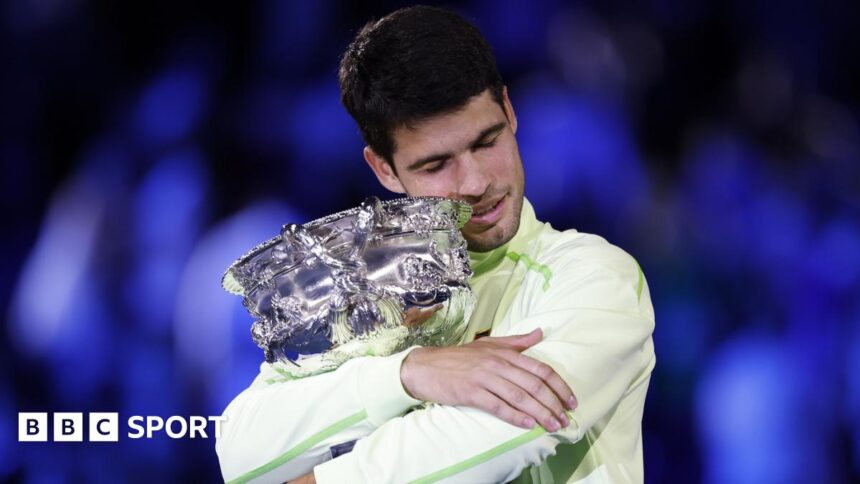
The roar inside Rod Laver Arena had barely subsided. The confetti was still settling. Carlos Alcaraz, having just dismantled a dream and secured his first Australian Open title, stood on the podium, a Grand Slam trophy in each hand. With that victory, a seismic fact clicked into place in men’s tennis history. At 21 years and 6 months, Alcaraz had completed the career Grand Slam. His name—Carlos Alcaraz—is now etched on every major trophy in the sport. Yet, in the euphoric aftermath, a simple truth, shared two years prior, echoed louder than any statistic: “I don’t like being called Carlos.” The youngest man to ever achieve this feat prefers the warmth of Carlitos, or the playful Charlie. Herein lies the captivating core of his ascent: a legacy built not on stern, monolithic intensity, but on a foundation of irrepressible, happy tennis.
The Alchemy of Joy and Fury: From Smashed Racquets to Grand Slam Glory
To understand the champion is to acknowledge the prodigy’s fire. The narrative of Alcaraz as a perpetually smiling virtuoso omits a crucial chapter. Early in his junior and initial professional days, Carlos was a cauldron of passion. Frustration was not internalized; it was exorcised with the crack of graphite on concrete. Smashed racquets were the punctuation marks of points that got away, a visible testament to the immense expectations he placed on his own young shoulders. This was not the calculated rage of a veteran, but the raw, unfiltered outburst of a teenager who knew his potential and raged against any falling short.
This evolution from fiery prodigy to complete champion is the most telling subplot of his career. The transformation wasn’t about extinguishing that fire, but about channeling its immense energy. Under the guidance of coach Juan Carlos Ferrero, a man of renowned composure, Alcaraz learned to transmute frustration into fuel. The emotional outbursts became less frequent, replaced by a focused intensity that could be sustained over five sets. The racquets survived, and the opponents did not. This maturation was not a personality transplant; it was the strategic harnessing of his entire emotional spectrum, with joy increasingly chosen as the default setting.
Carlos vs. Carlitos: The Psychology of a Nickname
“Honestly, Carlos seems too serious to me, like I’ve done something wrong. I like Carlitos or Charlie.” This isn’t a mere preference; it’s a profound window into the competitor’s psyche. The name Carlos Alcaraz carries a weight of formality, of history, of stern expectation. It is the name on the official draw sheet, the name engraved on the trophies. It is, in his own mind, the name of consequence.
Carlitos, however, is the boy from El Palmar who fell in love with the game. Charlie is the engaging, globally-friendly persona. These are the identities that play the tennis. They are free, creative, and unburdened. This self-imposed dichotomy is a masterstroke of psychological management. By separating the institutional “Carlos” from the playing “Carlitos,” he creates a mental space where pressure is compartmentalized. On court, he is not carrying the legacy of Spanish tennis or the hopes of a nation; he is simply Carlitos, solving the exhilarating puzzle in front of him with a dazzling array of tools:
- Drop shot mastery: A playful, disruptive weapon deployed from any position.
- Fearless net rushing: A joyful embrace of aggression and touch.
- Improvisational genius: The audacity to attempt the spectacular, because for Carlitos, it’s fun.
This nickname nuance is the secret sauce. It allows him to compete with a lightness of being that disarms opponents and captivates audiences, all while “Carlos” quietly, seriously, accumulates history.
The Blueprint of a Modern Legend: Analysis of a Complete Game
Alcaraz’s completion of the career Grand Slam before his 22nd birthday is not a fluke of timing or surface specialization. It is the direct result of the most complete and versatile skill set assembled in the modern game. He is the evolutionary product, a hybrid model built for all conditions and all eras.
His game is a breathtaking synthesis of tennis history’s greatest strengths. He possesses the powerful baseline aggression of a Juan Martín del Potro, the unmatched defensive scrambling and speed of a Novak Djokovic, the volleying touch and net presence of a Roger Federer, and the competitive ferocity and topspin forehand reminiscent of Rafael Nadal. This is not hyperbole; it is the weekly evidence on display.
What makes this amalgamation so potent is the tactical flexibility it affords him. On the clay of Roland Garros, he can grind with heavy spin. On the grass of Wimbledon, he can slice, charge, and finish. On the hard courts of New York and Melbourne, he can toggle between thunderous power and delicate finesse. He is the ultimate adaptive organism in tennis, a player without a clear surface weakness. His coach, Ferrero, has engineered not a one-dimensional champion, but a sovereign of all terrains.
The Road Ahead: Predictions for the Carlitos Era
With the career Grand Slam secured, the horizon expands. The conversation shifts from “potential” to “dominance.” The historical comparisons will now center on totals, on weeks at No. 1, on defining an era. The predictions are as exciting as his tennis.
We can anticipate a sustained rivalry with Jannik Sinner that has the potential to define this decade, a clash of styles and personalities that already delivers epic matches. The quest for Olympic gold in Paris will be a monumental target, adding another layer to his legacy. Furthermore, his ability to win on all surfaces makes him a perennial threat at every major, year after year. The pursuit of the Calendar Year Grand Slam is no longer a fantasy but a tangible, if monumental, goal.
Most importantly, Alcaraz represents a new paradigm for champion mentality. He proves that the pinnacle of sport can be reached with a smile, that unbridled joy is not a weakness but a weapon. He will inspire a generation to play with passion and creativity, to see competition as a celebration of skill. The pressure will mount, the targets on his back will grow, but his greatest shield may remain that unique ability to step onto the court as Carlitos, to play happy tennis, and to let “Carlos” handle the history books.
Conclusion: A Legacy Forged in Smiles
Carlos Alcaraz’s journey from a racket-smashing teen to the youngest man to complete the career Grand Slam is a story of transcendent talent refined by intelligent maturation. He has not abandoned his passionate core but has learned to wield it with precision. The deliberate choice of Carlitos over Carlos is the emblem of this journey—a commitment to competing with the heart of the boy who fell in love with the game.
His legacy is already secure, yet it is only beginning. He has broken records with a style that feels like a revolution, reminding the world that supreme athletic achievement and palpable joy are not just compatible, but synergistic. In an era often defined by granite-like intensity, Alcaraz is a force of nature, a whirlwind of skill and smiles. The trophies bear the serious name, Carlos Alcaraz. But the world will remember the art, the athleticism, and the unforgettable, happy tennis of Carlitos.
Source: Based on news from BBC Sport.