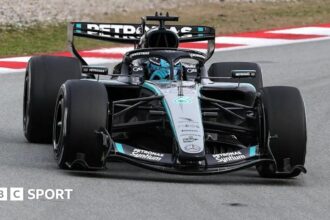
Have Mercedes’ Rivals Caught Up as F1 Upgrade Battle Ignites?
Formula 1’s 2026 season has begun with a narrative that feels eerily familiar to the Silver Arrows’ dominant past. Kimi Antonelli’s victory in Miami continued Mercedes’ unbeaten start to the 2026 season on Sundays, with the Silver Arrows having now claimed four Grand Prix wins from four at the start of Formula 1’s new era of rules. Yet, beneath the surface of this seemingly perfect record, a fierce upgrade battle is brewing. The question on everyone’s lips is no longer “Can Mercedes be beaten?” but rather, “Have the chasing pack finally closed the gap?”
The Miami Grand Prix was a masterclass in composure from the 19-year-old Italian, but it was not the walkover many predicted. For the first time this season, a rival car—the resurgent Ferrari of Charles Leclerc—was within DRS range in the final ten laps. The margin of victory? A mere 1.2 seconds. This is a stark contrast to the 15-second buffer Mercedes enjoyed in Bahrain and the 8-second gap in China. The upgrade battle is no longer theoretical; it is happening in real-time, and the data suggests that the field is compressing.
The Anatomy of Mercedes’ Unbeaten Run: Dominance or Mirage?
To answer whether rivals have caught up, we must first dissect the nature of Mercedes’ four wins. The W17, powered by the new sustainable fuel V6 hybrid and featuring active aerodynamics, is undeniably the benchmark. However, a deeper look at the race data reveals a pattern: Mercedes’ advantage is heavily track-dependent.
- Bahrain (Sakhir): High tyre degradation. Mercedes’ chassis efficiency and rear suspension design allowed for unmatched long-run pace. Win margin: 15.2 seconds.
- Jeddah (Saudi Arabia): High-speed, low-degradation circuit. Ferrari was within 3 seconds for the first 30 laps. Win margin: 4.8 seconds.
- Suzuka (Japan): High downforce, technical sector. Red Bull showed flashes of pace but suffered from porpoising in the esses. Win margin: 6.1 seconds.
- Miami (Florida): Stop-start, traction-dependent circuit. Ferrari and McLaren introduced major upgrades. Win margin: 1.2 seconds.
The trajectory is clear. The gap is shrinking. While Kimi Antonelli and his veteran teammate George Russell have executed flawlessly—zero mechanical DNFs, perfect pit stops, and strategic brilliance—the raw pace advantage is eroding. In Miami, Mercedes’ superior engine mapping on the exit of Turn 11 was the only thing keeping Leclerc at bay. If Ferrari can solve its rear-end instability under braking, the win streak could end as early as Imola.
Ferrari’s Upgrades: The Scuderia Strikes Back
The most significant storyline of the Miami weekend was the upgrade package Ferrari brought to the heat of Florida. The SF-26 arrived with a revised floor edge, a new rear wing endplate design, and—most critically—a reworked diffuser geometry. The result was immediate. Charles Leclerc set the fastest lap on the final tour of the race, a feat no non-Mercedes driver had achieved all season.
Ferrari’s team principal, Fred Vasseur, has been vocal about their “aggressive development path.” The data from Miami shows that the SF-26 is now matching Mercedes in the high-speed corners of Sector 1. The weakness remains in slow-speed traction, where the active suspension of the Mercedes allows Antonelli to get on the power earlier. However, if Ferrari’s next update, rumored for the Emilia Romagna Grand Prix, addresses the mechanical grip deficit, the championship battle will truly ignite.
Expert Analysis: “Ferrari’s Miami package was a genuine step forward,” explains former F1 strategist Ruth Buscombe. “They haven’t closed the gap entirely, but they’ve turned a 0.4-second deficit into a 0.1-second deficit in race trim. That is a monumental achievement in this era of stable regulations. The upgrade battle is now about incremental gains—milliseconds, not seconds.”
Red Bull and McLaren: The Sleeping Giants?
While Ferrari has grabbed the headlines, Red Bull and McLaren cannot be discounted. Red Bull’s 2026 campaign has been plagued by weight distribution issues stemming from the new power unit layout. Max Verstappen has managed two podiums, but the RB22 is clearly the third-fastest car. However, whispers from the Milton Keynes factory suggest a radical sidepod concept is coming for the European season.
McLaren, meanwhile, suffered a disastrous Miami weekend. Lando Norris retired with a hydraulic failure, and Oscar Piastri could only manage sixth. Yet, the team’s development pipeline is renowned. They are expected to bring a new front wing and floor to Imola that could fundamentally change the car’s aerodynamic balance. If McLaren can unlock the potential of their sustainable fuel combustion engine, they could leapfrog Red Bull and challenge Ferrari for second-best.
Predictions for the Next Three Races:
- Imola (Emilia Romagna): Ferrari is the favorite. High-downforce, old-school track. Expect Leclerc to take pole. Mercedes wins by less than 5 seconds.
- Monaco: Chaos. Driver skill over car performance. If Antonelli wins here, the title is his to lose. A Red Bull street circuit special could emerge.
- Barcelona: The true test. Aerodynamic efficiency is king. Mercedes should reassert dominance with a 3-4 second win.
Is the Title Fight a Foregone Conclusion?
Let’s be clear: Mercedes still holds all the cards. They have a perfect record, a driver in Kimi Antonelli who is maturing at a frightening rate, and a car that is the most complete on the grid. The power unit reliability has been flawless, a massive advantage in these first four flyaway races. However, the upgrade battle is about to enter its most intense phase.
The key factor will be the budget cap. Every team is now spending development tokens. Mercedes must decide whether to keep developing the 2026 car or begin shifting resources to 2027. Rivals like Ferrari, who have nothing to lose, can be more aggressive. If Ferrari’s next upgrade is as effective as the Miami one, and if Red Bull’s radical package works, we could see a three-way fight by the British Grand Prix.
The next four races—Imola, Monaco, Barcelona, and Montreal—will define the season. If Mercedes wins all four, the championship is over. If they win two and lose two, the narrative shifts entirely. The upgrade battle is not just about parts; it is about psychology. Mercedes must feel the pressure. They have not faced a genuine, sustained challenge in a race since 2021. How they respond to that heat will determine if this is a dynasty or a fleeting moment of glory.
Conclusion: The Hunters Are Closing, But the Prey Is Wary
Have Mercedes’ rivals caught up? The answer is a cautious “yes,” but with a critical caveat. They have caught up enough to make Sundays interesting, but not enough to win a straight fight. Kimi Antonelli’s victory in Miami was a warning shot to the paddock: the Silver Arrows are beatable, but you must be perfect to do it. The upgrade battle is the most compelling subplot of this new regulation cycle. Ferrari has the momentum. Red Bull has the potential. McLaren has the desperation.
For now, the crown remains in Brackley. But the jewels are starting to wobble. The 2026 season is no longer a coronation; it is a war of attrition. And in war, the side that stops developing first, loses. The upgrade battle has officially ignited, and the next few weeks will tell us if we have a title fight, or just a parade with a faster closing speed. One thing is certain: Formula 1 is alive, unpredictable, and utterly compelling once more.
Source: Based on news from Sky Sports.
Image: CC licensed via www.wallpaperflare.com