


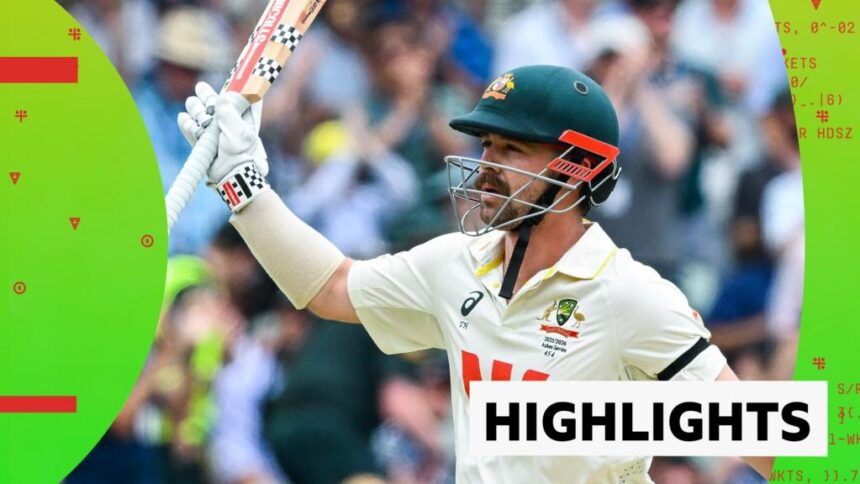
Travis Head’s Thunderous Century Puts England on the Brink of Historic Ashes Humiliation
The roar that erupted from Travis Head as he crunched a cover drive to the boundary to bring up his century was more than just personal triumph. It was the sound of a coffin nail being hammered into England’s Ashes hopes. On a merciless day three at the MCG, Head’s unbeaten 142, a masterpiece of controlled aggression, propelled Australia to a commanding 271-4 at stumps, a lead of 356. England, battered and bereft of answers, now stare down the barrel of the fastest Ashes series defeat in over a century, a 3-0 deficit with two Tests to play.
A Masterclass in Momentum-Shifting Batting
When Travis Head walked to the crease, the match was intriguingly poised. Australia, leading by 82, had lost both openers. England’s bowlers, for the first time in the series, sensed a flicker of opportunity. What followed was a systematic demolition of that hope. Head, initially watchful, soon unleashed the attacking instincts that have defined his resurgence. He targeted the off-side with ferocious cuts and drives, punishing anything short with disdain. His partnership of 112 with the immovable Steve Smith (51) steadied the ship, but it was his unbroken 121-run stand with Alex Carey (52*) that sank England.
Alex Carey’s supporting role was equally critical. The wicketkeeper, showing immense composure, rotated the strike and capitalised on loose deliveries, registering his second fifty of the match. Together, they turned a solid position into a impregnable one in the final session, batting England into the ground and out of the contest. England’s bowling, so potent at times, looked toothless on a flattening pitch, their body language telling a story of utter dejection.
England’s Tactical Collapse and the Weight of History
While Head deserves all plaudits, this was a day that exposed the chasm between the two sides. England’s bowling attack lacked penetration and, crucially, a coherent plan. The decision to underbowl Mark Wood, their quickest and most threatening bowler, was baffling. Their field placements seemed reactive, and as the partnership grew, a sense of fatalism set in. This was a complete reversal from their fighting spirit in Adelaide.
The historical context makes this impending defeat even more stark. England now face the grim prospect of losing the Ashes inside 12 days of cricket. The last time an Ashes series was decided this swiftly was in 1920-21, a century-old record of futility they are desperate to avoid but seem powerless to prevent. The Ashes series defeat is now a formality; the only remaining question is the margin of Australia’s dominance.
- Batting Fragility: England’s first-innings 185 remains the root cause of their predicament.
- Captaincy Questions: Joe Root’s leadership and tactical acumen are under intense scrutiny.
- Missed Opportunities: Dropped catches and poor reviews have compounded their errors.
Expert Analysis: Where Did It All Go Wrong for England?
From a technical standpoint, England’s failings are multifaceted. Their top-order batting has been consistently fragile, failing to construct the kind of monumental innings that Smith and Head have produced. The bowling attack, while showing flashes, has been unable to maintain pressure in partnerships. James Anderson and Ollie Robinson have been economical but not wicket-taking in key moments.
Contrast this with Australia. In Travis Head, they have found a game-winner at No. 5, a player who shifts matches in a session. Their bowling unit, led by the peerless Pat Cummins, has hunted as a pack, exploiting English technical deficiencies with ruthless efficiency. The Australian cricket team is not just winning; they are executing a perfect game plan built on discipline, powerful batting, and relentless bowling.
Psychologically, England are broken. The defiance of Brisbane and the fight of Adelaide have evaporated, replaced by a weary acceptance of their fate. The MCG crowd, a sea of celebrating Australian fans, has only amplified the sense of English isolation and despair.
Predictions: An Inevitable End and a Reckoning to Come
The prediction for the remainder of this Test is bleakly straightforward. Australia will declare overnight or early on day four, setting England an impossible target north of 400. On a pitch showing increasing variable bounce, particularly from the cracks outside the right-hander’s off-stump, facing Cummins, Mitchell Starc, and Scott Boland will be a nightmare proposition. An England batting collapse feels more a matter of ‘when’ than ‘if’. A defeat by a mammoth margin, likely inside four days, is the only logical conclusion.
Looking beyond Melbourne, the fallout will be seismic for English cricket. A 5-0 whitewash now looks a distinct possibility. This will trigger a profound post-Ashes inquest into every facet of the English game: from the domestic structure and the focus on white-ball cricket to the leadership of Root and the future of coach Chris Silverwood. The careers of several senior players may be drawing to a close on this tour.
Conclusion: Head’s Day, Australia’s Ashes, England’s Agony
Day three at the MCG was the Travis Head show, a brutal exhibition of modern Test match batting that has all but secured the Ashes urn for Australia. His century was the knockout blow in a contest England have been losing since the first morning in Brisbane. The third Ashes Test has laid bare the stark differences between these two rivals: one side is confident, clinical, and blessed with players in form; the other is riddled with doubt, error-prone, and seemingly out of ideas.
As the sun set on Melbourne, England were not just facing a defeat in a Test match. They were confronting their worst Ashes nightmare: a historic, rapid-fire humiliation that will echo through the annals of the sport. The urn is gone. Now, all that remains is for England to salvage pride from the wreckage—a task that, on the evidence of the last three days, looks beyond them. The Ashes are Australia’s, and a new chapter of English cricketing soul-searching is about to begin.
Source: Based on news from BBC Sport.


