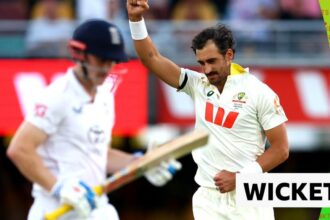
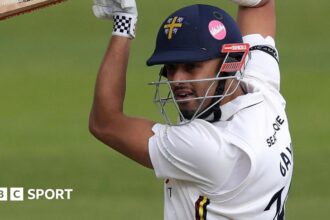
He’s Broken Pixels! Harry Brook’s Colossal Six Crashes Into Colombo Screen
The digital age has given us new ways to measure sporting carnage. We track exit velocity, launch angles, and projected distance. But sometimes, a single, visceral act of violence on a cricket ball renders all that data obsolete. It creates its own unit of measurement. In a crucial Super 8s clash at the ICC Men’s T20 World Cup, England’s Harry Brook didn’t just clear the boundary at the R. Premadasa Stadium; he transcended it, launching a six so monstrous it didn’t just hit the advertising screen—it reportedly crashed into the very pixels, leaving a mark of pure, unadulterated power. A “Content not available in your location” message for the stadium itself.
The Shot That Silenced Colombo: A Moment of Pure Destruction
The context was tense. England, in a must-win scenario against a formidable New Zealand, needed acceleration. The Premadasa pitch, often slow and tricky, was asking questions. Then, Harry Brook provided an answer written in pure force. Facing a delivery begging to be dispatched, Brook cleared his front leg, got into position with frightening speed, and swung through the line with the ferocity of a heavyweight boxer. The connection was a thunderclap. The ball, a white meteor, soared over square leg, rising and rising long after the fielders below had become spectators. It cleared the rope, the padding, the stands, and flew on an unwavering trajectory towards the giant stadium screen. The audible thud of leather on technology was a sound for the modern era—a physical declaration of intent from England’s young gun.
This was more than six runs. It was a statement. In a tournament where margins are fine, Brook’s shot was a broadsword in a duel of rapiers. It shifted momentum, electrified the English contingent, and sent a clear message to every bowling attack watching: there is no safe zone. The ball didn’t ricochet back onto the field; it seemed to be absorbed by the digital display, a piece of hardware momentarily stunned into submission. Social media erupted instantly. “He’s broken the screen!” and “Brook has killed the DRS!” trended globally, capturing the sheer, jaw-dropping absurdity of the moment.
Expert Analysis: The Anatomy of a Pixel-Breaking Strike
As a stroke, it was a masterpiece of controlled aggression. Let’s break down why this hit was different from other big sixes.
- Technical Perfection Meets Raw Power: Brook didn’t just rely on muscle. His base was solid, his head still, and his swing was a perfect arc through the plane of the ball. The power was generated from impeccable core rotation and timing, not just arm strength.
- Adapting to the Conditions: The Premadasa isn’t known for being a batter’s paradise. To generate that kind of elevation and distance on a potentially tired pitch speaks volumes about Brook’s ability to adapt his power game. He didn’t try to force it; he let the technique unleash the force.
- The Psychological Blow: In T20 cricket, sixes are currency. But some are worth more. This was a demoralizing hit for the bowler and the captain. It announced that the pitch was no longer a factor, that good deliveries could still disappear into the digital ether. It forces fielding changes that open up other areas and puts immense pressure on the next few deliveries.
This shot places Brook in a rare category of hitter. It’s not the genteel lofted drive; it’s the calculated, brutal dismantling of a bowling plan. It echoes the legendary hits of the past—like a modern-day version of a Symonds or a Gayle special—but with its own unique, tech-wrecking signature.
Ripple Effects: What Brook’s Bomb Means for England’s Campaign
Beyond the viral moment and the runs on the board, this incident has tangible implications for England’s World Cup defense.
First, it solidifies Brook’s role as the engine room of the middle order. He is the versatile powerhouse who can rebuild and destroy in equal measure. This innings, punctuated by that six, proves he can be the defining X-factor in tight tournaments. Second, it sends a psychological shockwave through the competition. England’s batting lineup, from Buttler at the top to Livingstone and Curran later, is fearsome. Adding a player capable of literal screen-breaking hits deepens that threat exponentially. Opponents must now game-plan not just for England’s savvy, but for their game-breaking, hardware-damaging power.
Most importantly, it provides a massive momentum swing within a high-pressure game. In the compact Super 8s stage, net run rate can be decisive. An over that yields 20+ runs because of one mind-bending shot doesn’t just boost the total; it cripples the opponent’s NRR. Brook’s six was a two-fold strike: it added to England’s score while potentially subtracting from New Zealand’s tournament life.
Predictions: A New Benchmark for Power-Hitting?
Harry Brook’s “pixel-breaker” might just be a watershed moment. We’ve seen balls lost, windows broken, and roofs hit. But physically impacting the fundamental technology of the broadcast *within* the stadium is a new frontier. It raises amusing yet serious questions for tournament organizers and stadium engineers. Do screens need “Brook-proof” shielding? Will we see a new metric for “screen clearance” alongside traditional distance measurements?
For Brook and England, the prediction is clear: this shot marks his arrival as a global T20 icon. He is no longer just a promising talent; he is a proven match-winner capable of moments that define tournaments. Expect:
- Bowling strategies to become even more defensive against him, favoring wide lines or desperate yorkers.
- A surge in confidence that could carry him and England deep into the knockout stages.
- Every subsequent big hit from any player will be measured against the “Did it hit the screen?” benchmark.
The spectacle also reinforces T20 cricket’s appeal as a sport of extreme, shareable moments. This wasn’t just a boundary; it was an event, a story that will be told and re-told, ensuring that even those who didn’t see the live broadcast will seek out the clip, making Brook and the World Cup the talk of the sporting world.
Conclusion: A Shot for the History Books
In years to come, cricket fans will remember where they were when Harry Brook broke the screen in Colombo. It was a fusion of sport and technology, where a centuries-old game found a new, digital way to showcase its explosive potential. The image of that ball disappearing into the glow of the stadium screen is an iconic snapshot of modern cricket: powerful, instantaneous, and globally resonant.
For England, it was the exclamation point on a statement performance. For New Zealand, it was a brutal lesson in the margin for error at this level. And for Harry Brook, it was the moment he moved from prodigy to powerhouse, announcing himself not just with runs, but with a career-defining strike that literally left a mark on the tournament. The Premadasa Stadium screen may have been repaired, but the memory of that six—the sound, the trajectory, the sheer audacity—is permanently etched into the lore of the T20 World Cup. The message is clear: in the hunt for the trophy, England have a weapon that can break more than just partnerships; he can break pixels.
Source: Based on news from BBC Sport.