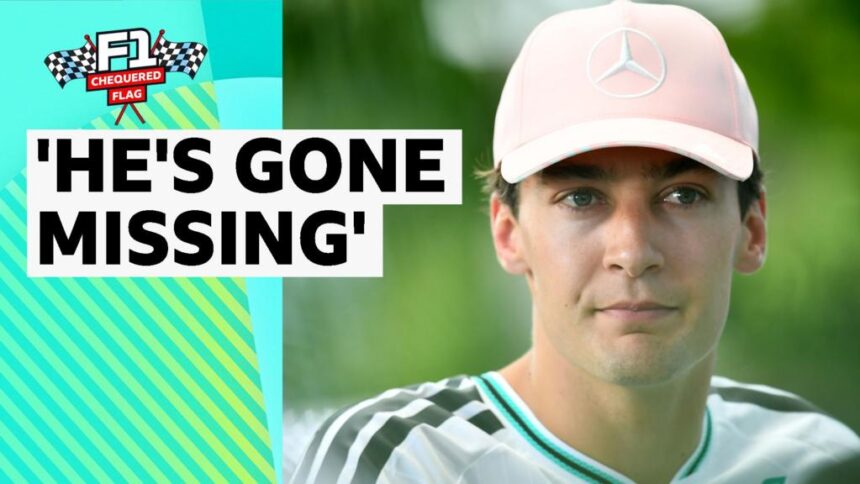
‘He’s gone missing’ – Damon Hill questions George Russell’s mindset as Kimi Antonelli shines at Mercedes
In the high-octane world of Formula 1, perception can shift faster than a DRS overtake. One moment you are the future of a storied team; the next, you are fighting shadows. Following a turbulent weekend at the 2026 Miami Grand Prix, former World Champion Damon Hill has raised serious questions about George Russell’s psychological state, bluntly stating that the British driver has “gone missing” within the Mercedes camp. The catalyst for this concern? The stunning performance of his teenage teammate, Kimi Antonelli, who stormed to his third victory of the season under the Florida sun.
Speaking on the BBC’s The Chequered Flag podcast, Hill—joined by fellow ex-F1 star Juan Pablo Montoya—delivered a scathing yet insightful analysis of Russell’s current trajectory. While Antonelli continues to defy his rookie status, Russell appears to be trapped in a cycle of frustration and inconsistency. This article dissects the Miami meltdown, the psychological toll of being outperformed, and what the future holds for Mercedes’ most experienced driver.
The Miami Meltdown: Where did George Russell go?
The 2026 Miami Grand Prix was supposed to be a turning point for Mercedes. After a pre-season plagued by porpoising issues, the W16 showed genuine pace on the street circuit. But while the garage celebrated a masterclass from Kimi Antonelli, George Russell was left staring at a telemetry screen, searching for answers he could not find.
Hill did not mince words on the podcast. “He’s gone missing,” Hill stated. “You watch the race, and you see Kimi carving through traffic, managing his tyres like a veteran. Then you look at George, and he’s just… there. Not attacking, not defending. He’s in no-man’s land.”
The numbers back up the narrative. Antonelli secured his third win of the season, placing him firmly in the title conversation. Russell, meanwhile, finished a distant P6, complaining of understeer and a lack of front-end grip—issues that Antonelli seemed to manage with ease. This disparity raises a critical question: Is the car fundamentally flawed, or is Russell failing to adapt?
Key statistics from the Miami weekend:
- Kimi Antonelli: Qualified P2, Race P1, Fastest Lap, Driver of the Day.
- George Russell: Qualified P5, Race P6, 0.8 seconds off teammate’s race pace.
- Championship gap: Antonelli leads Russell by 34 points after six rounds.
The contrast is stark. While Antonelli is thriving under pressure, Russell is wilting. The once-confident driver who famously dueled with Lewis Hamilton now looks hesitant, almost reactive. As Hill noted, “He’s waiting for something to happen rather than making it happen.”
The Mindset Question: Psychology vs. Performance
Juan Pablo Montoya, never one for sugar-coating, offered a different perspective on the podcast. The Colombian legend argued that Russell’s problems are not mechanical but mental. “In F1, if you think you are the number two, you become the number two,” Montoya said. “Right now, George is racing against a kid who has no fear. That’s dangerous for him.”
The concept of mindset is often overlooked in the data-driven world of Formula 1. Drivers spend millions on simulators, yet the most expensive piece of equipment remains the one between the ears. Russell’s recent body language tells a story of a man battling self-doubt. In Miami, his radio messages were clipped, defensive. There was no fire, no “send it” calls. There was only resignation.
Hill expanded on this psychological fragility: “When you have a teammate who is winning, and you are not, your brain starts playing tricks. You over-drive the car, you make mistakes, you blame the setup. It’s a spiral. George is in that spiral right now.”
The irony is that Russell was once the hunter. He entered Mercedes as the young lion ready to dethrone Lewis Hamilton. Now, the roles have reversed. Antonelli is the young lion, and Russell is the established veteran fighting for relevance. The pressure of being the “senior” driver at Mercedes—a team that expects nothing less than perfection—is clearly taking its toll.
Antonelli’s Ascension: The New Benchmark at Mercedes
Let us not diminish what Kimi Antonelli is achieving. At just 19 years old, the Italian driver is dismantling the notion that Formula 1 requires years of seasoning. His third win in Miami was not a lucky break. It was a statement of dominance. He out-braked Lando Norris into Turn 1, managed a safety car restart with ice-cold composure, and crossed the line with a 12-second gap to the Red Bull.
For Mercedes, this is both a blessing and a curse. They have found a generational talent. But they are also witnessing the psychological demolition of their previous “future star.” Hill highlighted this dynamic on the podcast: “Kimi is not just beating George; he is breaking him. Every weekend, he shows George what is possible in that car. That is devastating for a driver’s confidence.”
What makes Antonelli so dangerous?
- Adaptability: He can drive around car problems that Russell cannot solve.
- Fearlessness: He is willing to take risks in high-stakes moments.
- Consistency: He has finished on the podium in five of six races this season.
Montoya summed it up succinctly: “When Kimi gets in the car, he doesn’t think about the contract. He doesn’t think about the team principal. He just drives. George is thinking too much.”
Predictions: Can Russell recover or is the writing on the wall?
The million-dollar question is whether George Russell can reverse this narrative. History shows that F1 drivers can recover from slumps. Sebastian Vettel did it. Fernando Alonso did it. But the key difference is that those drivers had multiple world titles to lean on. Russell has potential, but he lacks the championship pedigree to buy himself time.
Looking ahead to the European leg of the season, the next three races—Imola, Monaco, and Barcelona—will be career-defining for Russell. If he cannot close the gap to Antonelli on traditional circuits, the whispers will become shouts. Team principal Toto Wolff has publicly supported Russell, but in private, the Mercedes board is watching the data.
Three scenarios for Russell’s future:
- The Resurgence: Russell simplifies his approach, stops overthinking, and wins at Imola. The narrative flips overnight.
- The Slow Fade: He remains competitive but second-best, becoming a reliable number two driver—a role he never signed up for.
- The Exit: If Antonelli wins the title, Mercedes may look to pair him with a new teammate (perhaps a returning Valtteri Bottas or a young academy star) by 2028.
Hill believes the clock is ticking. “George has to find himself again. He has to remember why he was so fast in the first place. Right now, he looks like a man who has lost his compass. And in F1, if you lose your compass, you lose your seat.”
Conclusion: The spotlight is unforgiving
The Miami Grand Prix was a microcosm of a larger drama unfolding at Mercedes. Kimi Antonelli is not just a rising star; he is a force of nature. And George Russell is not just struggling; he is disappearing. Damon Hill’s candid assessment on The Chequered Flag podcast serves as a wake-up call. The British driver is at a crossroads. He can either dig deep, rediscover his killer instinct, and reclaim his status as a future champion—or he can continue to fade into the background, becoming a footnote in Antonelli’s ascent.
Formula 1 is a sport of brutal honesty. The car does not care about your feelings. The stopwatch does not lie. And as the circus moves to Europe, all eyes will be on the silver garages. Will George Russell find his way back to the front? Or will he remain missing in action?
One thing is certain: the answer will come faster than a pit stop. For Russell, there is no more time to waste.
For more expert analysis and race breakdowns, watch The Chequered Flag Podcast exclusively on BBC iPlayer.
Source: Based on news from BBC Sport.