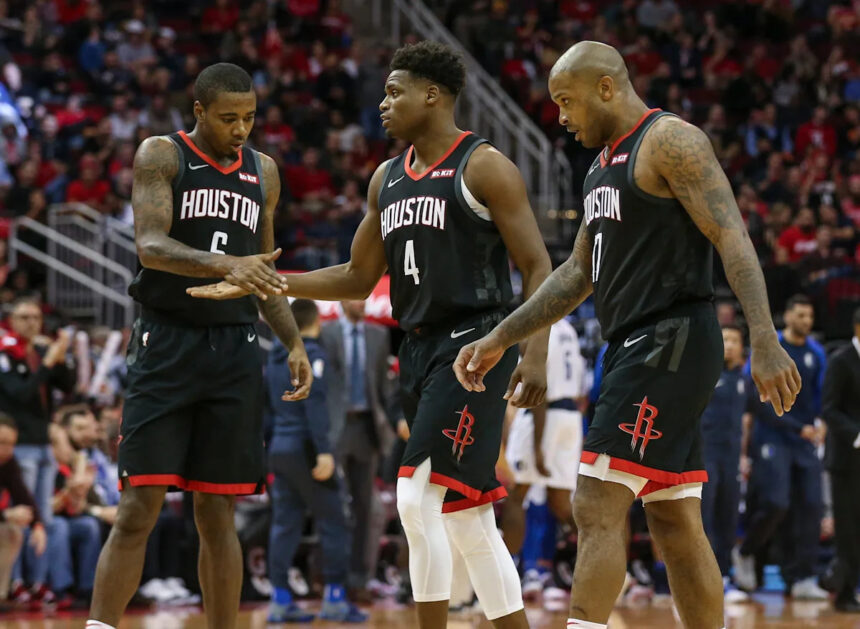
Gary Clark and the No. 6: The Undrafted Grinder’s Brief, Impactful Houston Rockets Tenure
In the storied tapestry of the Houston Rockets, a franchise boasting over 500 players across 52 different jersey numbers, some threads are woven from gold—Hall of Fame legends whose retired jerseys hang from the rafters. Others are spun from a grittier, more determined fiber. The history of jersey No. 6 in Houston is one of transition, worn by 15 different players, but few embodied the relentless, underdog spirit of the number quite like Gary Clark. His tenure from 2018 to 2020 was brief, unheralded, and born from being overlooked. Yet, in the specific, high-stakes ecosystem of the Mike D’Antoni-era Rockets, Clark carved out a vital niche as the quintessential “3-and-D” grinder, proving that even the most unassuming threads are essential to the fabric of a contender.
From Undrafted to Unwavering: Clark’s Path to Clutch City
Gary Clark’s NBA origin story is a familiar archetype with a Cincinnati twist. A celebrated college career with the Bearcats, where he was the 2018 AAC Player of the Year and a two-time Defensive Player of the Year, did not culminate with a draft night call. In an era increasingly obsessed with athletic prototypes, Clark’s perceived lack of a defined position and offensive ceiling saw him go unselected. However, the Houston Rockets, a team analytically driven and perpetually in search of cost-effective role players, saw a perfect fit. They signed the undrafted free agent to a two-way contract, a move that typified their “moneyball” approach to roster construction under General Manager Daryl Morey.
Clark’s challenge was monumental. He was joining a team with championship aspirations, built around the iso-heavy brilliance of James Harden and Chris Paul (later Russell Westbrook), and a system that demanded one thing above all from its role players: three-point shooting and switchable defense. The Rockets’ philosophy was extreme—shoot threes, layups, or free throws—and every player on the floor had to space the court for its superstars. For a rookie who shot just 32.8% from deep in his final college season, the adjustment was steep. Yet, Clark’s unwavering work ethic and defensive IQ, honed under Mick Cronin at Cincinnati, provided his entry point.
The Modern Role Player: Defense, Spacing, and Doing the Dirty Work
Gary Clark’s value to the Rockets was never about traditional box score glory. It was about functionality within a hyper-specialized system. He emerged as a versatile defensive asset, capable of using his 6’6”, 225-pound frame to guard multiple positions. In Houston’s switch-everything scheme, his ability to momentarily hold his own against both wings and bigger forwards was invaluable. He played with a physicality and intelligence that belied his rookie status, often drawing the tough, initial assignment to wear down opposing scorers.
Offensively, his mission was clear: stand in the corner and be ready. As defenses collapsed on Harden and Westbrook, Clark had to be a reliable release valve. His shooting form was overhauled, and the results were a testament to his dedication. While his percentages fluctuated, he provided crucial spacing in key moments. Who can forget the night of November 11, 2019? With the Rockets shorthanded, Clark erupted for a career-high 22 points, drilling 6-of-8 from three-point range in a win over the New Orleans Pelicans. It was a flash of the potential Houston saw—a hard-nosed defender who could also punish a helping defense.
His role can be summarized by these key contributions:
- Switchable Defense: A core component of Houston’s defensive identity, allowing the scheme to function.
- Corner Three Threat: Provided essential floor spacing for the team’s MVP-caliber guards.
- High Basketball IQ: Rarely out of position, making smart, low-mistake plays within a complex system.
- Culture Player: Embodied the grind of an undrafted player, bringing energy and professionalism daily.
Expert Analysis: Why Clark’s Story Resonates in Rockets Lore
Analyzing Gary Clark’s stint requires context beyond statistics. In the grand history of Rockets jersey No. 6—a number worn by journeymen and short-term players—Clark’s story is a perfect snapshot of a specific NBA era and team-building philosophy. He was a prototypical “Moreyball” role player: undervalued by the broader market, but with a skill (defensive versatility) that could be amplified and a weakness (shooting) that could be coached into adequacy.
His time coincided with the peak of Houston’s “micro-ball” experiment. When the team traded starting center Clint Capela in 2020, they fully committed to a lineup with P.J. Tucker at center. Clark, with similar size and a skill set, was a direct beneficiary and a testament to the philosophy. He wasn’t just a player; he was an embodiment of a tactical ideal. While he didn’t have Tucker’s legendary strength or consistency, his path showed the blueprint Houston used to compete with financial and tactical constraints. In this sense, Clark’s No. 6 jersey represents more than a player; it represents a systematic approach to finding value on the margins of the roster.
Ultimately, his departure to the Orlando Magic in 2020 was a product of the NBA’s harsh economics and Houston’s perpetual roster churn. The Rockets, always maneuvering for a star, could not guarantee the roster spot or developmental minutes Clark needed to solidify his shooting. He became a casualty of the win-now pressure that defines contending teams.
Predictions & Legacy: The Lasting Impact of the Grinder’s Mentality
While Gary Clark’s NBA journey has continued beyond Houston with stops in Orlando, Denver, and New Orleans, his legacy with the Rockets is cemented as a cult favorite for the analytically-inclined fan. He won’t have his number retired, nor will he top franchise statistical lists. But in the niche history of jersey No. 6, he stands out as a player who perfectly fulfilled a demanding, specific role during a high-stakes period.
Looking forward, Clark’s career path offers a prediction and a lesson for future Rockets rebuilds. As Houston cultivates its next generation of talent, the importance of identifying and developing “glue guys” like Clark remains paramount. Every contender needs players who embrace dirty work, excel in a defined role, and play with the hunger of someone with everything to prove. The next Gary Clark might be an undrafted free agent, a G League standout, or a second-round pick. The key is recognizing that value isn’t always about ceiling; sometimes, it’s about fit, floor, and fortitude.
Conclusion: A Vital Thread in the Rocket’s Fabric
The Houston Rockets’ jersey history is a mosaic of superstars, legends, and a long parade of players who contributed in quieter ways. Gary Clark’s ownership of the No. 6 from 2018 to 2020 is a chapter of that latter group. He arrived undrafted, worked tirelessly, and found a way to contribute meaningful minutes on a team with championship aspirations. He was the embodiment of the modern, system-specific role player—a defender who could switch, a shooter who could space, and a professional who never stopped grinding.
In the lineage of No. 6, a number destined for rotation rather than retirement, Clark’s story is one of the most resonant. It reminds us that franchise history isn’t written solely by MVPs. It’s also written by the determined undrafted free agents who, for a few seasons, wear their number with pride, execute their role with precision, and in doing so, become an unforgettable part of the team’s identity. Gary Clark’s No. 6 Rockets jersey symbolizes that enduring, gritty truth.
Source: Based on news from Yahoo Sports.