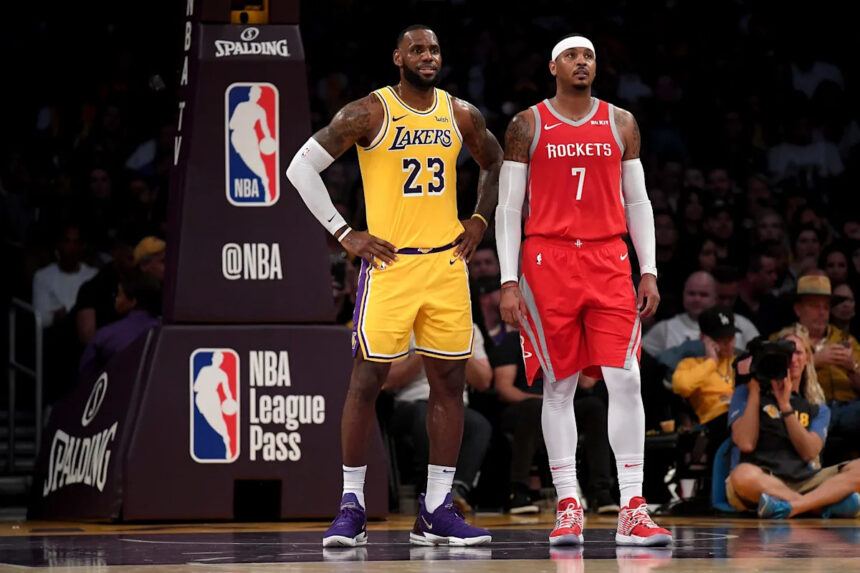
Carmelo Anthony’s No. 7: The Houston Rockets’ Brief, Baffling Experiment
In the sprawling tapestry of the Houston Rockets’ jersey history, spanning over 50 numbers and nearly 500 players, some threads are woven with championship gold, others with the steady fiber of franchise icons. And then there are threads like Carmelo Anthony’s No. 7—vibrant, storied, and abruptly cut short, leaving behind a fascinating “what if” in its wake. The Rockets have retired seven numbers to honor their legends, but the story of the 13th player to wear No. 7 is a compelling tale of a future Hall of Famer’s ill-fated ten-game stint that became one of the most intriguing footnotes in modern NBA history.
A Convergence of Stars and a System on the Brink
By the summer of 2018, the trajectories of Carmelo Anthony and the Houston Rockets created a seemingly perfect intersection. Houston, coming off a franchise-record 65-win season and a heartbreaking Western Conference Finals loss to the Golden State Warriors, was in “win-now” mode, seeking one more elite scorer to pair with James Harden and Chris Paul. Anthony, a 10-time All-Star and one of the most prolific scorers of his generation, was at a career crossroads. After a disappointing season with the Oklahoma City Thunder, he was bought out and seeking a contender where his skills could be maximized.
The fit, on paper, was logical. The Rockets’ offensive system, engineered by Mike D’Antoni, was built on isolation basketball and three-point shooting. Anthony, a master isolation scorer, was expected to provide a lethal third option, spacing the floor and punishing mismatches. He signed a one-year, veteran minimum deal, a stunning value for a player of his pedigree. The narrative was set: the savvy veteran, chasing a ring, joining a powerhouse. Yet, from the outset, there was an undercurrent of skepticism. How would Melo, a career-long focal point, adapt to a clearly defined, lower-usage role? Could his defensive liabilities be hidden in Houston’s switch-heavy scheme?
The Ten-Game Experiment: A Statistical and Stylistic Misfire
Carmelo Anthony’s Rockets career lasted just 10 games. The numbers, in a vacuum, were not catastrophic: 13.4 points per game on 40.5% shooting from the field and 32.8% from three-point range. But the underlying metrics and the eye test revealed a profound disconnect. The Rockets’ offense, which had flowed with a specific rhythm the previous season, now looked stagnant and out of sync with Anthony on the floor.
- Defensive Woes: Houston’s defensive rating plummeted with Anthony in the lineup. His lack of lateral quickness made him a target in the Rockets’ switching scheme, breaking down their defensive integrity.
- Offensive Friction: Anthony’s preferred method of operating—holding the ball, surveying from the mid-post—clashed with Houston’s philosophy of quick decisions and extreme floor spacing. His catch-and-shoot opportunities often came after a noticeable pause, disrupting the offense’s pace.
- The “Stretch-Four” Dilemma: While played primarily as a power forward, Anthony’s shooting was inconsistent, and he didn’t provide the defensive rebounding or rim protection the position often required in small-ball lineups.
The nadir came in a mid-November loss to the Oklahoma City Thunder, his former team. Anthony went 1-for-11 from the field, and the Rockets fell to a dismal 4-6 start. The experiment, designed to push Houston over the championship hump, was instead sinking their season before it began. Within days, the organization made a stunning decision.
The Sudden Divorce and a Lasting Legacy
On November 15, 2018, the Rockets announced they were “parting ways” with Carmelo Anthony. He was subsequently traded to the Chicago Bulls and waived, never playing a game for them. The message was clear: the fit was irreparably broken. For Anthony, it was a brutal public reckoning, leading to him being out of the league for nearly a year. For the Rockets, it was a swift and clinical admission of a failed gamble.
This episode, however, is crucial to understanding both entities. For Houston, it highlighted the razor-thin margins of team construction in the modern NBA. Their system was a precise machine; even a part as illustrious as Carmelo Anthony could cause it to seize if it wasn’t the exact right fit. It underscored the front office’s willingness to make ruthless, data-driven decisions, no matter the player’s name.
For Carmelo Anthony, the Houston debacle became a pivotal turning point. It forced a period of reflection and, ultimately, a dramatic reinvention. When he returned to the NBA with the Portland Trail Blazers, he embraced a true bench role, becoming a efficient spot-up shooter and veteran leader. This successful second act, which solidified his Hall of Fame resume, was born from the ashes of his Houston experience.
No. 7 in Rockets Lore: A Number of Transience and What-Ifs
Where does Carmelo Anthony’s No. 7 rank in the grand history of Rockets jersey numbers? It will never hang from the rafters alongside Hakeem Olajuwon’s 34 or Calvin Murphy’s 23. Yet, its significance is undeniable. It serves as a permanent reminder of the high-risk, high-reward nature of NBA team building. In the sequence of players to wear No. 7 for Houston—a list including earlier figures like Robert Reid and later ones like Jae’Sean Tate—Anthony’s tenure is the ultimate anomaly: the brightest star with the shortest, most turbulent flight.
His jersey, though briefly worn, represents a specific moment in time: the end of an era for one superstar and a cautionary tale for a franchise on the championship doorstep. It’s a jersey that sparks debate among fans—was Anthony a scapegoat for a struggling team, or was he truly the square peg in a round hole? The truth likely lies somewhere in between.
The Houston Rockets’ jersey history is built on legends, role players, and everything in between. Carmelo Anthony’s No. 7 is a unique patch in that quilt—a splash of brilliant, unexpected color that didn’t match the pattern. Its story is not one of triumph, but of transition, adaptation, and the relentless pursuit of a championship formula that sometimes requires painful, immediate correction. While his time in Houston may be a forgotten blip to some, for those who study the game, it remains an essential chapter in the careers of both a resilient Hall of Famer and a perpetually ambitious franchise.
Source: Based on news from Yahoo Sports.