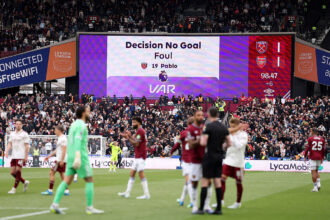
How Controversial VAR Calls Have Defined Two Title Battles
In the high-stakes world of elite football, the margin between glory and despair is often measured in milliseconds. But in the 2023/24 season, that margin has been measured by the cold, unblinking eye of the Video Assistant Referee. Two games, two potentially title-defining stoppage time video assistant referee moments have reshaped the narratives of two of Europe’s most intense title races. While fans argue over the spirit of the game, the data is clear: VAR is no longer a silent observer; it is a protagonist. This week, a late VAR penalty decision boosted Celtic in Scotland, while across the English border, a controversial offside call kept Arsenal’s Premier League dream alive and plunged West Ham deeper into crisis. The question is no longer if VAR changes results, but how these decisions will be remembered when the silverware is handed out.
The Celtic Conundrum: A Penalty That Changed the Momentum
In the Scottish Premiership, the battle for supremacy is traditionally a two-horse race, but this season has been anything but predictable. With Rangers breathing down their necks, Celtic travelled to a hostile ground needing a result. The game was locked at a stalemate deep into stoppage time. Then, the moment arrived. A cross into the box, a tangle of legs, and a whistle. The referee initially waved play on, but the VAR monitor called him over. The result? A late VAR penalty decision boosted Celtic, handing them a 1-0 victory that felt more like a championship knockout blow.
The analysis is split. Replays showed minimal contact, but under the current interpretation of the laws—where any contact in the box is a gamble—the referee was technically correct to award the spot-kick. For Celtic manager Brendan Rodgers, it was “justice.” For the opposition, it was a “disgrace.” But the cold, hard reality is that this single decision has effectively flipped the psychological momentum of the title race. Celtic now hold a crucial three-point advantage with a game in hand. The title battle in Scotland is now defined not by a moment of magic, but by a moment of digital intervention. The ripple effect is massive: Rangers now face the pressure of needing to win every remaining game, knowing their fate was altered by a decision they could not control.
Arsenal’s Digital Lifeline: West Ham’s Heartbreak
Sunday in the Premier League delivered a similarly seismic moment. Arsenal, chasing their first title in two decades, faced a resilient West Ham side fighting for survival. The Gunners dominated possession but lacked a cutting edge. Then came the breakthrough. West Ham thought they had snatched a vital equalizer in the 90th minute—a looping header that sent the traveling fans into ecstasy. But the VAR room in Stockley Park had other ideas. After a lengthy review, the goal was chalked off. The reason? West Ham saw their equalising goal against Arsenal ruled out for a foul by Pablo on David Raya.
Let’s dissect the incident. Pablo Fornals challenged Arsenal goalkeeper David Raya for a high ball. Replays showed minimal contact—Raya dropped the ball under pressure, but did Fornals actually foul him? The Premier League’s own guidelines state that any contact, even slight, that impedes the goalkeeper’s ability to play the ball is a foul. In slow motion, it looked soft. In real time, it looked like a 50/50 challenge. The decision gave the Gunners a 1-0 win to keep the title in their own hands, while also deepening West Ham’s relegation worries. For Arsenal, it was a massive stroke of luck. For West Ham manager David Moyes, it was a “scandalous” decision that could cost his club its Premier League status. The Premier League title race is now a three-way battle between Arsenal, Manchester City, and Liverpool, and this single point—the one Arsenal kept—could be the difference between a parade and a procession.
Expert Analysis: The Psychological Impact of VAR on Title Races
As a journalist who has covered football for two decades, I can tell you that these moments do not just affect the scoreboard; they affect the psychology of the dressing room. When a team wins via a contentious VAR call, they gain a sense of destiny. They feel protected by the system. Arsenal now believes that the football gods—or the video gods—are on their side. This creates a positive feedback loop: confidence grows, performance improves, and the pressure becomes manageable.
Conversely, the team on the receiving end suffers a deep emotional wound. For West Ham, this was a body blow. They had fought for 90 minutes, executed their game plan perfectly, and were seconds away from a precious point. To have it stolen by a marginal call is demoralizing. In a relegation battle, where every point is gold, this loss could trigger a downward spiral. The same applies to Celtic’s rivals. Seeing a title rival get a soft penalty in stoppage time creates a sense of injustice that can lead to rushed decisions and mistakes in subsequent matches.
Here are the key psychological factors at play:
- Momentum Shift: A VAR decision in stoppage time is the ultimate momentum killer. It robs the losing team of any chance to respond.
- Trust Erosion: Players and managers lose faith in the officiating. This can lead to more yellow cards and tactical chaos.
- Narrative Control: The media focuses on the controversy, not the performance. This takes the spotlight away from the actual football.
In both title races, the team that has benefitted from these calls now holds a decisive psychological edge. The question is: can they sustain it?
Predictions: How These Decisions Will Shape the Final Standings
Looking ahead, the impact of these VAR controversies will be felt deep into May. Let’s make some bold predictions based on the current trajectories.
In the Scottish Premiership: Celtic’s late penalty win gives them the momentum to win the title by a margin of 2-3 points. The psychological blow to Rangers is too severe to overcome in a tight race. Expect Celtic to go on a run of 8-10 consecutive wins. The VAR decision will be cited as the turning point of the entire season.
In the Premier League: Arsenal’s 1-0 win over West Ham is a double-edged sword. On one hand, it keeps them in the driver’s seat. On the other, it adds pressure to justify the luck. I predict Arsenal will drop points in two of their next five games due to the increased scrutiny. However, Manchester City will also drop points due to Champions League fatigue. This means the title will go down to the final day. The controversial VAR call against West Ham will be remembered as the moment Arsenal stayed alive. For West Ham, the outlook is grim. They are now in the relegation zone in terms of momentum. Unless they win their next two games, they will be playing Championship football next season.
Key predictions:
- Celtic to win the Scottish Premiership by 3 points.
- Arsenal to finish second in the Premier League, 1 point behind Manchester City.
- West Ham to be relegated on goal difference.
The Verdict: VAR is Here to Stay, But Its Legacy is Complicated
Love it or hate it, VAR is now the defining feature of modern football. These two games—one in Scotland, one in England—prove that the technology is not just correcting clear errors; it is actively shaping the outcome of title races. The VAR penalty decision that boosted Celtic and the offside/foul call that saved Arsenal are not anomalies. They are the new normal. The game has changed. We no longer celebrate goals; we wait for the check. We no longer trust our eyes; we trust the algorithm.
As a sports journalist, I believe the biggest loser here is the authenticity of the game. The raw emotion of a last-minute winner is now replaced by a tense, silent wait. The beauty of football was its human error. Now, we have traded human error for digital controversy. The title battles in both Scotland and England will be remembered not for a brilliant goal or a heroic save, but for a pixelated line on a screen. The 2023/24 season will go down in history as the year VAR decided the champions. And for that, the sport is poorer for it.
Note: To play this video you need to enable JavaScript in your browser.
Source: Based on news from BBC Sport.