How Flick’s Relentless Machine Reshaped Barcelona and Dominated La Liga Again
There is a certain poetry in the way Barcelona sealed their 28th La Liga title. It wasn’t a nerve-shredding finale on the last day of the season, nor was it a dramatic comeback fueled by a hostile crowd. Instead, it was a coronation. A 2-0 victory over Real Madrid at the Camp Nou, in a Sunday night El Clasico that will be remembered not for its tension, but for its sheer authority. The final margin? A staggering 14 points. In a season where the narrative was supposed to be about parity and the rise of challengers, Hansi Flick’s Barcelona simply refused to play along.
This wasn’t just a title win; it was a statement of intent. For the first time in almost a century, a single Clasico match definitively decided the league champion. The script was perfect: at home, against their historic rivals, with the trophy on the line. But the story behind the script is far more interesting. It is a story of tactical reinvention, psychological resilience, and the unlikely heroics of a loan signing from Manchester United. This is how Flick reshaped Barcelona and made La Liga look easy.
From Chaos to Control: The Flick Blueprint
When Hansi Flick took over at Barcelona two seasons ago, the club was in a state of flux. Financial constraints were tight, the squad was aging in key positions, and the football identity had become muddled. Previous managers had tried to replicate the Guardiola era, but Flick understood something crucial: you don’t copy the past; you build for the present.
His philosophy was immediate and uncompromising. Gone was the tiki-taka that often prioritized sideways possession over vertical penetration. In its place, Flick installed a high-intensity, direct pressing system that suffocated opponents before they could even think. The key metrics tell the story:
- Goals Scored: Barcelona led the league with 92 goals, 15 more than second-placed Real Madrid.
- High Press Recoveries: They ranked first in La Liga for regaining possession in the final third.
- Defensive Solidity: Conceded just 22 goals all season, the best defensive record in Europe’s top five leagues.
The transformation was not just tactical; it was physical. Flick demanded a level of fitness that shocked the squad in pre-season. Players who had been labeled as “technical but lazy” were suddenly running 12 kilometers per game. The result was a team that could sustain pressure for 90 minutes, breaking opponents not just with skill, but with sheer exhaustion. This year’s title race lacked the drama of previous seasons because Flick’s Barcelona didn’t allow for momentum swings. They crushed the spirit of every challenger before March.
The Rashford Revolution: A Loan That Changed Everything
Perhaps the most surprising element of this title run was the role of Marcus Rashford. When the English winger arrived on loan from Manchester United last summer, many pundits questioned the move. Rashford had struggled for form and confidence at Old Trafford, and Barcelona’s attacking line was already crowded. But Flick saw something others missed: a raw, powerful runner who could operate as a hybrid between a winger and a second striker.
Flick didn’t just plug Rashford into the system; he rebuilt the left flank around him. The key adjustment was positional freedom. While traditional wingers hug the touchline, Rashford was given a license to drift inside, creating overloads in the half-spaces. This tactical tweak unlocked his best attributes:
- Direct Running: Rashford completed 85 dribbles in the final third, the most of any player in La Liga.
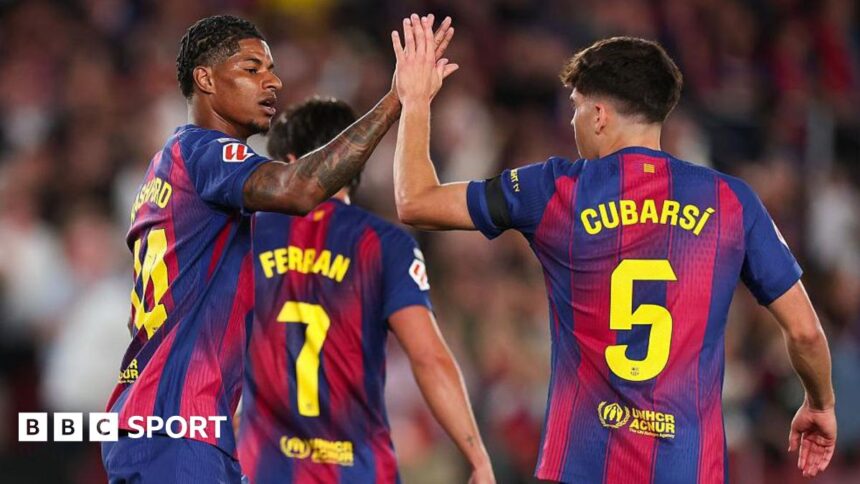
- Big Game Impact: He scored in both Clasicos this season, including the opening goal in Sunday’s title decider.
- Assists from Wide Areas: His 12 assists were a career high, proving he had evolved beyond a pure goal scorer.
Rashford’s partnership with Robert Lewandowski became the league’s most feared combination. While Lewandowski occupied center-backs, Rashford attacked the space behind the full-back. It was a simple, devastating tactic. The Englishman’s resurgence is a testament to Flick’s man-management. He didn’t try to fix Rashford’s head; he gave him a clear role and trusted him to execute. The result is a player who looks reborn, and a Barcelona attack that was unstoppable.
The Clasico That Ended the Race
Sunday’s match was billed as a potential turning point. Real Madrid had clawed back an eight-point deficit earlier in the season, and a win at Camp Nou would have cut the gap to five with six games remaining. But from the first whistle, there was a palpable difference in intensity. Barcelona didn’t just want to win; they wanted to prove a point.
The opening 20 minutes were a masterclass in controlled aggression. Flick’s side pressed Real Madrid’s backline into submission, forcing four errors in their own half. The first goal came from a set piece—a routine Flick had drilled relentlessly in training. A short corner found Pedri on the edge of the box, whose deflected shot fell perfectly for Rashford to prod home from six yards. It was scrappy, but it was earned.
The second goal, scored by Gavi in the 67th minute, was a thing of beauty. A sweeping counter-attack started by goalkeeper Marc-André ter Stegen, passed through Frenkie de Jong, and finished with a first-time chip over Thibaut Courtois. The Camp Nou erupted, but the players remained calm. They knew the job was done. Real Madrid, for all their Champions League pedigree, had no answer to the relentless energy of Flick’s machine.
Statistically, the game was a microcosm of the season: Barcelona had 58% possession, but more importantly, they had 7 shots on target to Madrid’s 2. They didn’t just control the ball; they controlled the danger. This Clasico wasn’t a classic because of drama; it was a classic because of dominance.
Why This Title Feels Different: The Flick Dynasty
Winning back-to-back titles is difficult in any league. In La Liga, where Real Madrid and Atlético Madrid have historically been relentless, it is a measure of greatness. Flick has now won the league in both of his seasons in charge. But this second title feels different from the first.
Last season, Barcelona won the league by a narrow margin, relying on individual brilliance from Lewandowski and a late-season collapse from Madrid. This season, there was no collapse. There was no luck. There was only a system so well-oiled that it rendered the title race boring for neutrals. The 14-point margin is the largest in a non-COVID season since 2013. It is a margin that speaks to a team that has achieved tactical perfection.
Expert Analysis: The key to Flick’s success has been his ability to evolve. Early in the season, when results were tight, he switched from a 4-3-3 to a 4-2-3-1 to give more protection to his full-backs. Later, when injuries hit the midfield, he introduced a 3-4-3 diamond that maximized the output of Rashford and Lamine Yamal. This tactical flexibility, combined with an unshakeable belief in high pressing, is what separates Flick from his predecessors. He is not a one-trick pony; he is a chess master who adapts faster than his opponents.
Predictions for Next Season: The danger for Barcelona is complacency. Real Madrid will spend heavily this summer, and the loss of key loanees like Rashford (whose future remains uncertain) could create a void. However, if Flick stays—and there are no indications he will leave—the foundation is set. The youth academy is producing talent like Yamal and Pau Cubarsí, who are already integrated into the first team. Expect Barcelona to not only defend their title but to make a deep run in the Champions League. Flick’s style is built for European knockout football.
Conclusion: The Perfect Script for an Imperfect Season
La Liga title races are often remembered for their chaos: the bottle jobs, the last-minute penalties, the dramatic collapses. This year’s race will be remembered for the opposite. It was a season of control, of a manager who reshaped a sleeping giant into a relentless winner. The 2-0 win against Real Madrid was not a climax; it was a confirmation.
Hansi Flick has done what few thought possible: he has made Barcelona look inevitable again. With a loan star from Manchester United playing the lead role, a tactical system that suffocates creativity, and a squad that believes in the process, the Blaugrana are back on top. The script was perfect—home soil, arch-rivals, and a 14-point gap. But the real story is the man behind the script. Flick didn’t just win the league; he reshaped the identity of a club. And if this season is any indication, the dynasty is just beginning.
Source: Based on news from BBC Sport.