The Night the Earth Moved: How Scotland’s 30-Year World Cup Wait Ended in 3.38 Seconds
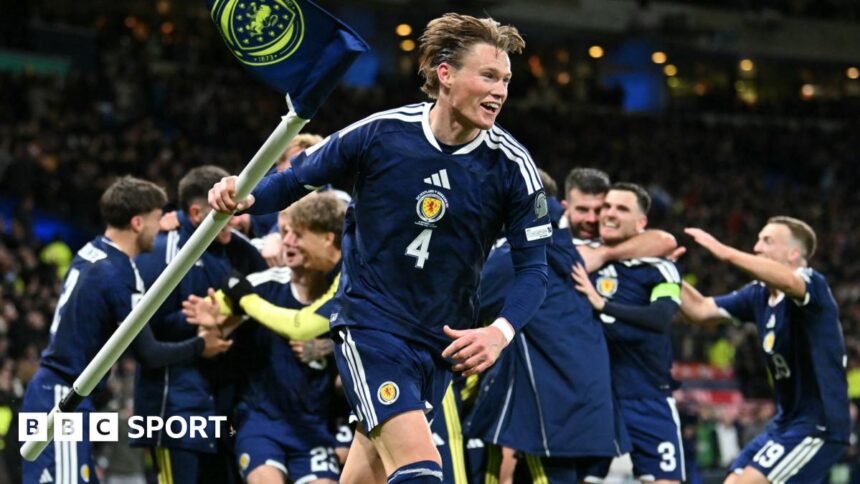
On the scientific charts, it registered as a minor tremor. But for a nation, it was a cataclysm of joy. On Tuesday, 18 November last year, between 21:48 and 21:50 GMT, the Glasgow Geothermal Observatory in Dalmarnock detected seismic activity originating from Hampden Park. The cause was not geological, but spiritual. In those 120 seconds, a 30-year dream was realized, a nation’s angst was exorcised, and Kenny McLean’s right boot connected with history. This is the story of how Scotland reached the World Cup, told through the moments and people that made it happen—a tale of a shot heard around the world, and felt beneath its feet.
The Long Road: From France ’98 to the Edge of Glory
To understand the magnitude of that night, you must first comprehend the weight of the years. Since the 1998 World Cup in France, Scotland had navigated a landscape of near-misses, heartbreaking playoffs, and generational change. The tournament became a fading memory, a relic for a football-loving country to cling to. Under head coach Steve Clarke, appointed in 2019, a pragmatic rebuild began. Clarke instilled a steely defensive organization and a potent team spirit, harnessing a golden generation of talent playing at Europe’s top clubs. The qualifying campaign was a masterclass in resilience, setting the stage for a final, winner-takes-all showdown against a familiar foe: Denmark, already qualified but never relenting.
The equation was simple yet terrifying: avoid defeat to secure automatic qualification. Hampden Park, bathed in floodlights and a cacophony of hope, was the stage. The drama that unfolded was beyond any script.
120 Seconds That Shook a Nation: Anatomy of a Seismic Moment
The match was a tense, tactical deadlock, poised at 1-1 deep into injury time. Denmark, pressing for a winner, committed men forward. With the clock ticking past 21:48, a Danish attack broke down. What happened next is now etched in national folklore.
- The Interception: Scott McTominay, a colossus in midfield, read a pass and stretched to reclaim possession.
- The Vision: With a glance, he saw Kenny McLean in space near the halfway line and played a simple ball.
- The Execution: McLean took one touch. With Kasper Schmeichel off his line, he launched a daring, audacious shot from nearly 50 yards.
- The Arc of History: For 3.38 seconds, the ball hung in the Glasgow night. Time suspended for 60,000 in the stadium and millions beyond.
- The Net Bulges: At 21:50, the ball nestled in the goal. Hampden erupted. The seismic sensors twitched. The wait was over.
“You don’t think,” McLean would later say, reflecting on that instinctive strike. “You just hit it. And in that moment, everything we’d worked for, everything the fans had waited for, just… connected.” In the technical area, Steve Clarke felt the shift. “You could smell it,” he recounted. “It wasn’t just noise or excitement. It was magic in the air at Hampden. A release of 30 years of pent-up belief.”
The Architects: Clarke’s Blueprint and a Squad’s Resolve
While McLean provided the iconic finale, the foundation was laid by a collective effort. Clarke’s system, often a 3-4-2-1, provided the platform. Key pillars included:
Captain Andy Robertson, whose relentless energy epitomized the team’s spirit. Kieran Tierney, forming a formidable left-sided partnership, showcasing tactical flexibility. The midfield engine of Callum McGregor and McTominay, offering both grit and guile. And the clinical finishing of Lyndon Dykes and Che Adams throughout the campaign.
This was no fluke. It was the culmination of a cultural shift. Clarke fostered a club-like camaraderie in the national set-up, a “no excuses” mentality that transformed Scotland from plucky underdogs into a formidable, qualified force. The victory over Denmark was a microcosm of the entire campaign: tough to break down, fearless in moments, and ultimately, triumphant.
Germany Awaits: Predictions for a Nation Reborn on the World Stage
So, what now for Scotland at the World Cup this summer? Landing in a group with hosts Germany, Switzerland, and Hungary presents a stern but navigable challenge. The nation travels not just with hope, but with legitimate expectation.
Expert analysis suggests Scotland’s key strengths—a miserly defense, set-piece threat, and explosive counter-attacks—are perfectly suited for tournament football. The opening match against Germany in Munich will be a monumental test, but one this resilient squad will relish. The targets will be clear:
- Navigate the Group: A result against Germany or Switzerland could pave the way for a historic knockout stage berth.
- Embrace the Pressure: Unlike previous tournaments, this squad carries the confidence of achievers, not just participants.
- Showcase Scottish Football: The world stage is an opportunity to cement the legacy of this generation and inspire the next.
Predicting a deep run may be optimistic, but predicting a passionate, organized, and fiercely competitive Scotland is a certainty. They have earned the right to be there and will believe they belong.
Conclusion: More Than a Game, A National Catharsis
The story of Scotland’s qualification is more than a football match. It is a story of scientific curiosity—a blip on a seismograph caused by pure, unadulterated euphoria. It is a story of a single kick, 3.38 seconds from boot to net, that ended a 30-year narrative of longing. But most of all, it is a story of people: Steve Clarke’s quiet leadership, Kenny McLean’s moment of inspiration, and a nation’s unwavering faith finally rewarded.
As the squad prepares for Germany, they carry with them the seismic energy of that night in Glasgow. The earthquake was small, but the impact was immeasurable. Scotland is back on the world’s stage, and the world has been put on notice: the Tartan Army is marching, and the ground beneath them is trembling once more.
Source: Based on news from BBC Sport.