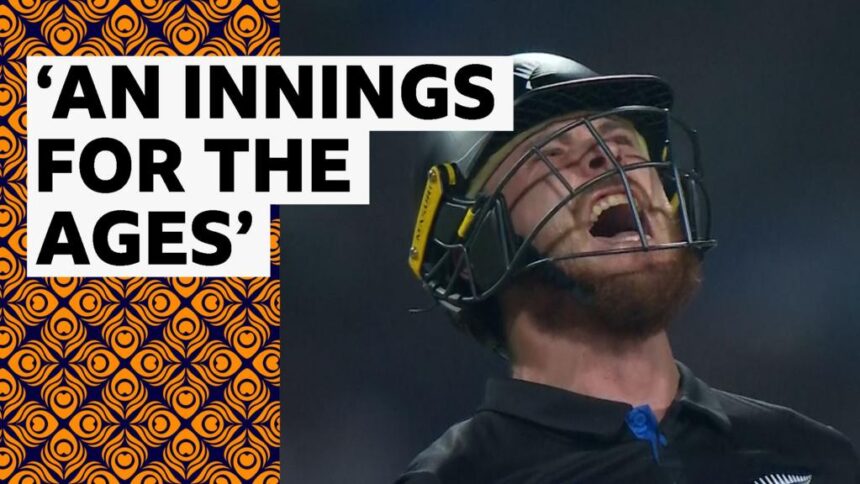
Finn Allen’s Blitzkrieg: A 33-Ball Century That Redefined T20 Power
The cricketing world has a new benchmark for explosive brutality. In a display of raw, unadulterated power-hitting that left pundits scrambling for superlatives, New Zealand’s Finn Allen authored one of the most devastating innings in T20 World Cup history. His sensational 33-ball century didn’t just propel the Black Caps to a crushing nine-wicket semi-final victory over South Africa; it announced the arrival of a new era of opening batsmanship and sent a seismic warning to every other contender for the crown.
A Carnage of Unprecedented Proportions
From the first over, Allen’s intent was not merely to score, but to dismantle. Facing a formidable South African attack, he transformed the pitch into his personal launching pad. The innings was less a traditional knock and more a calculated assault, blending impeccable timing with savage strength. There were no quiet periods, no settling in. Each ball was treated as an opportunity to inflict maximum damage, turning the semi-final into a one-man highlight reel that will be replayed for generations.
What made Allen’s century truly historic was its context and its sheer pace. Reaching three figures in 33 deliveries places it among the fastest ever in men’s T20 Internationals, and certainly the most consequential on the World Cup stage. He didn’t just break the spirit of the Proteas bowlers; he shattered any pre-conceived notions of how a high-pressure knockout match could be approached.
- Record-Breaking Strike Rate: Finishing with a strike rate soaring well over 300, Allen rewrote the manual on powerplay batting.
- Boundary Onslaught: The innings was a blur of clean hits, with Allen peppering and clearing the ropes with astonishing frequency.
- Psychological Domination: The assault was so comprehensive it rendered South Africa’s previously vaunted bowling plans utterly obsolete.
Deconstructing the Allen Hurricane: Technique Meets Temperament
Beyond the raw numbers lies a fascinating technical and mental blueprint. Allen’s innings was not a blind slog; it was a masterpiece of modern T20 batting. His base is incredibly strong, allowing him to maintain balance even when swinging with ferocious power. His ability to access all areas of the ground—with particular emphasis on the arc between long-on and wide long-off—makes him a nightmare to bowl to. Bowlers cannot hide.
Expert analysis points to two key facets. First, his hand-speed is exceptional. The quickness through the hitting zone allows him to wait that fraction longer on the ball, committing to a shot later than most, which in turn gives him more options. Second, and perhaps more crucially for the knock, was his mental clarity. In a World Cup semi-final, the pressure can stifle. Allen, however, played with the freedom of a net session, a testament to a mindset that embraces risk as opportunity. He didn’t just play shots; he played percentages, targeting specific bowlers and zones with cold, calculated aggression.
The Ripple Effect: New Zealand Transformed, World Cup Upended
The ramifications of this innings extend far beyond a single victory. For New Zealand, often perceived as the consistent, slightly conservative contenders, Allen has injected a game-changing X-factor they have sometimes lacked. He provides a blistering start that allows the middle order, including the likes of Kane Williamson, to play with even more freedom and strategic depth. The Black Caps are no longer just efficient; they are explosively dangerous.
For the rest of the tournament, Allen’s century is a defining statement. It has:
- Redefined Par Scores: What looked like a competitive total is now potentially sub-par against a team with such firepower.
- Forced Tactical Rethinks: Opposing captains must now construct entire game plans around containing the Allen threat from Ball 1.
- Elevated Pressure on Rivals: Every other top-order batsman now watches this benchmark, knowing the standard for match-winning innings has been raised.
Looking Ahead: Is This the Dawn of the “Allen Era”?
Predicting the future in T20 cricket is a fool’s errand, but some trajectories are undeniable. Finn Allen, with this innings, has catapulted himself into the conversation as the most destructive opener in the world. The predictions for the final and beyond are now centered on him. Can he replicate this fury on the biggest stage? More importantly, can anyone stop him?
The challenge for bowlers is profound. Traditional lines and lengths are fodder. Extreme pace can be brutalized. The only hope may lie in a combination of impeccable defensive bowling, relentless variation, and perhaps a prayer. For New Zealand, managing Allen’s momentum and ensuring this peak form is channeled at the perfect moment in the final will be their key task. He has given them a weapon of mass destruction; its deployment could decide the World Cup.
In conclusion, Finn Allen’s 33-ball century was more than just a spectacular innings. It was a cultural reset for T20 batting in knockout cricket. It was a statement that the next generation of power-hitters operates on a different plane, combining fearless intent with refined skill. As the dust settles on a shell-shocked South African team and the cricketing world picks its jaw up from the floor, one truth is inescapable: a new star has detonated onto the center stage, and the landscape of the T20 World Cup—and perhaps the format itself—has been irrevocably altered. The final awaits, and all eyes will be on whether the man from New Zealand can produce one more moment of magic to cement his legacy.
Source: Based on news from BBC Sport.