Hugely Disappointing: Moyes Blasts FA as Keane Red Card Appeal Fails
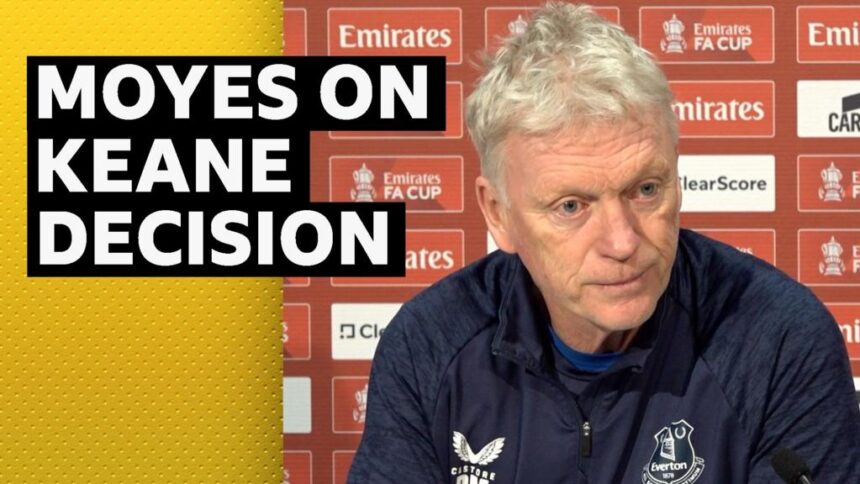
The video assistant referee was summoned, the on-field monitor was consulted, and the red card was shown. In the moment, Michael Keane’s sending-off against Wolverhampton Wanderers was contentious. Now, days later, the decision and its subsequent ratification have ignited a fresh firestorm at Everton, with manager David Moyes branding the Football Association’s appeal rejection “hugely disappointing” and casting a long shadow over the club’s crucial run-in.
A Pivotal Moment Re-examined
The incident itself unfolded in the 64th minute of Everton’s 3-0 defeat at Molineux. As Wolves forward Matheus Cunha burst into the box, covering defender Keane attempted a last-ditch challenge. Contact was minimal, Cunha went down, and after a lengthy VAR review, referee Michael Salisbury upgraded his initial yellow card to a red for denying a clear goalscoring opportunity. Everton, believing Keane had made a genuine attempt to play the ball and that the contact did not merit a dismissal, immediately launched an appeal. The hope was that an independent regulatory commission would see the nuance and rescind the three-match ban. That hope was extinguished this week, a decision that has left Goodison Park in a state of frustrated disbelief.
Moyes’s reaction was pointed and public. “We’re hugely disappointed,” he stated. “We felt we had a strong case. Michael’s intention was always to play the ball, he’s made contact with it, and the nature of the coming together has been judged in what we feel is an extremely harsh manner. To have the appeal rejected compounds the frustration of the entire event.” This isn’t merely a manager defending his player; it’s a calculated critique of a process many perceive as increasingly opaque and inconsistent.
Expert Analysis: The Rulebook vs. The “Spirit of the Game”
This case sits at the thorny intersection of the letter of the law and football’s subjective reality. Under the strictest interpretation of Law 12, a foul that denies an obvious goalscoring opportunity (DOGSO) is a red card offense. The key debates here are twofold:
- Was it a clear goalscoring opportunity? Cunha was arguably moving away from goal and under pressure from another defender.
- Was the challenge a genuine attempt to play the ball? This is where Everton’s grievance lies. IFAB guidelines suggest that if a defender is making a challenge for the ball, even if it is poorly timed, it should be considered. Keane’s outstretched leg did make contact with the ball before Cunha.
“The FA commission’s decision to uphold the red card suggests they viewed the attempt as not ‘genuine’ in a footballing sense, or that the primary action was a foul,” explains a former Premier League referee, speaking on condition of anonymity. “But for fans, players, and managers, this is where the disconnect happens. They see a player sliding in, touching the ball, and a forward going down easily. The ‘clear and obvious’ threshold for VAR intervention, meant to correct egregious errors, is now being used to adjudicate on these 50-50 moments, and that’s creating immense tension.”
For Everton, the timing of the suspension could not be worse. Keane will miss critical Premier League matches against a direct rival, a London giant, and a derby clash. His absence, coupled with injuries to other defensive mainstays, leaves Moyes with severely depleted options at the back during a period where every point is precious.
The Wider Implications for Everton’s Survival Fight
This is more than a one-match ban; it’s a strategic blow. Michael Keane, while not always a guaranteed starter, provides essential experience and aerial dominance. His suspension forces a reshuffle in a defensive unit already lacking stability.
Moyes now faces a tactical dilemma. Does he thrust a younger, less experienced player into the fray, or does he reconfigure his entire defensive shape, potentially moving a midfielder into the backline? This disruption comes during a brutal stretch of fixtures. The lack of defensive continuity could prove costly in tight matches where a single set-piece or defensive error decides the outcome.
Furthermore, the psychological impact cannot be understated. The club and its supporters feel a sense of injustice, a perception that decisions are going against them at a vital time. While Moyes will channel this into a “siege mentality,” it also adds another layer of pressure to a squad already carrying the immense weight of a relegation battle. The message from the FA, as perceived at Goodison, is stark: the door to common-sense appeals is firmly shut.
Predictions: Fallout and Future Appeals
The immediate fallout is clear: a weakened Everton side must navigate a gauntlet without a key squad player. Looking ahead, this case may have a chilling effect on future appeals. Clubs will now look at this decision and wonder what constitutes a “successful” appeal if a debatable ball-winning challenge like Keane’s is upheld. It risks making the appeals process seem like a mere formality, eroding trust in the system.
We can predict with near certainty that this will not be the last time Moyes or another manager voices fierce criticism of the FA’s disciplinary process this season. As the relegation and European races intensify, every borderline decision is magnified. The consistency of application remains the holy grail, and cases like Keane’s are cited as evidence it remains elusive.
For the FA, the challenge is to better communicate the reasoning behind such decisions. A brief, standardized statement on why an appeal was rejected would at least provide a semblance of transparency, moving the debate from “why?” to a discussion on the specific interpretation of the laws.
Conclusion: A Decision That Could Echo Beyond Goodison
David Moyes’s “hugely disappointing” verdict resonates far beyond the confines of Everton’s training ground. It speaks to a growing rift between football’s governing bodies and its participants over the soul of the game’s disciplinary measures. The rejection of Michael Keane’s appeal is not just a three-match ban; it is a symbol of perceived inflexibility in a sport built on split-second, human judgment.
As Everton march into their most important period of the season, they do so feeling aggrieved and short-handed. The FA, meanwhile, has upheld its ruling but may have further damaged the fragile confidence clubs have in its review systems. In the high-stakes theatre of a Premier League relegation dogfight, this decision could have tangible consequences for the final table, proving that sometimes, the most significant impacts are not made by a boot on the ball, but by a pen on an appeal form.
Source: Based on news from BBC Sport.