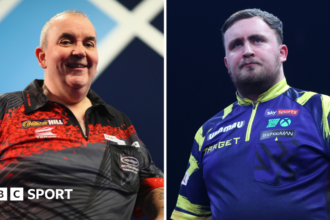
Gian van Veen Fires Back: “I Don’t Care What Luke Littler Thinks of Me”
The world of professional darts is no stranger to rivalries, but the latest chapter between teenage sensation Luke Littler and rising Dutch star Gian van Veen has added a potent new layer of needle to the oche. Following a tense, verbal exchange during their Premier League Darts clash in Manchester, Van Veen has delivered a blunt, headline-grabbing retort, asserting he cares “little” for the opinion of the World Championship finalist. This isn’t just post-match bravado; it’s a declaration of intent from a player determined to carve his own path, regardless of the shadow cast by darts’ newest superstar.
The Manchester Flashpoint: More Than Just Darts
While the precise words exchanged at the AO Arena remain between the two players, the body language told a compelling story. Their Premier League encounter, a high-pressure contest in the sport’s most glamorous weekly arena, was a tight affair. Observers noted intense stares and brief verbal crossfire, a palpable tension that transcended the typical competitive focus. Littler, the 17-year-old phenomenon accustomed to dominating headlines, seemed to meet his match in steely defiance. Van Veen, 21, himself a World Youth Champion and a player of immense pedigree, did not take a backward step. The Dutchman’s subsequent comments peel back the curtain on a modern darting dynamic: the established young gun versus the challenger demanding equal respect.
“It was a competitive game, as they all are at this level,” Van Veen has been quoted as saying. “What was said stays on the stage. But the truth is, I care little about what Luke thinks of me. My focus is on my game, my development, and winning matches. Everything else is just noise.” This calculated dismissal is a powerful psychological play, reframing the narrative from a personal spat to a single-minded pursuit of excellence.
Expert Analysis: The Psychology of a New Rivalry
From a sporting psychology perspective, Van Veen’s stance is a textbook maneuver for a challenger. By publicly deprioritizing Littler’s opinion, he achieves several key objectives:
- Neutralizes Mind Games: It acts as a shield against potential psychological warfare, declaring that external chatter does not affect his process.
- Asserts Equality: In one sentence, he elevates himself from the role of “opponent” to that of a peer. The statement implies their relationship is one of parallel ambition, not hierarchy.
- Controls the Narrative: Instead of being drawn into a “feud,” Van Veen steers the conversation back to performance, an area where his formidable scoring power speaks for itself.
This is not to say Littler is engaged in a war of words. The teenager has largely let his darts do the talking since his stratospheric rise. However, his unparalleled fame creates a unique atmosphere. Every opponent faces not just Littler, but the “Littler Circus”—the media frenzy and fan adoration. Van Veen’s comments are perhaps as much about blocking out that surrounding noise as they are about addressing Littler personally. He is drawing a line: inside the arena, they are simply two of the world’s best young players competing for a win.
Contrasting Paths, Converging Destinies
Their journeys, while both exceptional, highlight different facets of darts’ new generation. Luke Littler exploded into global consciousness with his fairytale run to the World Championship final, a narrative of precocious talent meeting the grandest stage. His adaptation to Premier League life, under immense scrutiny, has been remarkably seamless.
Gian van Veen, in contrast, has been a tipped prospect for years, grinding through the development tours and ranking circuits. His victory in the 2023 World Youth Championship was a culmination of steady progress, not an overnight sensation. He represents the “traditional” path, albeit accelerated by his own genius. This clash of narratives—the meteor vs. the prodigy—adds rich context to their encounters. Van Veen’s “I don’t care” mantra can be seen as a refusal to be cast as a supporting actor in someone else’s story.
Their playing styles also offer a fascinating contrast. Littler is known for his explosive, fast-paced scoring and relentless aggression. Van Veen, while also a heavy scorer, possesses a methodical, ice-cool rhythm and a lethal proficiency on the double-18 bed. It’s a classic clash of tempo and temperament, guaranteeing compelling darts whenever they meet.
Predictions: A Defining Rivalry for the Next Decade?
The seeds have been sown for what could become the defining rivalry of darts’ next era. Here’s what we can likely expect:
- Increased Stakes: Future matches will carry the weight of this burgeoning narrative. Every encounter in majors like the World Matchplay, Grand Prix, or the World Championship itself will be scrutinized for both darting quality and personal tension.
- Elevated Performance: Great rivalries push athletes to new heights. The desire to gain a tangible upper hand will fuel both players’ practice regimens and on-stage intensity, potentially raising the level of the entire sport.
- Fan Engagement Boom: The darts community will inevitably split into camps, debating not just who is the better player, but the validity of each one’s attitude and journey. This is pure box office for the PDC.
Van Veen’s comments are not the end of a conversation, but the beginning of a new one. They establish a clear “us against the world” mentality for himself, while Littler will continue to operate under the unique pressures of being the face of the sport’s new generation. Their next meeting is now must-watch television.
Conclusion: The Unflinching Focus of Gian van Veen
Gian van Veen’s statement, “I don’t care what Luke Littler thinks of me,” is far more than a throwaway line in a post-match interview. It is a strategic, philosophical, and public positioning of his career compass. In the glittering, often distracting world of modern professional darts, he has declared that his true north is his own performance, his own growth, and his own silverware. This unflinching focus is the hallmark of champions. While the darting world delights in the narrative of a spicy new rivalry, Van Veen is attempting to simplify the equation: it’s not about Littler, it’s about the dartboard. Whether he can maintain that singular focus under the increasing spotlight of this compelling clash will be one of the great subplots in darts over the coming years. One thing is certain: when these two young titans step up to the oche again, it won’t just be darts flying—it will be statements, legacies, and a palpable charge that reminds us why sport, at its best, is human drama played out in the most intense of arenas.
Source: Based on news from Sky Sports.
Image: CC licensed via www.rawpixel.com