Sebastian Musson: The One-Handed Climber Redefining the Impossible on the Path to Paralympic History
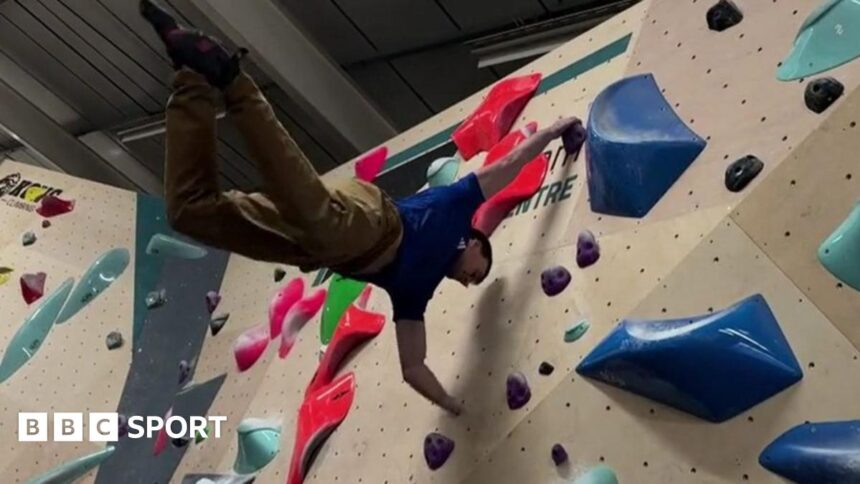
The wall is a canvas of colored holds, a vertical puzzle that demands strength, strategy, and supreme grip. For most, the solution requires two hands. For Sebastian Musson, it requires a vision that sees beyond the conventional. With a powerful swing, he latches onto a critical hold with his left hand, his body swinging out into open air. His right arm, ending just below the elbow, is a study in balance and core tension. In this moment of apparent defiance, he is not just climbing a route; he is dismantling a preconception. “I go up climbs where people can’t go – without a hand,” he states, a simple declaration of a complex reality. This is not a story of limitation, but of liberation—a young athlete using the unique geometry of his body to chart a new course up the world’s most daunting walls.
A Chance Encounter That Launched a Vertical Ascent
Six years ago, the trajectory of British climbing changed in a Derby climbing centre. Sebastian Musson, then 13, was there with a friend. What began as a casual try blossomed into an immediate and profound connection. The sport, with its physical and mental three-dimensional chess, called to him. His rapid progression was meteoric. Without a traditional pathway for para-climbers, he simply climbed, solving problems his own way. Today, at just 19 years old, the Long Eaton athlete is a four-time British Para-climbing champion and sits at a formidable third in the world rankings. His ascent in the competitive arena has been as swift and direct as his climbing style, setting the stage for a monumental career peak: the Paralympic Games Los Angeles 2028, where sport climbing will make its historic debut.
Redefining the Possible: Technique Where Others See Limitation
Watching Musson climb is an exercise in re-education. Where a two-handed climber might use a matched grip for stability, Musson innovates. He employs dynamic, swinging movements, generates immense rotational force from his core, and uses his right arm as a perfect counter-balance. He doesn’t replicate two-handed beta; he engineers his own. “When Sebastian Musson climbs walls with one hand, he knows it looks like he is redefining the impossible,” observers note. But for him, it’s a logical application of physics and strength. This innovative approach embodies a powerful ethos in climbing’s adaptive community. As Musson himself puts it: “There is no exclusivity because there’s no rules in climbing.” This philosophy is his compass, allowing him to find solutions on rock and plastic that others might never perceive, proving that the only true rules are those of gravity and imagination.
His training is a meticulous blend of the universal and the uniquely specific:
- Extreme Core and Leg Strength: His lower body and core are his primary engines, generating the upward momentum and stability that others might get from a second arm pull.
- Dynamic Movement Mastery: He specializes in “deadpoint” moves—launching to a hold at the precise apex of his swing, minimizing the need for readjustment.
- Strategic Route Reading: Before he touches the wall, his visualization is critical. He identifies key holds for his left hand and plans sequences that optimize his body’s unique mechanics.
- Mental Fortitude: Every climb is a high-stakes puzzle. The pressure to execute a complex sequence perfectly, with no margin for a slip, forges a competitor of immense mental resilience.
The LA 2028 Summit: Chasing Paralympic Gold in a Historic Moment
For any athlete, the Olympics and Paralympics represent the pinnacle. For Sebastian Musson and the entire para-climbing world, Los Angeles 2028 carries the weight of history. It will be the sport’s inaugural appearance on the Paralympic stage, meaning the first champions will etch their names into legend forever. Musson’s focus is laser-sharp on that historic gold medal. The journey there will be a grueling four-year cycle of qualification events, intensified training, and evolving competition. Currently ranked third globally, he is already in the medal conversation, but the target is the top of the podium. The pressure will be immense, but it is pressure he has been preparing for with every seemingly impossible climb he has conquered.
Expert analysis suggests Musson’s trajectory positions him perfectly for this moment. His combination of innovative technique, competitive experience gained in a still-developing international circuit, and his youth—he will be 24 at LA28, arguably at the start of his physical prime—creates a potent formula for success. The challenge will be maintaining his technical evolution as rivals study his methods and as the sport standardizes further for Paralympic inclusion. His ability to stay one creative step ahead will be as crucial as his physical power.
A Legacy Beyond the Podium: Inspiring a New Generation
Whether or not Sebastian Musson stands atop the podium in Los Angeles, his impact is already cemented. He is a visible, dominant force in a sport that celebrates adaptive prowess. Every competition he enters, every viral clip of him solving a “two-handed” problem with one, sends a powerful message: ability is defined by creativity and will, not by convention. He is pioneering a style that will be studied and emulated by young climbers with similar disabilities for years to come, showing them that the routes are not closed, just waiting for a new solution.
His journey from a Derby climbing centre to the verge of Paralympic history is a compelling narrative of chance meeting purpose. It underscores the importance of accessible facilities and inclusive environments where talent can be discovered and nurtured, regardless of its form. Sebastian Musson isn’t just climbing for gold; he is climbing to expand the very idea of what an athlete looks like, proving that on the vertical plane, the most powerful limb is the mind. As the world turns its eyes to LA in 2028, they won’t just see a climber with one hand. They will witness an architect of the impossible, building his path to the summit, hold by audacious hold.
Source: Based on news from BBC Sport.