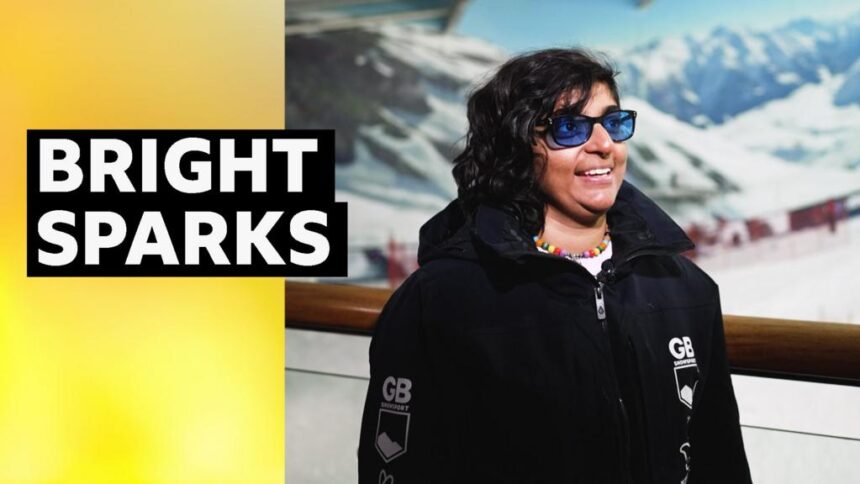
From Hobbyist to Hopeful: How Kadeena Cox Inspired ParalympicsGB’s Nina Sparks
The path to the Paralympic podium is rarely a straight line. For many, it is a winding road of rediscovery, resilience, and, sometimes, a single moment of profound inspiration. For British adaptive snowboarder Nina Sparks, that moment came not on a snow-dusted mountain, but on a television screen, watching a fellow Briton conquer the world. “I saw Kadeena Cox,” Sparks reveals, “and thought ‘why not me?'” This simple, powerful question has become the catalyst for Sparks’s remarkable journey from a ‘hobby’ snowboarder to a dedicated athlete targeting the Milan Cortina 2026 Winter Paralympics.
The Spark: A Question That Changed Everything
Nina Sparks’s story defies the traditional athlete narrative. Snowboarding began as a passion, a recreational escape, not a professional pursuit. However, living with a physical impairment, the world of elite adaptive sport can sometimes feel like a distant realm, occupied by others. That perception shattered when she witnessed the monumental achievements of Kadeena Cox. Cox, a trailblazing Paralympian, made history by winning gold in two different sports—athletics and cycling—at the same Games, Rio 2016. Her defiance of limits, her sheer athleticism, and her visible joy in competition sent a seismic message.
“Seeing someone like Kadeena, who excels with such power and grace, reframed what I believed was possible,” Sparks explains. It wasn’t just about winning medals; it was about the audacity to compete at the highest level. Kadeena Cox’s inspiration provided the crucial mental shift. The question “why not me?” transitioned from a fleeting thought to a driving philosophy. It was the permission Sparks needed to take her own talent seriously, to transform a beloved hobby into a concrete goal: wearing the ParalympicsGB jersey on the world’s biggest stage.
The Journey: From Slope to System
Embracing the “why not me?” mindset meant embarking on a radical transformation. A hobbyist snowboarder enjoys the freedom of the mountain; an elite athlete submits to the rigors of a structured system. Sparks’s journey into high-performance sport required a complete overhaul:
- Structured Training: Moving from occasional trips to the slopes to a year-round, periodized training plan encompassing strength, conditioning, and technical snowboard drills.
- Technical Precision: Deconstructing her intuitive riding style with coaches to build a technically flawless and competitive approach suited to the demands of Para snowboard cross.
- Sports Science Integration: Leveraging nutrition, physiology, and psychology—resources typically beyond the reach of a recreational athlete.
- Equipment Optimization: Transitioning to elite-level, custom-fitted adaptive snowboarding equipment designed for maximum performance and safety at speed.
This shift is a testament to Sparks’s dedication. It represents the often-unseen grind behind the glamour of international competition, a grind she willingly embraced after Cox’s example illuminated the path.
Expert Analysis: The Ripple Effect of Visibility
The dynamic between Cox and Sparks is a powerful case study in the importance of representation in sports. Cox, as a high-profile, multi-sport Paralympic champion, operates as a “visibility catalyst.” Her success does more than fill the medal table; it actively expands the talent pipeline. Sports psychologists note that athlete inspiration is most potent when the source is relatable. For aspiring disabled athletes, seeing someone who shares a similar lived experience achieving greatness breaks down internal and external barriers.
Dr. Anya Miller, a sports sociologist, comments: “When an athlete like Kadeena Cox is ubiquitous in media, she normalizes elite disability sport. She moves the conversation from ‘overcoming’ to simply ‘competing.’ This empowers individuals like Nina Sparks to self-identify as athletes first. The ‘why not me?’ moment is a direct result of this normalization. It’s not just admiration; it’s a recognizable roadmap.” Sparks is now part of that same roadmap for others, demonstrating that the journey can begin at any point, even from a standing start as a hobbyist.
Road to Milan Cortina 2026: Predictions and Challenges
With the Milan Cortina Winter Paralympics now on the horizon, Nina Sparks’s trajectory is one to watch. The field in women’s Para snowboard is increasingly competitive, with athletes from nations like the USA, Netherlands, and China pushing the boundaries of the sport. Sparks’s unique pathway, however, could be her secret weapon.
Milan Cortina 2026 predictions suggest that her recent, rapid immersion in high-performance systems means she is still on a steep upward curve, potentially peaking at just the right time. Her motivation, rooted in a deep-seated personal revelation rather than a lifetime of pressure, may also provide a psychological edge. The challenges are significant: securing sufficient funding, gaining crucial world-class competition experience, and staying healthy through an intense training cycle. Yet, her story is already one of defying expectations. A top-10 finish would be a monumental achievement, while a podium performance would be a story for the ages, perfectly encapsulating the “why not me?” spirit.
A New Legacy of Inspiration
Nina Sparks’s story is more than an athletic progression; it is a narrative about the transformative power of seeing someone like you succeed. Kadeena Cox’s legacy extends beyond her own medals—it lives in the questions she inspires others to ask themselves. Sparks, by embracing that question, is forging a legacy of her own. She represents a new wave of Paralympic athlete: those who discover their elite potential later, who bring the pure joy of a hobbyist into the arena of world sport.
As the countdown to Winter Paralympics coverage intensifies, all eyes will be on the established stars. But the most compelling stories often come from the shadows, from those who dared to ask “why not?” Nina Sparks, once a hobbyist watching from her sofa, is now training to answer that question on the slopes of Italy. Her journey reaffirms that the Paralympic movement is continually renewed not just by talent, but by visibility, inspiration, and the courageous individuals who decide their moment is now.
Source: Based on news from BBC Sport.