Ilia Malinin’s Olympic Heartbreak and the Hug That Defined a Champion
The air in Milan’s Palazzo del Ghiaccio was thick with a singular, suffocating expectation. Ilia Malinin, the “Quad God,” stood at the center of the Olympic ice for the final time, the weight of gold not just hoped for, but presumed, resting on his 21-year-old shoulders. What followed was not the coronation the world anticipated, but a slow-motion unraveling—a popped jump here, a hand down there, a catastrophic fall on a quad that had long been his signature. When the music stopped, the silence was louder than any roar. The score confirmed it: off the podium. In that raw, gut-wrenching instant, where a lifetime of work seemed to dissolve, Malinin did not look to the heavens in despair. He turned, skated directly to the new Olympic champion, Mikhail Shaidorov of Kazakhstan, and wrapped him in a heartfelt, congratulatory embrace. In a flash, the narrative of disaster was rewritten into a lasting lesson in grace.
The Unthinkable Unfolds: A Favorite’s Free Skate Falls Apart
The 2026 Milan-Cortina Olympics men’s figure skating competition was, by all pre-event metrics, Ilia Malinin’s to lose. Having redefined the sport’s technical boundaries, he was the undisputed favorite. The short program had been a masterclass, setting him up for what should have been a victory lap. Yet, the free skate is a fickle beast, and pressure is a silent saboteur.
From the opening notes, something was amiss. The explosive power seemed muted. The first planned quad toe loop was shaky, landed on a deep edge. The cascade had begun. A quad axel—his pioneering jump—was two-footed. Then came the fall on the quad lutz, a shocking sight that sent a gasp through the arena. Each subsequent element was a battle, the program’s artistic flow shattered by survival mode. Watching Malinin struggle was a poignant reminder that figure skating, at its core, is a high-wire act performed on a blade’s edge. No amount of favoritism can defy physics or psychology on the wrong night.
Key moments that defined the disaster:
- Technical Breakdown: Multiple jumping passes, including his signature quad axel, received severe negative grades of execution (GOE).
- Momentum Collapse: The early errors created a snowball effect, disrupting the choreographic sequence and mental focus for the remainder of the four-minute program.
- The Final Pose: His expression upon finishing was not one of triumph, but of immediate, devastating realization. He knew before the scores flashed.
The Embrace That Echoed Louder Than Cheers
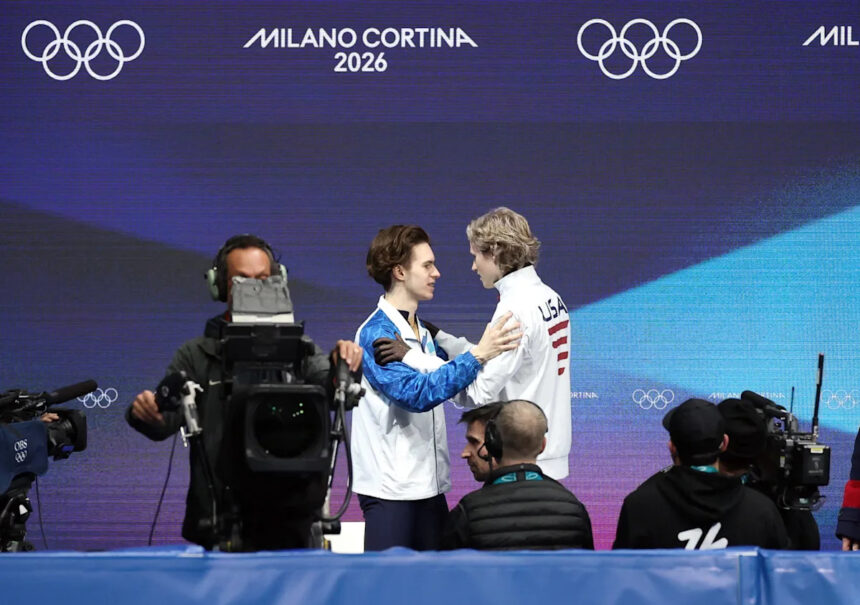
As Malinin sat in the kiss-and-cry, the numbers confirming his fifth-place finish illuminated the screen. The camera, hungry for tears of anguish, closed in. What it captured instead was a moment of profound sportsmanship. Without hesitation, Malinin rose, stepped past his own coaches, and walked purposefully toward the athlete who had just lived his dream.
Mikhail Shaidorov, the steady and elegant skater from Kazakhstan, had delivered the performance of his life to clinch a stunning gold. He was still processing his own shock when Malinin approached. The hug was not a brief, perfunctory pat. It was a genuine, full-hearted embrace. Malinin spoke into Shaidorov’s ear, his face conveying sincere congratulations. In that gesture, Malinin demonstrated a champion’s class that exists independently of medals.
This act was more than polite protocol. It was an active choice to participate in another’s joy while swimming in a personal sea of disappointment. It acknowledged a fundamental truth of the Olympic Games: that excellence, when achieved, deserves recognition, even from its most thwarted rival. This Olympic moment of respect instantly became the defining image of the men’s competition, transcending the final standings.
Expert Analysis: The Anatomy of Pressure and the Legacy of Grace
From a technical standpoint, analysts will dissect Malinin’s performance for years. Was it the physical toll of a long season? The psychological burden of the “favorite” label? Likely, a perfect storm of both. “The expectation on Ilia was historical, not just competitive,” notes former Olympic silver medalist and sports psychologist, Dr. Eliza Chen. “He wasn’t just expected to win; he was expected to transcend. That weight can alter neuromuscular timing by millimeters—and millimeters are everything on a quad jump.”
However, the post-performance analysis must now permanently include his reaction. “What we witnessed was the real-time application of elite athletic values,” Chen continues. “Malinin separated the performance from the person. He was disappointed in his skate, but he did not let that disappointment poison his respect for Shaidorov’s achievement. That is an advanced emotional skill most veterans never master.”
This act of sportsmanship also reshapes Malinin’s legacy in the immediate aftermath of a crushing defeat. He is no longer solely the skater who fell under pressure; he is the skater who, while picking himself up, first lifted up his competitor. In the long arc of a career, such character moments resonate as deeply as any gold medal for the public and for the sport’s culture.
The Road Ahead: Predictions for Malinin and the New Landscape
Where does Ilia Malinin go from here? History offers a guide. Great champions like Michelle Kwan, Evgeni Plushenko, and Yuzuru Hanyu have all faced seismic Olympic disappointments, only to return with renewed purpose.
Short-term predictions: Malinin will likely take a strategic break before reassessing his technical content. We may see a temporary simplification of his free skate to rebuild confidence, focusing on the pristine execution of fewer quads rather than sheer volume. The narrative for the next World Championships will be one of a redemption arc.
Long-term outlook: This defeat, painful as it is, could forge a more complete, resilient athlete. Malinin’s technical arsenal remains unparalleled. Coupled with the profound maturity displayed in Milan, he has the potential to return for the 2030 Games not just as a jumping phenom, but as a battle-tested, wise champion. The hug showed he understands there is more to winning than winning.
For Mikhail Shaidorov, the landscape is forever changed. He enters a new era as the Olympic gold medalist, the leader of the sport. How he handles the spotlight, and the target on his back, will be his next test. The respect shown to him by the favorite in that vulnerable moment may well set the tone for his reign.
Conclusion: The True Gold Standard
The 2026 Olympic men’s figure skating final will be recorded in the history books with Mikhail Shaidorov as gold medalist. But its enduring memory will be Ilia Malinin’s embrace. In a world obsessed with podium placements, Malinin reminded us that the Olympic spirit is not a platitude but a practice. It is the choice to honor the sport itself when your personal dream within it has just shattered.
This was not a moment of defeat, but a demonstration of a different kind of victory. The Quad God reminded us that the highest score isn’t always the most meaningful one. By choosing class in the face of disaster, Ilia Malinin authored a legacy moment that no fall could tarnish and no gold could outshine. He showed us that while champions are crowned with medals, they are defined by their character. And in that, he stood tallest of all.
Source: Based on news from Yahoo Sports.