‘I’m Always the Chaser?’: Novak Djokovic’s Fiery Retort and the Psychology of the Perpetual Pursuit
The narrative is a familiar one in sports: the young, hungry challenger hunting down the established king. For over two decades in men’s tennis, this story has been told and retold, with the characters changing but the archetypes remaining stubbornly the same. After a recent match, however, the protagonist of this drama for so long, Novak Djokovic, forcefully rejected his assigned role. When a reporter framed his current position relative to Jannik Sinner and Carlos Alcaraz as “chasing,” the 24-time Grand Slam champion didn’t just correct the record—he defended his entire legacy.
The Question That Crossed a Line
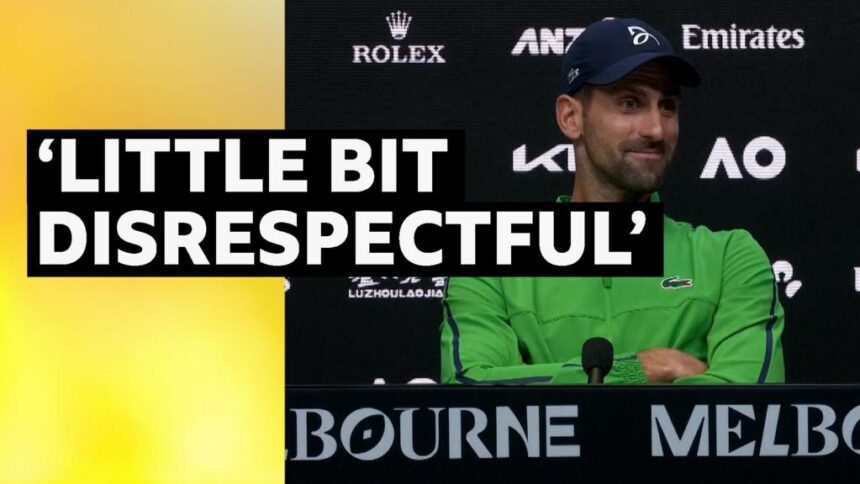
Following a tense victory, the press conference took an unexpected turn. A journalist, perhaps aiming to draw a poetic parallel, asked Djokovic how it felt to now be in a position of “chasing” the younger duo of Sinner and Alcaraz, much like he once chased Roger Federer and Rafael Nadal. The reaction was immediate and pointed. Djokovic’s demeanor shifted, his words measured but sharp. He found the premise “disrespectful,” not just to his current status as the world’s top-ranked player, but to the entirety of his career’s work. The subtext of his response was clear: a man holding every significant record in the sport, including the most Grand Slam titles in history, cannot be logically framed as a chaser. The question, while perhaps innocently intended, touched a nerve about how his era-defining dominance is still, in his view, often contextualized through the prism of others.
Deconstructing the “Chaser” Narrative: A Legacy in Perspective
To understand Djokovic’s frustration, one must dissect the persistent narrative arc of his career. For years, the tennis world was captivated by the Federer-Nadal rivalry. Djokovic’s explosive arrival and sustained excellence disrupted that binary. He was often positioned as the third wheel, the interloper, the one “chasing” their popularity and legacy.
- Historical Context: He broke the Federer-Nadal duopoly at Majors, often having to defeat both back-to-back to win titles.
- Record Book Reality: He has since surpassed both in total Slam count, weeks at No. 1, and Year-End Championship titles.
- Psychological Burden: The “chaser” label implies a deficit, a position of weakness. For an athlete who has spent years as the benchmark, it diminishes his position as the hunted frontrunner.
Now, with brilliant new champions emerging, the media instinctively wants to recast him back into that old, familiar role. For Djokovic, this isn’t just inaccurate; it’s an erasure of the mountain he has already climbed. He is not chasing Sinner and Alcaraz for validation or a place in history; they are challenging him for the throne he currently occupies.
The Mindset of the Ultimate Competitor
This incident offers a rare window into the elite champion psychology that fuels Djokovic. His objection isn’t about pride alone; it’s about competitive framing. Champions at his level meticulously control their mindset, and language is a critical component. Accepting the “chaser” label subconsciously accepts a position of inferiority. Djokovic’s entire brand of tennis is built on supreme confidence, relentless pressure, and an unwavering belief that he is the best on the court on any given day. To allow a narrative of pursuit to take root would be to cede a mental edge. His retort was a deliberate act of frame control, a public recalibration insisting that the tour, including its dazzling new stars, must still go through him. He is the standard, not the aspirant.
What This Means for the Rivalry’s Future
This fiery exchange isn’t a sidebar; it’s fuel for the next chapter of men’s tennis. Djokovic’s message was as much for his rivals and the public as it was for the reporter.
- Elevated Stakes: Matches against Sinner and Alcaraz are now underscored by this narrative battle. Every clash is not just for points, but for the rightful ownership of the sport’s present tense.
- Motivation Multiplied: If the young stars needed any extra motivation, Djokovic has publicly declared the throne occupied. They are not being chased; they are the challengers. This sets the stage for a classic, high-stakes power struggle.
- Media Recalibration: The press will now be more cautious. The question has been asked and definitively answered. The story is no longer “Can Novak catch up?” but “How long can the king hold off the princes?“
This dynamic is far more compelling and accurate. It creates a tension between proven, historic greatness and the explosive, undeniable force of youth—a true clash of eras, not a repeat of an old script.
Conclusion: The Hunter Forever Hunted
Novak Djokovic’s “chaser” rebuttal was a landmark moment in self-advocacy. It was the culmination of a career spent battling not just opponents across the net, but perceptions and narratives off the court. He has transitioned from hunter to hunted, yet the language around him sometimes lagged behind. By forcefully rejecting that framing, he has drawn a line in the clay. He stands not as a figure chasing history, but as history itself—a living, breathing monument that the new generation must topple. The coming seasons will be defined by this clarified reality: Carlos Alcaraz and Jannik Sinner are phenomenal talents chasing a ghost, a legend, and a record book all embodied in one relentless competitor. And as his reaction proved, Novak Djokovic will ensure they, and everyone else, remember exactly who is being chased.
Source: Based on news from BBC Sport.