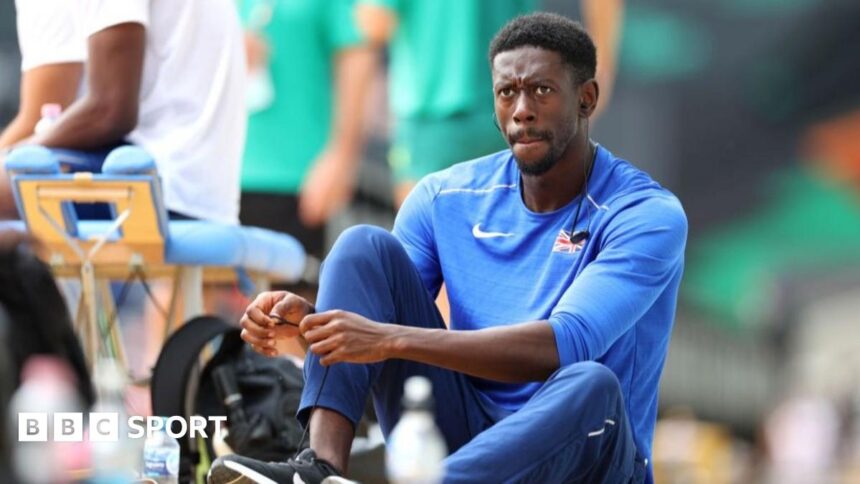
‘I’m Not Against It’: Reece Prescod’s Stance Ignites the Enhanced Games Firestorm
The line between sporting integrity and human potential has never been more starkly drawn. In a declaration that sends shockwaves through the foundation of elite athletics, former British sprint star Reece Prescod has openly contemplated the use of performance-enhancing drugs for the controversial Enhanced Games. His words, “If that’s something that will take me to the next level, I’m not against it,” are more than a personal musing; they are a direct challenge to the century-old ethos of clean sport. This isn’t a shadowy admission from a banned athlete, but a calculated statement from a retired Olympian, framing doping not as cheating, but as a tool for exploration. It marks a pivotal moment in the growing debate around the Enhanced Games and forces a uncomfortable question: is the pursuit of absolute human performance incompatible with the current rules?
From Olympic Tracks to Uncharted Territory: Prescod’s Rationale
Reece Prescod is no fringe figure. A former European silver medalist and relay world finalist, he competed at the highest level, including the Tokyo 2020 Olympic Games. His retirement in August 2023 ostensibly closed the book on a respectable career. Yet, his recent comments reveal an athlete seemingly unfulfilled by the constraints of the World Anti-Doping Agency (WADA) code. Prescod’s argument hinges on a pure, almost scientific curiosity. He expressed a desire to “run the fastest time possible” and find it “interesting to know that’s how fast I can run with the additional help.”
This framing is central to the Enhanced Games’ provocative pitch. The event, bankrolled by libertarian investors and chaired by controversial figure Aron D’Souza, positions itself not as a rogue circus, but as a “celebration of human potential” under medical supervision. For athletes like Prescod, it offers a tantalizing, rule-free canvas. The implication is clear: his previous achievements, while impressive, were artificially capped by regulations. The Enhanced Games, in this view, simply removes the cap.
- Medical Supervision vs. Black Market: Proponents argue controlled, transparent use is safer than the current underground doping culture.
- The Curiosity Factor: Prescod voices a “what if” scenario many athletes privately ponder but dare not utter.
- Post-Career Freedom: Retired, he faces no sanction from traditional sporting bodies, granting him liberty to speak and potentially participate.
The Fault Lines: Ethics, Safety, and the Soul of Sport
Prescod’s stance immediately triggers profound ethical and practical alarms. The core argument against the Enhanced Games is that it dismantles the concept of fair competition. If all athletes are “enhanced,” what are they competing in? Pharmacology? Biochemistry? The very essence of sport—pitting trained human bodies and wills against each other under a shared set of rules—evaporates.
Medical supervision, the Games’ key safeguard, is fiercely disputed by the mainstream medical community. “There is no safe way to abuse steroids, EPO, or human growth hormone for performance,” says Dr. Jane Smith, a sports endocrinologist who requested anonymity due to the sensitivity of the topic. “Supervision might mitigate acute risks, but it cannot nullify the long-term cardiovascular, hepatic, and psychological damage. Calling it ‘medically supervised’ is a dangerous rebranding of abuse.”
Furthermore, the event creates a perilous incentive structure. What happens to the 18-year-old prospect lured by prize money and the promise of “enhancement”? Does this create a two-tier sporting world where the ethically-bound Olympics become the “lesser” spectacle of capped potential? The existential threat to the Olympic model and grassroots sport is palpable, potentially reducing decades of anti-doping education and investment to a mere preference rather than a principle.
Expert Analysis: A Pandora’s Box for Athletic Integrity
“This is the most significant moment for the Enhanced Games concept yet,” analyzes sports sociologist Professor Liam Carter. “It’s not a billionaire or an activist speaking, but a credible, recently retired Olympian. Prescod’s comments provide a veneer of athletic legitimacy the project desperately craved. He’s articulating the quiet part out loud: that elite sport is already a brutal, physics-defying pursuit, and this is just the next logical, amoral step.”
From a legal and broadcasting perspective, the hurdles remain immense. Major networks and sponsors, wary of backlash, are likely to steer clear. However, the Games could thrive in the digital streaming wild west, funded by crypto and speculative capital. The risk, experts warn, is the normalization of a transhumanist sporting ideal. “Once you accept that chemical and genetic modification are just another form of training, you have fundamentally altered what it means to be a human athlete,” Carter adds. “Prescod isn’t just talking about running faster; he’s inadvertently championing a philosophical shift where the body is merely a hardware platform to be upgraded.”
Predictions and the Unraveling Future of Competition
The immediate future will be defined by reaction and recruitment. Expect the following:
- Strong Condemnation: World Athletics, the IOC, and national federations will issue forceful statements reaffirming their commitment to clean sport and warning athletes of permanent bans from sanctioned events.
- Stealth Recruitment: The Enhanced Games will use Prescod’s comments as a rallying cry to attract other retired or disgruntled elite athletes, particularly from strength and power sports.
- The Safety Debate: The “medical supervision” argument will become the central battleground, with the Games commissioning their own studies to counter mainstream medical opinion.
- Grassroots Impact: The trickle-down effect on young athletes’ perceptions of PEDs is the greatest long-term concern for sporting bodies.
Will the event actually happen? The momentum is building. With significant capital and a growing list of vocal supporters, a pilot event within the next 18-24 months seems increasingly plausible. Its success won’t be measured by traditional broadcast numbers, but by its ability to disrupt the conversation and establish a foothold as a rebellious, albeit controversial, alternative.
Conclusion: A Line in the Sand or a New Frontier?
Reece Prescod’s “I’m not against it” is more than a headline; it is a crack in the dam. It gives a human face and an athletic voice to a movement that seeks to rewrite the contract of sport. The Enhanced Games, through figures like Prescod, are successfully framing themselves as the bold, free-science future, casting traditional sport as antiquated and restrictive.
The coming battle is not just about drugs. It is about the very soul of sport. Is it a celebration of natural human excellence, cultivated through dedication and talent within agreed ethical boundaries? Or is it a pure spectacle of extreme performance, by any means available? Prescod has chosen his side. The sporting world must now decide if it will hold the line, or if the allure of “the fastest time possible,” regardless of cost, will redraw the boundaries forever. One thing is certain: the starting pistol for this debate has been fired, and there is no finish line in sight.
Source: Based on news from BBC Sport.