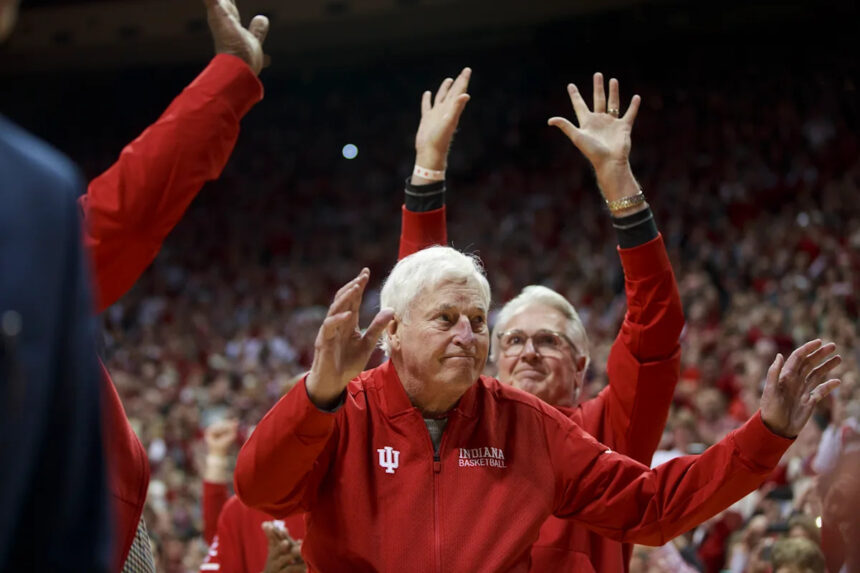
The General Takes His Post: Indiana University to Erect Bronze Statue Honoring Bob Knight
In the hallowed halls of college basketball, few names command as much reverence, controversy, and sheer gravitational pull as Bob Knight. For nearly three decades, the man known as “The General” was not just the coach of the Indiana Hoosiers; he was the fiery, uncompromising soul of the program and, for many, the state itself. On Monday, Indiana University announced a permanent, physical testament to that legacy: a bronze statue of Robert Montgomery Knight will be erected at Simon Skjodt Assembly Hall, finally casting in metal a legacy that has long been etched in the hearts of fans and the annals of the sport.
This decision marks a profound and symbolic closure to a complex relationship. It immortalizes Knight not just as a coach, but as a foundational pillar, ensuring his formidable presence will forever overlook the court he dominated. The statue, set to stand alongside tributes to his greatest team, is more than an honor; it’s a historical reckoning, a full-circle moment for a university and a giant whose story was, for a time, fractured.
A Legacy Forged in Victory and Perfection
To understand the weight of this tribute, one must first comprehend the sheer scale of Bob Knight’s on-court achievements at Indiana. His 29-year tenure was a masterclass in sustained excellence, built on a foundation of discipline, meticulous preparation, and an unyielding will to win.
Bob Knight’s coaching record at Indiana stands as a monument to consistency: 662 victories against 239 losses, a .735 winning percentage that dominated an era. But the numbers only tell part of the story. Knight’s teams were defined by a distinct, hard-nosed identity—tenacious man-to-man defense, selfless motion offense, and an intellectual approach to the game that often left opponents out-thought as well as out-played.
His trophy case, soon to be physically mirrored in bronze, is the stuff of legend:
- Three NCAA National Championships (1976, 1981, 1987)
- One NIT Championship (1979)
- 11 Big Ten Conference Titles
- 23 NCAA Tournament appearances
Yet, one achievement shines above all others, destined to be forever highlighted in any discussion of his statue: the 1976 undefeated season. That team, already honored with its own statues in the Assembly Hall lobby, finished a perfect 32-0. In the decades since, no Division I men’s team has matched that flawless run, cementing it as one of the most untouchable records in all of sports. Knight didn’t just win; he achieved perfection, a standard that has haunted and inspired every team since.
The Path to Reconciliation: From Fracture to Bronze
The announcement of the statue is the final step in a long, and at times uncertain, journey of reconciliation between Knight and the university he made famous. Knight’s 2000 dismissal by then-President Myles Brand was acrimonious, leading to a nearly two-decade-long estrangement. For years, Knight’s absence was a palpable void, a ghost in the machinery of Assembly Hall.
The thaw began slowly. Current IU Athletic Director Scott Dolson, a manager for Knight’s teams in the 1980s, made re-engagement a priority upon taking his role. The return was gradual—a visit to practice, a documentary premiere, and finally, in February 2020, an emotional return to Assembly Hall for a game, where he received a thunderous, tear-streaked standing ovation that lasted minutes. That night healed a wound for an entire generation of fans.
“This is about honoring one of the most consequential figures in the history of Indiana University and college basketball,” Dolson stated in the release. Placing the statue prominently alongside the 1976 team statues is a deeply intentional choice. It visually and spiritually reunites the architect with his masterpiece. It acknowledges that Knight’s legacy cannot be separated from the players who executed his vision, and it grounds his honor in the program’s collective achievement, not just individual glory.
Expert Analysis: The Statue’s Meaning Beyond the Metal
From a historical and cultural perspective, this statue transcends sports memorabilia. “This isn’t just about commemorating wins,” notes Dr. Alicia Johnson, a sports historian. “It’s about confronting and consolidating a complex legacy. Bob Knight represented an era of absolute authority, both its brilliant successes and its volatile excesses. By placing him in bronze, IU is making a definitive statement: his contributions to the university’s identity are foundational and permanent, worthy of permanent, public art.”
The statue’s location is its most powerful feature. Simon Skjodt Assembly Hall is the perfect setting—a building whose life began the same year Knight’s tenure did (1971). They grew old together. Every future recruit, every visiting team, and every fan will now pass the stern, bronze gaze of The General. It serves as a constant reminder of the standard, a sentinel of history guarding the entrance to the arena.
Furthermore, it completes a narrative. For years, the 1976 team statues stood as a testament to a peak achievement, yet the architect was conspicuously absent. Now, the circle is closed. The display will tell a full story: of visionary leadership, perfect execution, and a tradition that demands excellence.
Predictions: How The General’s Presence Will Shape Indiana’s Future
The permanent installation of Knight’s likeness will have tangible effects on the Indiana basketball program for years to come.
- Recruiting Tool & Cultural Anchor: Coaches can point to the statue not just as a history lesson, but as a promise. It signals that Indiana fully embraces its demanding, championship-rich past. For a certain type of player—one drawn to legacy, discipline, and hard work—that physical symbol will be a powerful lure.
- Unifying Symbol for the Fanbase: The fan base, sometimes divided over modern coaching tenures, universally reveres the Knight era. The statue becomes a pilgrimage site, a common ground where all generations of Hoosiers can connect over shared history and pride.
- Elevated Standard: It will hang over the current team, not as a shadow, but as a beacon. The implicit message is clear: this is what is possible here. The pursuit of the next championship, the next perfect season, is now literally embodied in the building’s architecture.
Expect the statue’s unveiling, likely before the 2024-25 season, to be one of the most emotional events in modern IU history. It will be a celebration, a memorial, and a coronation all at once.
Conclusion: A Permanent Post for an Indelible Legacy
The decision to build a bronze Bob Knight statue is the final, fitting chapter in the story of a man who was, for better and for worse, larger than life. It moves his legacy from the realm of memory and highlight reels into the physical world. He will stand, forever, in the home he built, alongside the perfect team he created.
This act of commemoration does not ask us to forget the complexities of Bob Knight. Instead, it challenges us to remember him wholly: the brilliant tactician, the relentless teacher, the volatile competitor, and the foundational force who made Indiana University synonymous with college basketball excellence. The bronze will capture his scowl, his stare, perhaps his trademark red sweater. But what it truly immortalizes is an era, a standard, and an undeniable truth—that for 29 seasons, Bob Knight was Indiana basketball. Now, and forever, The General has his post.
Source: Based on news from Yahoo Sports.