Silent Protest on the Pitch: Iran’s Football Team Honors School Attack Victims Amid World Cup Uncertainty
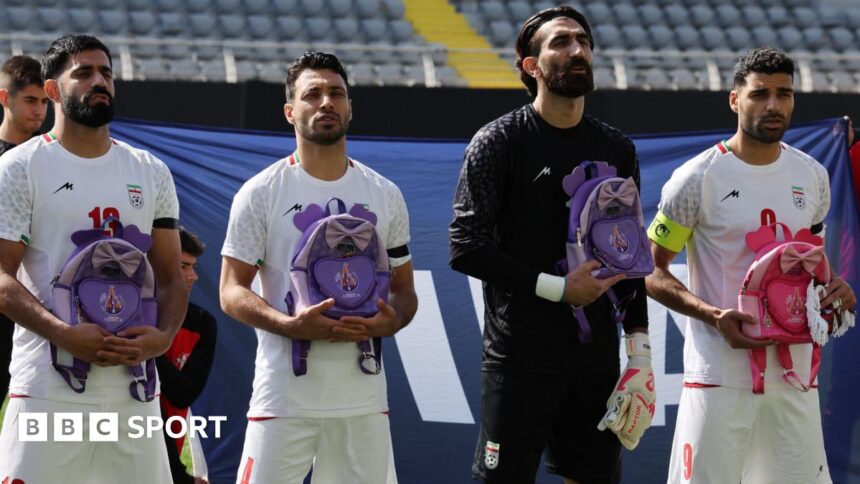
In the charged atmosphere of a pre-World Cup friendly, a moment of profound silence spoke volumes. As the Iranian national anthem echoed through the Stadion Wiener Neustadt in Austria, the players of Team Melli stood not with hands on hearts in customary salute, but with heads bowed, each clutching a child’s schoolbag. Black armbands adorned their sleeves, a somber tribute cutting through the usual pre-match pomp. This powerful, silent protest was for the 168 lives, including approximately 110 children, lost in a catastrophic strike on Shajareh Tayyebeh primary school in Minab, southern Iran, just weeks prior. The gesture, a stark intersection of sport, politics, and human tragedy, unfolded as the team’s participation in the upcoming World Cup hangs in a delicate balance, casting a long shadow over what should be a celebratory qualification.
A Gesture Beyond Sport: Decoding the Pitch-Side Protest
The image of elite athletes holding brightly colored schoolbags is one that resonates on a visceral, global level. This was not a protest about football, but a deliberate use of football’s immense platform to enact a public mourning and demand accountability. The symbolism was meticulously chosen and universally understandable.
The schoolbags represented the stolen futures of the young victims, a tangible reminder of the ordinary lives obliterated. The black armbands, a traditional symbol of mourning in sport, connected this tragedy to the communal heart of the nation. By maintaining a solemn, silent stance during the anthem—a ritual typically signifying patriotic fervor—the players transformed the moment into one of collective grief and a subtle, powerful demand for answers.
This action continues a recent tradition of political expression from Iranian athletes, particularly on the world stage. However, its focus on a specific, recent tragedy involving children gave it a raw, urgent poignancy that transcends geopolitical divides. It was a human cry for recognition, leveraging the team’s role as the most visible representatives of Iran on the global scene to spotlight a national wound.
The Shadow Over Qatar: World Cup Participation in Doubt
Iran’s qualification for a fourth consecutive World Cup is a significant footballing achievement. Yet, the road to Qatar is fraught with political and ethical dilemmas that threaten their presence at the tournament. The team’s protest directly amplifies the internal and external pressures surrounding their participation.
- Domestic Pressure: The Iranian public is grappling with profound grief and anger over the school attack. There is a growing sentiment, reflected in social media discourse, questioning the morality of representing a nation on sport’s biggest stage while such a grave incident remains unresolved. The team’s protest can be seen as an acknowledgment of this public sentiment.
- Geopolitical Tensions: The context of the attack is critical. Occurring on the first day of the Iran war, it is part of a broader, devastating conflict. US military investigators have reportedly concluded that American forces were likely responsible for the unintentional strike. This places the Iranian team in an impossibly difficult position, potentially heading to a tournament where they could face the United States politically, and possibly even on the pitch.
- The FIFA Precedent: World football’s governing body, FIFA, has a history of intervening in cases where political situations impact football. While they often demand that sports and politics remain separate, the sheer scale of this tragedy and the team’s own public stance create an unprecedented scenario. Could the team withdraw? Could FIFA impose sanctions related to broader political issues? The uncertainty is palpable.
The protest before the Nigeria friendly was, therefore, not just a memorial; it was a statement that the team carries this heavy burden with them as they prepare for the World Cup, a burden that may yet influence their final decision to compete.
The Unanswered Questions: Investigations and Accountability
At the core of the Iranian team’s silent protest is a cry for clarity and accountability. The attack on Shajareh Tayyebeh school remains shrouded in the fog of war, with competing narratives and incomplete investigations.
Iranian officials have stated the death toll and blamed the attack. The UN’s human rights chief has urgently called for the US to conclude and publish its findings. This international pressure is crucial. A transparent, public investigation is the bare minimum required for the victims’ families and for a nation in mourning. The football team’s action brings this demand from diplomatic corridors and news reports onto the front pages of sports sections worldwide, applying a unique form of soft-power pressure.
Until a definitive, accepted account of what happened is established, and responsibility is acknowledged, the incident will fester. It will continue to be a source of national trauma in Iran and a point of severe diplomatic tension. The players, by holding those schoolbags, became ambassadors not for their government’s politics, but for their people’s pursuit of truth.
Predictions and Implications: The Road Ahead for Team Melli
The path forward for the Iranian national team is arguably the most complex of any nation heading to the World Cup. Several scenarios could unfold, each with deep ramifications.
Scenario 1: Participation Under a Cloud. The most likely outcome is that Iran competes in Qatar. However, they will do so under immense psychological and political strain. Every match, every press conference, will be framed by this context. Should they be drawn against the United States, the encounter would be among the most politically charged in World Cup history. Their performances may be inspired by a sense of national duty, or weighed down by the burden of representation.
Scenario 2: A Withdrawal or Disqualification. While less probable, a voluntary withdrawal or a FIFA-enforced disqualification cannot be entirely ruled out. Escalating domestic pressure, a further deterioration in geopolitical relations, or internal team dissent could make participation untenable. Such an event would be a seismic shock to the tournament and a tragic coda to a successful qualifying campaign.
Scenario 3: Protests Amplified on the Global Stage. The silent protest in Austria may only be a prelude. The world will be watching Iran’s every move in Qatar. We may see further symbolic gestures—refusing to sing the anthem, displaying messages on gear, or dedicating goals to the victims. FIFA’s reaction to such actions would be a major test of its often-stated apolitical stance.
Ultimately, the team has transformed itself from mere footballers into symbols of a nation’s grief. Their sporting journey is now inextricably linked to a quest for justice.
Conclusion: When Football Carries the Weight of a Nation’s Grief
The poignant sight of Iran’s footballers holding schoolbags will be one of the enduring images of this World Cup cycle, regardless of whether they kick a ball in Qatar. It was a masterclass in impactful, silent protest, leveraging the universal language of sport to highlight an unspeakable tragedy. It underscored the reality that for many nations, football is never just a game; it is a vessel for identity, for mourning, and for voices that seek to be heard.
As the UN urges the US to conclude its investigation and the world awaits answers, the Iranian national team has shouldered a responsibility far beyond scoring goals. They have become custodians of memory for 168 souls. Their World Cup story is no longer just about tactics and talent; it is a narrative steeped in loss, a demand for accountability, and a powerful testament to the fact that sometimes, the most eloquent statements are made not with shouts, but with a solemn silence and the simple, heartbreaking prop of a child’s schoolbag.
Source: Based on news from BBC Sport.