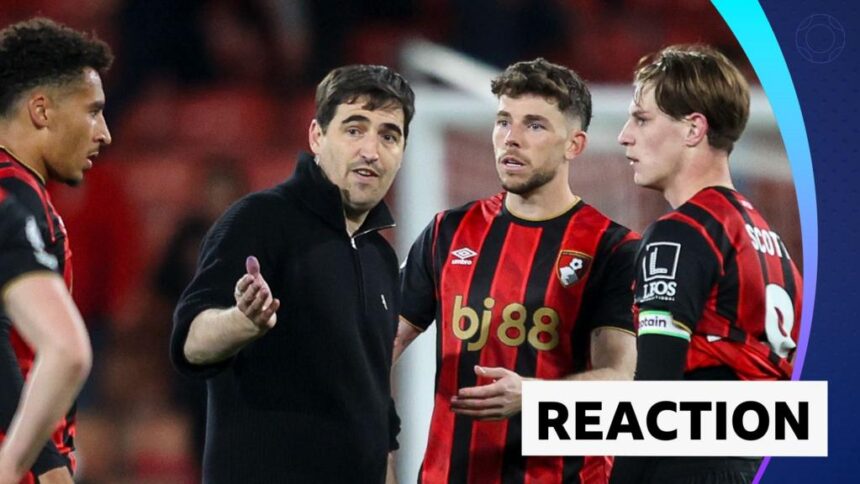
Andoni Iraola’s VAR Fury: The Offside Call That Cost Bournemouth Victory Against Leeds
The final whistle at the Vitality Stadium signaled a 2-2 draw, but the real story was a managerial eruption simmering with a sense of injustice. Bournemouth boss Andoni Iraola cut a figure of pure frustration, his post-match press conference dominated not by tactical analysis, but by a pivotal, game-altering decision that left him questioning the very consistency of the officiating. At the heart of the storm: Sean Longstaff’s 97th-minute equalizer for Leeds United, a goal Iraola insists should have been ruled out for a player being “offside in front of his goalkeeper.” In a league where margins are razor-thin, this incident has reignited the perennial debate over VAR’s role and the interpretation of football’s most contentious law.
A Dramatic Climax Overshadowed by Controversy
The match itself was a pulsating affair, a testament to the relentless pace and drama of the Premier League. Bournemouth, showcasing the aggressive, high-press philosophy instilled by Iraola, had fought back from a goal down to lead 2-1 deep into stoppage time. Just as the home supporters began to celebrate a hard-fought three points, Leeds launched one final, desperate assault. The ball found its way to Longstaff, whose shot nestled in the Bournemouth net, sparking wild celebrations from the visitors and utter despair on the Bournemouth bench.
However, Iraola’s immediate reaction was not one of defeat, but of protest. His focus was on a Leeds player positioned centrally, directly in the sightline of Bournemouth goalkeeper Neto, as Longstaff struck his shot. Andoni Iraola’s frustration was palpable and immediate. He argued that this player, by virtue of his offside position and proximity to the goalkeeper, was actively interfering with play—a violation that should nullify the goal. The fact that the Video Assistant Referee (VAR) conducted a check and deemed the goal valid only poured fuel on the fiery Spaniard’s discontent.
Interfering with Play: The Greyest Area of the Law
To understand Iraola’s fury, one must delve into the nuanced, often-misunderstood Law 11 concerning offside. The rule states a player in an offside position at the moment the ball is played is only penalized if they become involved in active play by:
- Interfering with play by playing or touching a ball passed or touched by a teammate.
- Interfering with an opponent by preventing an opponent from playing or being able to play the ball, or by clearly obstructing the opponent’s line of vision.
- Gaining an advantage by being in that position.
Iraola’s argument squarely falls under the second point: obstructing the goalkeeper’s line of vision. This is one of the most subjective areas for match officials. The key questions are: Was the offside player in the goalkeeper’s eye line? Did his presence impact the keeper’s ability to react to the shot? From Iraola’s perspective, the answer was a resounding yes. He believed the Leeds player’s positioning created a crucial screen, making it harder for Neto to see and react to Longstaff’s strike.
The VAR, however, after reviewing the footage, must have concluded that the player did not significantly impede Neto, or that Neto’s view was not sufficiently obstructed to constitute an offence. This VAR controversy highlights the immense difficulty in applying a binary decision (offside/not offside) to a scenario steeped in physical and optical interpretation. What one manager sees as clear interference, the officials may view as incidental presence.
Beyond the Moment: A Pattern of Perceived Injustice?
For Iraola, this incident likely felt like a recurring nightmare. Managers often speak about “decisions evening out over a season,” but in the heat of the moment, after his team had expended immense physical and mental energy to secure a lead, the late concession felt like a theft. His post-match comments were pointed and carried the weight of a man who feels his team is not getting the rub of the green from the technology designed to eliminate error.
This Bournemouth vs Leeds controversy does more than just impact a single match’s result. It has tangible consequences:
- Psychological blow: Dropping two points in such a manner can devastate squad morale and undermine the belief in a system that had put the team in a winning position.
- Table implications: In a tightly packed mid-table or relegation battle, a single point can be worth millions and define a club’s season.
- Managerial pressure: Iraola is a talented, modern coach implementing a bold style. Results are the ultimate currency, and decisions perceived as unjust can unfairly increase the scrutiny on his position.
The incident also places the match officials and the VAR hub under the microscope once again. Every week, the Premier League’s use of technology is dissected, and this last-minute equalizer debate will be another case study in the ongoing struggle to achieve perfect, or at least universally accepted, officiating.
What This Means for Bournemouth and the Premier League Going Forward
In the immediate aftermath, Bournemouth must regroup. Iraola’s challenge is to channel the collective sense of injustice into a unifying force, using it to bond the squad tighter rather than let it fester into negativity. The performance for large spells against a talented Leeds side was positive, and that is the foundation they must build upon.
For the Premier League and PGMOL (Professional Game Match Officials Limited), this is another moment that demands clarity. While they may stand by the decision, the frustration with officiating voiced by a respected manager like Iraola cannot be simply dismissed. There is a strong argument for more transparency—perhaps a brief explanation of the VAR’s reasoning for such critical decisions being broadcast or released post-match to bridge the understanding gap between the officials’ room and the football world.
Looking ahead, this incident will be remembered as a flashpoint in the 2023/24 season. It will be cited in future debates about offside interpretation and the human element within VAR. For Bournemouth, it’s a painful lesson in the cruelty of top-flight football. For Andoni Iraola, it was a moment where his tactical battle was, in his eyes, decided not by his players or the opposition, but by a decision from Stockley Park that he fundamentally disagreed with.
The final verdict on the pitch was 2-2. But in the court of managerial opinion, Andoni Iraola has already lodged a powerful appeal. The fallout from this dramatic draw will resonate long after the points are shared, serving as yet another chapter in the complex, often fraught, relationship between football and the technology that now governs its biggest moments.
Source: Based on news from BBC Sport.