Is Michael Carrick’s United Revival Proving Ruben Amorim’s Tenure Was a Lost Year?
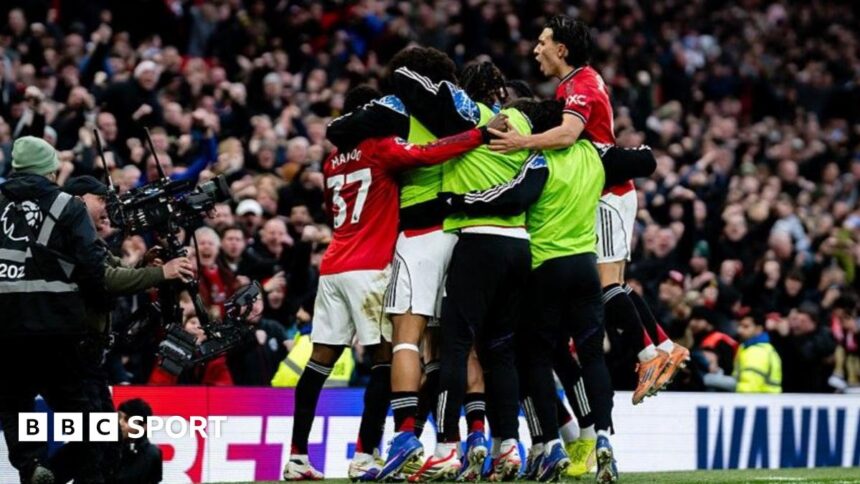
The roar that erupted at Old Trafford, a visceral, cathartic release of pent-up hope, told a story no possession statistic ever could. Deep into the seventh minute of stoppage time against Fulham, with the score locked at 1-1 and the spectre of another deflating draw looming, Benjamin Sesko rose to meet a swirling cross. The net bulged. Chaos ensued. Ecstatic teammates mobbed the young striker, a scrum of red jerseys fueled by pure, unadulterated joy. In the technical area, Michael Carrick clenched his fists, his usually composed demeanour shattered by the moment. This was more than three points. This, as the discourse since Ruben Amorim’s sacking has endlessly craved, felt like a reconnection with Manchester United’s DNA.
The Ghost of Amorim: A Year of Theoretical Football
To understand the potency of Sesko’s winner, one must first revisit the arid landscape from which it sprung. Ruben Amorim’s 12-month reign at Manchester United was an experiment in rigid philosophy. Arriving with immense pedigree, his tenure was defined by a possession-based system that prioritized control over chaos, patience over passion. The football was often technically proficient, a complex puzzle of positional rotations. Yet, for many fans, it was soul-crushingly sterile. Old Trafford’s famous decibel levels often dipped into a restless, anxious silence as sideways passes accumulated without penetrative purpose.
Amorim’s United knew how to dominate the ball, but they often forgot how to win matches in the manner this club’s history demands. The late, dramatic victories that are woven into the fabric of the Theatre of Dreams became extinct. The season ended trophyless, with a distant top-four finish. The post-mortem consensus was damning: the team had lost its identity. Amorim wasn’t sacked for poor results alone; he was dismissed for a fundamental misalignment with the club’s spirit. His year now stands as a curious, isolated chapter—a theoretical exercise that failed its practical exam.
Carrick’s Catalyst: Instinct Over Instruction
Enter Michael Carrick. The former United midfielder, a master of tempo in his playing days, has performed a subtle but profound recalibration. His approach has been less about installing a complex new doctrine and more about unshackling inherent qualities. Where Amorim demanded strict adherence to structure, Carrick has emphasized instinct, responsibility, and verticality. The statistics show a slight dip in average possession, but a dramatic increase in chances created, shots on target, and, crucially, a resurgence in goals from open play.
The victory over Fulham was a microcosm of this shift. United were not at their fluid best; they were scrappy, at times frustrated. Yet, they never stopped probing, never resigned themselves to a point. Carrick’s post-match assessment was telling: “It’s not always going to be perfect. But the desire to keep going, to find a way… that’s non-negotiable here. That’s what this badge demands.” This sentiment, this re-prioritization of heart alongside head, is what is now fostering that elusive reconnection.
Key changes under Carrick include:
- Empowering Youth & Pace: Leveraging the raw speed of players like Sesko and Alejandro Garnacho to transition quickly, directly challenging Amorim’s slower build-up.
- Midfield Fluidity: Allowing Bruno Fernandes greater positional freedom, recreating the unpredictable creative force he was before becoming a system player.
- Calculated Risk: Accepting that defensive solidity can sometimes be sacrificed for match-winning impetus, especially at home.
Sesko’s Symbolism: More Than Just a Goal
Benjamin Sesko’s injury-time winner is the perfect symbol for this new, yet familiar, era. The move itself wasn’t a rehearsed pattern from the training ground; it was born of individual brilliance, persistence, and a never-say-die collective will. Sesko, a signing initially scrutinized under Amorim for not fitting the technical mould, has become the talisman of Carrick’s United—a physical, relentless, and decisive focal point.
His dramatic intervention does more than just secure victory. It validates a feeling. It provides tangible, emotional evidence that the “United Way” isn’t a mythical construct, but a tangible force. It’s the Fergie Time mentality, repackaged for a new generation. This single moment did more to galvanize the fanbase and empower the squad than any number of Amorim’s 70%-possession stalemates. It proved that the capacity for such drama never left the club; it was merely suppressed by a system that viewed it as an unnecessary risk rather than the ultimate reward.
Looking Ahead: A Foundation of Feeling, Not Just Philosophy
The question now is whether this is a sustainable model or simply a post-managerial bounce. The early evidence under Carrick suggests a foundation built on emotional intelligence as much as tactical intelligence. He understands the cultural currency of last-minute winners at Old Trafford. He is building a team in the image of his own playing career: intelligent, resilient, and capable of moments of match-defining quality.
Predictions for the remainder of the season and beyond hinge on this cultural reset:
- Short-term: Expect volatility but increased excitement. United will likely lose games they “shouldn’t” under Carrick’s gung-ho approach but will also win games they’d have drawn under Amorim.
- Long-term: The club’s hierarchy must back Carrick’s vision in the transfer market, targeting players with the character and athletic profile for his intense, proactive style, moving definitively away from the Amorim prototype.
- Biggest Challenge: Balancing this revived spirit with the necessary defensive discipline to compete for the highest honours, ensuring passion is channeled, not chaotic.
Conclusion: The Lost Year That Found the Way
So, was Ruben Amorim’s tenure a wasted year? In the cold light of day, it provided a valuable, if painful, lesson. It was a costly deviation from identity that ultimately served to clarify what Manchester United truly is, and what it is not. The club is not an academic project. Its soul is not expressed in pass-completion percentages, but in stoppage-time pandemonium.
Michael Carrick’s success, punctuated by Sesko’s ecstatic winner, is not a rejection of modern coaching, but a reconciliation of tradition with progress. He is proving that the United DNA is not a tactical system, but a mindset—a belief that the game is never dead, that risk is a virtue in pursuit of glory. Amorim’s year was not entirely wasted if its failure became the necessary catalyst for this rediscovery. The lost year has, ironically, found the way home. The proof is in the roar, in the scrum of celebrating players, and in a league table that is starting to reflect the reawakened heartbeat of a club that finally remembers who it is.
Source: Based on news from BBC Sport.