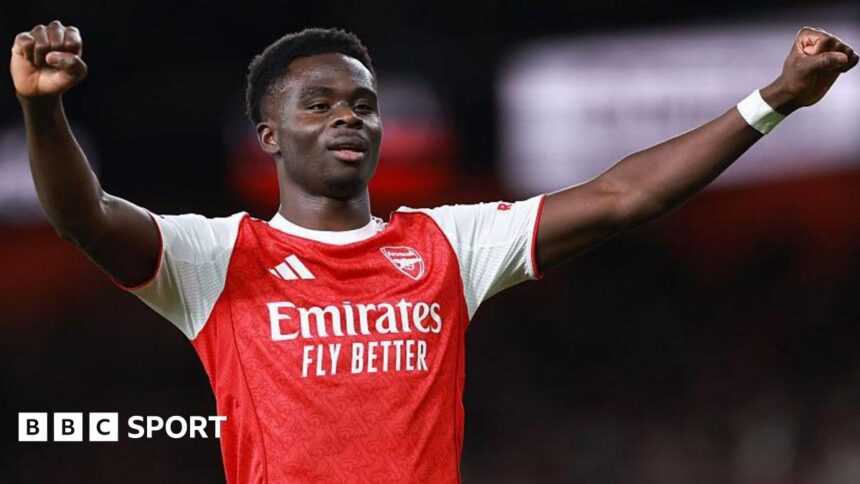
Is the Number 10 Role the Next Evolution for Arsenal’s Bukayo Saka?
Mikel Arteta’s Arsenal is a project in perpetual motion. Just when you think the blueprint is set, the manager unveils a new schematic, a subtle tweak that hints at a grander vision. In the often chaotic preamble to a routine FA Cup victory over Wigan Athletic, where Riccardo Calafiori’s late withdrawal became a frustratingly familiar scene, Arteta may have offered the most tantalizing glimpse of the future yet. The solution to the disruption wasn’t a like-for-like replacement, but a tactical reshuffle that placed Bukayo Saka at the heart of the attack. For the first time in a senior Arsenal shirt, the club’s talismanic right-winger operated centrally, in the coveted number 10 role. Was this a one-off necessity, or the first step in a deliberate evolution for Arsenal’s starboy?
The Art of Adaptation: From Crisis to Creative Opportunity
Player withdrawals have become an unsettling theme for Arteta this season. When Calafiori pulled out of the warm-up against Wigan, it marked the third such pre-match incident this campaign, following similar issues with Saka himself against Brighton and Calafiori again at Leeds. Previously, Arteta’s response was pragmatic: a straight swap, maintaining the system’s structure. Against Wigan, however, he chose innovation over preservation.
This decision is profoundly telling. It signals that Arteta views his squad not as a collection of fixed-position players, but as a fluid ensemble of multifaceted talents. By moving Saka inside to the number 10, with Gabriel Jesus wide and Kai Havertz leading the line, Arteta didn’t just plug a gap; he tested a hypothesis. He used an unforeseen crisis to explore a potential strategic upgrade, demonstrating a manager always thinking several moves ahead.
Deconstructing Saka: A Profile Built for the Pocket?
On the surface, moving one of the world’s most potent right-wingers seems counterintuitive. But a deeper analysis of Saka’s game reveals attributes that align strikingly well with the demands of a modern attacking midfielder.
- Dual-Threat Playmaking: Saka is no longer purely a dribbler who crosses. His development into a high-volume chance creator is key. From a central zone, he can receive the ball in the “half-spaces” between lines, face the goal, and utilize his improved passing range to slide through balls with either foot, a luxury less available from the touchline.
- Elusive Movement and Link-Up: His game is built on intelligent, disguised movements—quick one-twos, sharp turns, and drifting into dangerous areas. In the number 10 role, these skills could be even more devastating, allowing him to connect seamlessly with a striker like Havertz and the advanced midfield runners, creating a more dynamic and unpredictable central attack.
- Reduced Physical Burden: This is a critical, often overlooked factor. As the most fouled player in the Premier League for consecutive seasons, Saka endures relentless punishment on the wing. A central role, while still physical, could potentially offer marginally more protection from the brutal, constant double-teaming he faces out wide, preserving his longevity.
However, the transition isn’t without its challenges. The central corridor is more congested, requiring quicker decision-making and less time on the ball. Saka’s ability to beat a man in tight spaces would be tested differently, and he would need to enhance his defensive contributions in a more compact area of the pitch.
The Tactical Ripple Effect: Reshaping Arsenal’s Attack
Deploying Saka as a permanent number 10 wouldn’t just change his position; it would fundamentally alter Arsenal’s tactical architecture. This shift could unlock several strategic possibilities:
Unlocking a New Forward Line: It creates a pathway for a natural, pacy winger like Gabriel Martinelli or new signing Karim Adeyemi to occupy the left flank, with Jesus or another versatile attacker on the right. This restores blistering, direct width on both sides, with Saka as the central orchestrator.
Solving the Midfield Balance A permanent Saka at 10 allows Arteta to field a more defensively robust double pivot behind him—think Declan Rice and a true number 6—without sacrificing creative output. It solidifies the base and frees the front four to interchange with fluidity.
System Flexibility: Arsenal could seamlessly shift between a 4-2-3-1 with Saka central and a 4-3-3 where he starts from the right but drifts infield, becoming a tactical nightmare for opposing managers to track. This evolution of the Arsenal attack would add a layer of strategic ambiguity they have sometimes lacked.
The Verdict: A Strategic Option, Not an Immediate Overhaul
So, is the number 10 Saka’s destiny? The evidence suggests it is less about an immediate positional change and more about Arteta intentionally expanding his star player’s toolkit and the team’s tactical portfolio.
In the immediate future, Saka’s primary home will remain the right wing. His established chemistry with Ben White, his goal output from that side, and the sheer havoc he wreaks are too valuable to abandon. However, the Wigan experiment was a clear statement of intent. Arteta is preparing Saka, and by extension his team, for moments when a different solution is required—be it in-game, against low-block teams craving space in behind, or as a long-term career evolution.
Predictions for the path ahead:
- We will see Saka deployed centrally more frequently in cup games or against specific opponents where Arsenal dominates possession.
- His minutes in the role will gradually increase over the next 18-24 months, much like Phil Foden’s journey at Manchester City.
- This flexibility makes Arsenal a more adaptable and dangerous team in all competitions, especially the Champions League.
- Ultimately, Saka’s “position” may become “front four,” with the freedom to roam and dictate play from wherever he can be most effective.
Conclusion: The Making of a Complete Modern Attacker
Mikel Arteta’s masterstroke with Bukayo Saka isn’t confined to developing a world-class winger. It is about forging a complete, intelligent, and versatile attacking force for the modern game. The brief audition against Wigan was a signal flare. It revealed a manager proactive in solving not just today’s injury crisis, but tomorrow’s tactical puzzles. For Saka, the number 10 role represents not a demotion or a permanent shift, but an empowering expansion of his influence. It is the next logical step in the evolution of a player who has repeatedly shattered expectations. Arsenal’s starboy is being groomed not just to shine in one fixed position, but to become the central, illuminating force of a team with ambitions to dominate for years to come. The next step isn’t a step sideways; it’s a step into a larger, more commanding domain.
Source: Based on news from BBC Sport.