The Sinner-Alcaraz Era: A Thrilling Duopoly or a Threat to Grand Slam Drama?
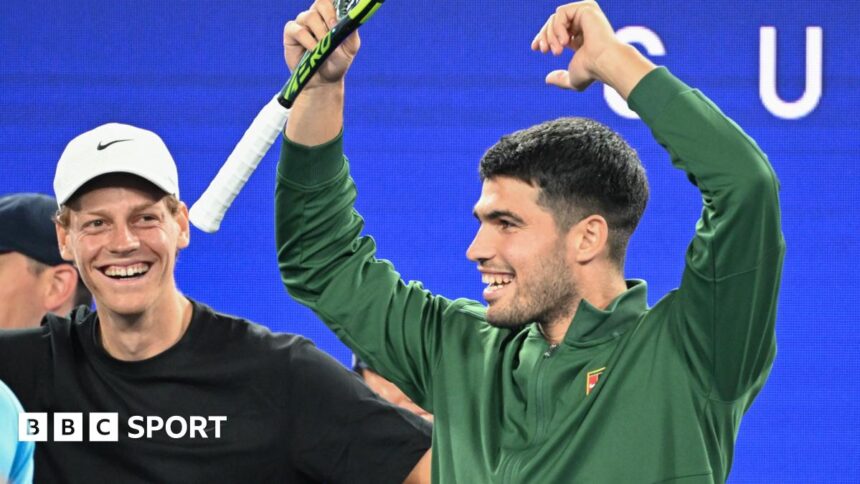
The air in Melbourne is thick with anticipation, but it carries a peculiar scent this year. It’s the aroma of inevitability. As the Australian Open unfolds, the tennis world is captivated by a single, burning question: will anyone stop them? Jannik Sinner, the ice-cool Italian with a rocket launcher for a forehand, and Carlos Alcaraz, the exuberant Spanish sorcerer conjuring impossible angles, have not just arrived; they have annexed the summit of men’s tennis. The past eight Grand Slam titles rest in their trophy cabinets. They have delivered three consecutive major finals of breathtaking intensity, culminating in last June’s Roland Garros epic where Alcaraz, back against the wall, saved three championship points in a victory for the ages. Yet, a murmur is growing beneath the roar of admiration. A worry voiced by champions of old: Is the Sinner-Alcaraz dominance, for all its brilliance, in danger of making the majors predictable?
The Gilded Cage of a Two-Horse Race
The statistics are staggering and, for their rivals, perhaps demoralizing. Since Novak Djokovic’s Wimbledon triumph in 2022, only two names have been etched on Grand Slam silverware: Carlos Alcaraz and Jannik Sinner. Their rivalry has quickly crystallized into the sport’s premier attraction, a perfect stylistic clash of fire and ice. However, this very concentration of power is sparking concern. Tennis legend Pat Cash, the 1987 Wimbledon champion, cut to the heart of the issue on BBC 5 Live, stating plainly: “It’s not a healthy situation to have a two-horse race.”
Cash’s perspective is rooted in the sport’s history. Tennis thrives on uncertainty, on the narrative chaos of a first-week giant-killing or a surprise semifinalist. The golden ages of Federer-Nadal-Djokovic or Sampras-Agassi were compelling precisely because of the multiple pathways to drama. The current landscape feels different. The journey to the final has become a formality for the duo, a procession where top 10 rivals have barely laid a glove on them in the latter stages of Slams. The question entering each major is no longer “Who will win?” but “Which one of the two will win, and will their meeting be in the final?” In Melbourne, with Sinner and Alcaraz on opposite halves of the draw, that final showdown is the only possible meeting, heightening the sense of a pre-ordained conclusion.
Anatomy of a Duopoly: Why The Field Is Falling Short
To blame Sinner and Alcaraz for their excellence is to miss the point. Their dominance is a product of generational talent fused with physical and mental prowess unseen in their peers. The issue lies in the vacuum beneath them. Let’s examine why the challengers are stuck.
- The Djokovic Conundrum: The once-imperious Serb remains a threat, but his aura of invincibility in Australia has been pierced. At 36, the quest for a 25th major is as much a battle against time as against his younger rivals.
- The Lost Generation Stalls: Players like Alexander Zverev, Daniil Medvedev, and Stefanos Tsitsipas—majors finalists all—have found their games picked apart by the sheer pace and tactical versatility of Sinner and Alcaraz. Medvedev’s defensive wall is breached by Alcaraz’s drop shots and Sinner’s blistering power. Zverev’s serve-plus-one pattern is neutralized by their elite returning.
- The Physical Gap: Both champions have redefined athleticism in tennis. Alcaraz’s explosive speed and Sinner’s relentless, efficient power force errors from opponents who simply cannot sustain the intensity over five sets.
- Tactical Rigidity: Many contenders possess a Plan A, but Sinner and Alcaraz boast Plans A through D. Alcaraz can switch from baseline bruiser to net-rushing artist in a point. Sinner can transition from relentless aggression to unsettling, angled depth.
This combination has created a chasm in consistency at the very highest level. The semifinals of a major are no longer a battleground; they are a proving ground where the rest are found wanting.
The Counter-Argument: Why This Rivalry is a Gift, Not a Curse
Before declaring an emergency, consider the alternative. The period between the Big Three’s absolute peak and the rise of Sinner-Alcaraz was often criticized for its lack of a sustained, head-to-head rivalry at the summit. What we have now is the sport’s dream scenario: two young, charismatic, and diametrically opposed champions pushing each other to historic heights.
Their matches are not just wins and losses; they are events. The 2024 Roland Garros final was an instant classic, a five-set thriller featuring momentum swings, breathtaking shot-making, and psychological warfare. The Wimbledon 2023 final showcased Alcaraz’s dethroning of a king. Their 2024 Australian Open quarterfinal was a masterclass in power and precision. This rivalry delivers on the grandest stage every single time. Furthermore, their dominance raises the standard for the entire tour. To compete, the chasing pack must innovate, train harder, and develop new dimensions in their game. This duopoly, while potentially predictable in outcome, is accelerating the evolution of the sport itself.
The Road Ahead: Predictions for the Australian Open and Beyond
In Melbourne, the draw dictates that the dream final is the only possible meeting. The intrigue, therefore, shifts. Can anyone play spoiler?
Dark Horse Disruptors: Look for a player with a specific, high-risk weapon that can cause a shock. Could Holger Rune’s chaotic power catch Sinner on an off-day? Might an in-form Alex de Minaur’s legs and home crowd will him to an unthinkable upset against Alcaraz? More likely, the threats come from the established: a resurgent Djokovic seeking revenge, or a strategically perfect day from Medvedev. But the smart money says the path will be cleared.
The Verdict for 2024: The prediction is that Sinner and Alcaraz will meet in the final at Rod Laver Arena. Sinner, riding a wave of confidence from his late-2023 surge and Davis Cup triumph, may have the slightest edge in current form on hard courts. However, betting against Carlos Alcaraz in a major final is a fool’s errand. It will go five sets. It will be legendary. And it will likely be the first of several such meetings this year.
The broader prediction is that this duopoly will not last forever—they never do—but it will define the next two to three seasons. The true test of its “health” will be the emergence of a consistent third force, perhaps a Ben Shelton or a Lorenzo Musetti, who can regularly crash the party.
Conclusion: Celebrating the Spectacle, Craving the Chaos
So, is the Sinner-Alcaraz era making majors boring? For the purest seeking the unpredictable drama of a wide-open draw, perhaps there is a tinge of predictability. But to label it boring is to profoundly misunderstand the moment. We are witnessing the birth of a legendary rivalry, one that already matches the intensity and quality of any in history. Their matches are must-see events that transcend sport.
The solution is not to wish for their decline, but to demand more from the chasing pack. The onus is on the field to adapt, improve, and challenge. The health of the sport depends on that response. Until then, we should savor the privilege of watching two all-time greats in their ascendancy, pushing each other to produce tennis that is, by any measure, spectacularly entertaining. The journey to their inevitable clashes may lack suspense, but the destination remains the most thrilling show in town. The era of Sinner and Alcaraz is not a problem to be solved; it is a golden age to be celebrated, even as we hope for a few more contenders to finally land a glove.
Source: Based on news from BBC Sport.