Kyrgios’ Brisbane Return Ends Swiftly, Casting Shadow Over Australian Open Hopes
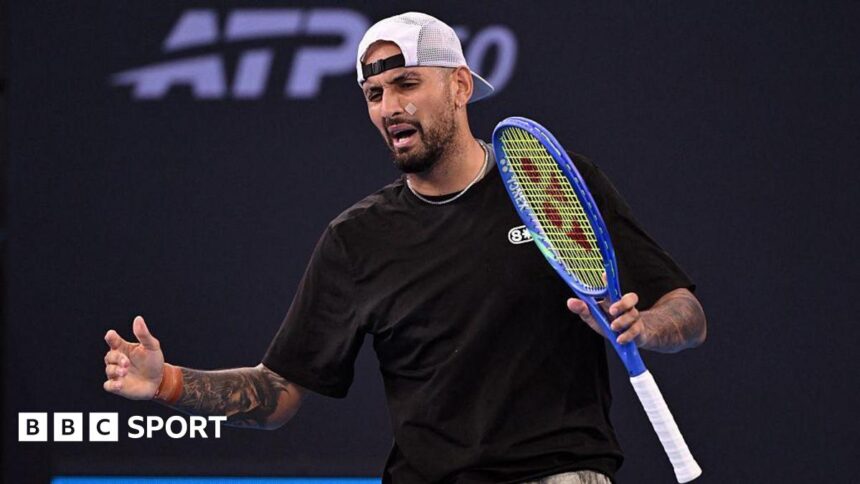
The roar of anticipation that greeted Nick Kyrgios as he strode onto Pat Rafter Arena was a familiar, electric force. The sight of him, however, was not. After 10 months away from the ATP Tour, a period defined more by surgical procedures and rehabilitation than by his trademark audacious tennis, Kyrgios’ return at the Brisbane International was a moment of collective hope. Sixty-five minutes later, that hope was met with the stark reality of competitive sport. In a performance that was more rust than revelry, Kyrgios fell 6-3, 6-4 to the 69th-ranked American, Aleksandar Kovacevic, a straight-sets defeat that leaves his immediate future shrouded in significant doubt.
A Glimpse of Genius, Overshadowed by Rust
For fleeting moments, the old Kyrgios flickered to life. A nonchalant, wristy forehand winner here; a thundering ace down the T there. The capacity crowd, desperate for a reason to erupt, seized upon each one. But these were isolated sparks in an evening dominated by unforced errors and a palpable lack of match conditioning. Kyrgios, now 30 and ranked a lowly 670th in the world, moved with understandable caution, his explosive lateral movement—once a weapon—now a calculated risk. His serve, arguably the most potent in the game at its peak, lacked its consistent venom. Kovacevic, a steady and opportunistic opponent, exploited this mercilessly.
The statistics painted a grim picture:
- Kyrgios committed 21 unforced errors to Kovacevic’s 9, a telling ratio for a player whose game is built on controlled aggression.
- He won a meager 48% of points on his second serve, making him vulnerable in nearly every service game.
- Most tellingly, he created zero break point opportunities against the American’s serve, a stunning anomaly for a player of his returning talent.
This was not a tactical failure, but a physical and rhythmic one. The match sharpness, the intuitive shot selection under pressure, the trust in a body that has betrayed him repeatedly—all were absent. “It’s a process,” Kyrgios would say post-match, a phrase that has become a weary mantra throughout his injury-plagued journey.
The Long Road Back: From Career High to Career Crossroads
To understand the significance of this loss, one must look at the precipitous fall from Kyrgios’ zenith. In 2016, he soared to a career-high singles ranking of World No. 13, a beacon of raw, unorthodox talent seemingly destined to disrupt the tennis establishment. His game was a thrilling paradox: a booming serve paired with delicate touch, relentless power tempered by underrated court craft. Yet, the past three seasons have been a near-total write-off, ravaged by a string of serious injuries including a chronic knee issue, a wrist problem, and most recently, a torn ligament in his foot that required surgery.
The numbers are stark: only six ATP singles matches in three years. The exhibition victory over women’s world No. 1 Aryna Sabalenka last month was a fun spectacle, but it bore no relation to the grueling, stop-start demands of tour-level tennis. The Brisbane International wildcard was a gift of faith from Tennis Australia, a chance to jumpstart his engine on home soil. The result, however, confirms that the gap between exhibition flair and tour-level rigor remains a chasm.
Kyrgios’ current mission is singular: to build his fitness for an Australian Open wildcard. He is now in a race against time and his own physical history. The first Grand Slam of the year begins on January 18th in Melbourne, a place where he reached the final in 2022 and commands a fanatical following. The decision by Tennis Australia will be among their most scrutinized. Do they award a wildcard based on past glory, crowd-pulling power, and potential? Or does it hinge on demonstrated form and fitness—two things the Brisbane match sorely lacked?
Expert Analysis: What Comes Next for the Enigmatic Star?
The path forward is fraught with complexity. Tennis analysts point to several critical factors that will determine whether Kyrgios can resurrect even a fraction of his former prowess.
The Physical Hurdle is Paramount. Can his body withstand the brutal, best-of-five-set format at a major? His movement against Kovacevic was conservative, protecting the knee and lacking the explosive spring that makes his net game so effective. Building “tennis fitness”—the specific stamina and muscle memory for match play—cannot be rushed, especially for a 30-year-old with his injury ledger.
The Mental Battle is Equally Crucial. Kyrgios has always been a mercurial competitor, but now he must manage the frustration of a diminished physical capacity. The expectation to instantly recapture 2022 magic is immense, and the patience required for a gradual rebuild does not come naturally to him. The defeat in Brisbane, while expected by many, will be a severe psychological test.
The Wildcard Dilemma for Australian Open Officials. Tennis Australia faces a public relations and sporting dilemma. Kyrgios moves television ratings and fills stadiums like few others. Denying him a wildcard could be commercially unpopular. Yet, awarding one to a player clearly undercooked risks a similarly deflating first-round exit on the sport’s biggest national stage, which helps no one. The likely compromise may involve a close assessment of his training and practice sessions in Melbourne over the next week.
Prediction: A Melbourne Swan Song or a New Beginning?
Predicting Nick Kyrgios’ trajectory has always been a fool’s errand, but the Brisbane evidence points toward a short, challenging Australian summer. The most plausible scenario is that he receives the Australian Open wildcard, drawing a massive night match on Rod Laver Arena. There, fueled by adrenaline and home support, he could summon a heroic performance. However, the likelihood of stringing together seven such performances to win the title—a dream he has openly voiced—seems remote based on current evidence.
A more realistic hope is that he uses any matches in Melbourne to accumulate crucial court time. The goal shifts from immediate glory to a slow, steady climb back into the top 100 by the end of 2024. This requires a level of patience and persistence he has rarely needed to show. The alternative—that this cycle of injury and abbreviated comeback continues—threatens to make his thrilling run to the 2022 Wimbledon final the definitive, final act of his singles career.
Conclusion: The Unfinished Symphony of Nick Kyrgios
The straight-sets loss to Aleksandar Kovacevic in Brisbane was more than a first-round exit; it was a poignant reality check. It underscored that Nick Kyrgios’ return is not a switch to be flipped, but a mountain to be climbed—one with a treacherous and uncertain path. The genius is still in the racket, as those fleeting winners proved. The body and the match rhythm, however, are works in painful progress.
As the tennis world turns its gaze to Melbourne, the question is no longer whether Kyrgios can win the Australian Open. The question is whether he can win a match. Whether he can win a battle with his own physical limits. And whether he can find, in this late chapter of his career, the sustained dedication to complete the unfinished symphony of his talent. The Brisbane International was not a conclusion, but a prologue to the next, and perhaps most defining, act of the Kyrgios saga.
Source: Based on news from BBC Sport.