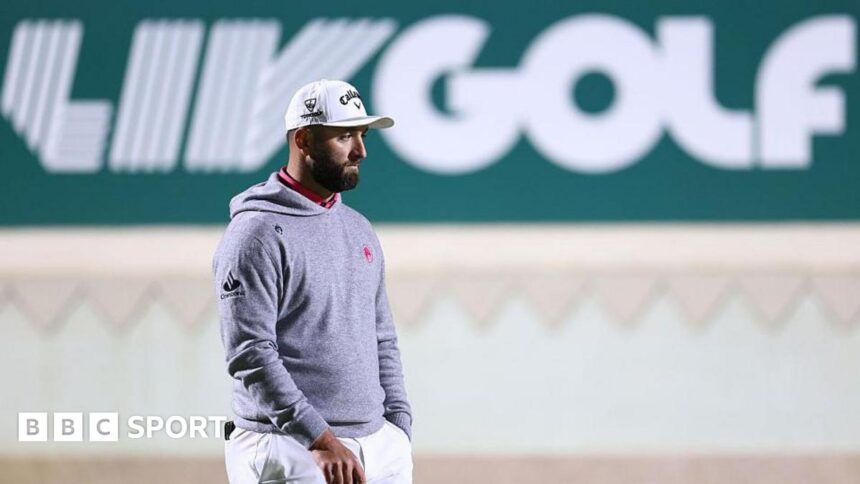
Is LIV Golf’s Revolution Stalling? The Uncertain Future of Golf’s Disruptor
The landscape of professional golf has been defined by fault lines for the past four years. The catalyst? The explosive arrival of LIV Golf, backed by the seemingly infinite wealth of Saudi Arabia’s Public Investment Fund (PIF). With a war chest exceeding £5 billion, LIV didn’t just enter the sport; it declared war on its century-old institutions. It promised a revolution: shotgun starts, team formats, 54 holes, no cuts, and life-changing, guaranteed money. The capture of two-time major champion Jon Rahm in 2023 was the seismic moment that proved no star was beyond reach. But today, a new tremor is shaking the foundation. As speculation intensifies that the PIF may be reconsidering its vast financial commitment, a pressing question echoes across fairways worldwide: Is this the beginning of the end for LIV Golf?
The Promise of Rebellion: How LIV Shook the Establishment
LIV Golf’s inception was a masterclass in disruption. Named for the Roman numeral of its 54-hole format (LIV = 54), it positioned itself as the vibrant, progressive alternative to the traditional, often staid, world of professional tours. It attacked the perceived flaws of the status quo head-on. Players were offered upfront signing bonuses reported to be in the hundreds of millions for top-tier talent, transforming their financial futures overnight. The league offered a less grueling schedule, a guaranteed payday every week, and a focus on entertainment over pure sport.
The impact was immediate and profound. LIV didn’t just sign players; it fractured friendships, divided fans, and sparked a bitter, public legal battle with the PGA Tour. It forced the golfing world to confront uncomfortable questions about sportswashing, morality, and the very soul of the game. For a while, the rebellious 54-hole concept and its team element, modeled after Formula One, generated genuine intrigue and a new, younger audience segment. It proved that golf’s model was not impervious to change.
The Cracks in the Foundation: Beyond the Billions
Despite the initial shock and awe, LIV Golf has faced persistent and significant challenges that money alone has not been able to solve. The tour’s foundation, built almost exclusively on capital rather than organic growth, has shown vulnerabilities:
- Limited Broadcast Reach: Struggling to secure a major mainstream television deal in key markets like the United States, LIV has relied on streaming and lesser-watched networks, drastically capping its audience and commercial appeal.
- Questionable Sport-Swashing ROI: While the PIF achieved global name recognition for its Saudi sponsors, the narrative remained dominated by controversy, often overshadowing the golf itself.
- Lack of Competitive Legacy: The no-cut, guaranteed-pay format, while player-friendly, has been criticized for lacking the competitive tension and meritocracy that define major championships and the PGA Tour’s best events.
- Player Integration Issues: Stars like Rahm, Cameron Smith, and Brooks Koepka found themselves barred from their former tour events, creating a fractured ecosystem that has arguably diminished the sport overall.
These issues culminated in the shocking framework agreement announcement on June 6, 2023, between the PIF and the PGA Tour. The move to negotiate a peace, after years of vitriol, was a tacit admission that the path of endless conflict was unsustainable for both sides.
The PIF Pivot: Reading the Tea Leaves on Financial Support
The most existential threat to LIV’s future is now financial. Recent reports suggest the Saudi Arabian Public Investment Fund is set to pull financial support or dramatically reshape its involvement. The PIF, while fabulously wealthy, is not a charity; it is a sovereign wealth fund with a mandate to generate returns and diversify the Saudi economy. The ROI on a multi-billion dollar golf investment with unclear profitability pathways is difficult to justify indefinitely.
Analysts point to a potential strategic pivot. The PIF’s primary goal—to force a seat at golf’s top table and acquire equity in the commercial ventures of the PGA Tour—may be nearing realization through the ongoing negotiations. If a finalized deal creates a new, global commercial entity with PIF investment, the need to fund a separate, loss-leading tour diminishes. LIV, in this scenario, could be folded, repurposed as a series of elevated events within a unified structure, or maintained as a niche product with drastically reduced funding. The speculation is not about Saudi Arabia abandoning golf, but about it seeking a more sustainable and integrated—and likely less expensive—form of influence.
Three Possible Futures for LIV Golf
The path forward is murky, but several distinct scenarios could unfold over the next 12-18 months, each with profound implications for players and fans.
Scenario 1: The Merger & Absorption. This is the most likely outcome. A finalized deal between the PIF and PGA Tour leads to a new commercial company. LIV is dissolved, but its most popular elements—like the team concept—are incorporated into a handful of “global series” events on the unified calendar. LIV players are welcomed back to the PGA Tour, perhaps with penalties or fines, ending the era of division.
Scenario 2: The Slow Fade. Without a deal, but with waning PIF enthusiasm, LIV continues but on a scaled-back budget. The era of billion-dollar signings ends. The tour contracts to 8-10 events, retains its core stars by contract, but fails to attract new top talent. It becomes a lucrative exhibition series for a closed shop of past champions, fading from mainstream relevance.
Scenario 3: The Independent Niche. In an unlikely but possible turn, LIV doubles down on its alternative model. It secures a solid media deal, leans further into entertainment, and carves out a sustainable, if smaller, niche audience. It becomes golf’s version of the IPL or World Surf League—a distinct, team-focused product that coexists but does not directly compete with the traditional majors and tours.
The Unavoidable Legacy: A Permanent Disruption
Regardless of its corporate fate, declaring LIV Golf a failure would be a profound misreading of its impact. LIV Golf changed golf as we know it, perhaps forever. It exposed the financial dissatisfaction of top players and the complacency of the existing tours. Its mere existence forced the PGA Tour to radically overhaul its own model, leading to the creation of elevated, no-cut events with massive purses—a direct concession to LIV’s appeal.
The sport is now fundamentally different. Players are empowered as financial stakeholders. The schedule is more global. The conversation about guaranteed money and quality of life is front and center. In that sense, LIV succeeded in its revolutionary goal, even if its own tour may not survive in its original form.
The beginning of the end for LIV Golf as a standalone, breakaway tour? All signs point to yes. The unsustainable financial model, the ongoing merger talks, and the strategic goals of its own backer all suggest a transformation is imminent. However, the end of LIV the *tour* is not the end of its influence. Its legacy is etched into the prize funds, the tournament formats, and the very business model of modern professional golf. The rebellion may be getting a corporate makeover, but the revolution it sparked is already complete. The game has been permanently, irrevocably disrupted, and the final chapter of this saga will likely be written not in defiance, but in a tense, complicated, and unprecedented partnership.
Source: Based on news from BBC Sport.