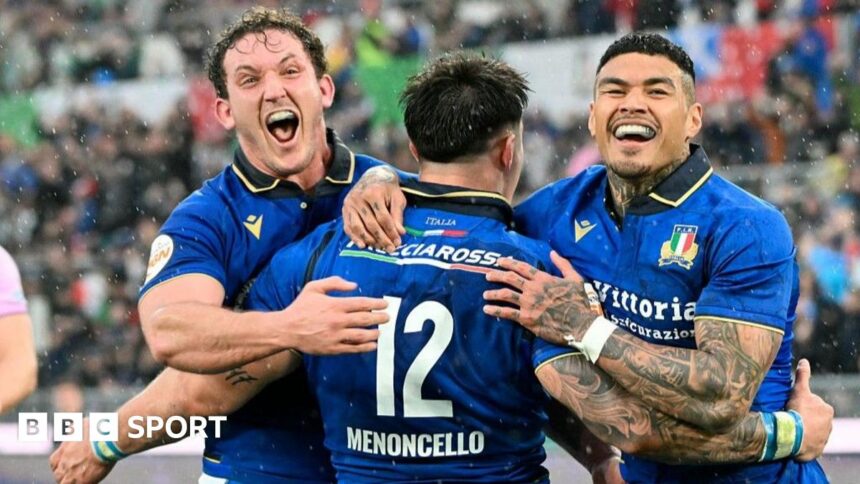
Italy Punish Lacklustre Scotland in Rome Rain to Ignite Six Nations Crisis
The Stadio Olimpico, shrouded in a persistent Roman drizzle, bore witness to a seismic shift in the Six Nations landscape. In a match where the weather seemed to mirror Scotland’s campaign prospects, Italy delivered a performance of gritty maturity to secure a historic 24-13 victory. This wasn’t a fluke or a flash of individual brilliance; it was a systematic, 80-minute dismantling of a Scottish side that arrived with Grand Slam whispers and departed with a full-blown identity crisis. The result leaves Gregor Townsend’s tenure under intense scrutiny and announces the arrival of Gonzalo Quesada’s Italy as a force of disciplined pragmatism.
A Roman Reckoning: Scotland’s Campaign Washes Away
From the first whistle, the narrative felt wrong for Scotland. The precision and fluidity that define their best performances were absent, replaced by a litany of unforced errors, poor decision-making, and a startling lack of physicality. The Italian pack, so often bullied in years past, set the tone early, dominating the collision area and turning the Scottish lineout into a lottery. Finn Russell, the orchestrator-in-chief, was harried and muted, his magic stifled by a relentless Italian defensive line led by the phenomenal Michele Lamaro. Scotland’s lack of a Plan B was glaring; as the rain fell and their intricate phase-play stuttered, they had no answer. The try from Rory Darge, later correctly chalked off for a clear knock-on by Sione Tuipulotu, symbolized a day of frustration—promise snuffed out by inaccuracy.
Italy, in stark contrast, played the conditions and the occasion perfectly. Their game management was exemplary. Key to their control was the half-back pairing of Martin Page-Relo and Paolo Garbisi, whose tactical kicking pinned Scotland deep and exploited a surprisingly fragile backfield. This was a victory built on Italian defensive resilience and set-piece solidity, foundations that have been shaky for over a decade but now look impressively robust.
Expert Analysis: The Key Battles That Defined the Defeat
Dissecting this result requires looking beyond the scoreboard to the individual duels that Italy won convincingly.
- The Breakdown Battle: This was the epicenter of Italian dominance. Players like Sebastian Negri and Lorenzo Cannone were omnipresent, slowing down or stealing Scottish ball with alarming consistency. Scotland’s clearing was lethargic, allowing Italy to dictate the tempo and strangle their attacking flow.
- Midfield Mismatch: The centre partnership of Juan Ignacio Brex and Tommaso Menoncello was utterly dominant. Brex’s defensive reads and brutal tackling shut down channels, while Menoncello’s powerful carrying constantly broke the gainline. Tuipulotu and Huw Jones, usually so influential, were neutralized.
- The Tactical Kicking Masterclass: Page-Relo’s box-kicking was a weapon, but it was his and Garbisi’s varied grubbers and cross-field punts that exposed Scotland’s back-three. The clinical Italian finishing was then showcased when chances arose, a stark contrast to Scottish profligacy.
The tries told the story. Louis Lynagh’s debut score came from sustained pressure and a simple, powerful carry. Menoncello’s second-half clincher was born from a Scottish handling error and ruthless transition. Scotland’s replies from Jack Dempsey and George Horne felt like consolations, moments of individual quality in a collective void.
Pressure Mounts: What’s Next for Townsend and Scotland?
The fallout in the Scottish camp will be severe. Questions that have simmered for years are now at a boiling point. Gregor Townsend, once hailed for modernizing their attack, faces accusations of tactical rigidity and an inability to galvanize his squad for key fixtures. The Six Nations campaign outlook has turned from potential champions to damage limitation within one weekend.
With a trip to Cardiff to face a wounded Wales next, followed by the visit of an England side finding its feet under Steve Borthwick, this could spiral quickly. The core issues—mental fragility on the road, an over-reliance on Russell, and a pack that can be outmuscled—are not new. The difference now is that Italy have proven they are no longer a guaranteed five points. The pressure on Gregor Townsend is now immense, with the upcoming fixtures looking like a referendum on his leadership.
The Quesada Effect: A New Azzurri Dawn
For Italy, this victory is a landmark moment that transcends the points. Under Gonzalo Quesada, they have shed the “plucky underdog” tag in record time. He has instilled a hard-edged, pragmatic philosophy that complements their traditional passion. This win was built on Italian set-piece authority and game intelligence, attributes previously in short supply.
The confidence this generates is immeasurable. They travel to Dublin next as a team to be respected, not patronized. With a home game against Wales and a trip to France to come, a first-ever top-half finish in the Six Nations is no longer a fantasy. Quesada has given them a system and, more importantly, the belief that they belong. In the rain of Rome, Italy didn’t just win a rugby match; they announced a new era.
Conclusion: A Watershed Moment in the Six Nations
As the Roman rain washed over the emptying Stadio Olimpico, the contrasting scenes were telling. Italian jubilation was raw and deserved, a celebration of a plan perfectly executed and a historic hurdle cleared. Scottish despondency was deep, the realization dawning that a golden generation’s window of opportunity is threatening to slam shut without the tangible success their talent has promised.
This result is a watershed. It ends Italy’s long, painful run of home defeats in the championship and validates their path under Quesada. For Scotland, it is a profound wake-up call. The talent within their squad is undeniable, but talent without grit, adaptability, and mental fortitude is wasted. The 2024 Six Nations is only one round old, but its narrative has been violently upended. Italy are on the rise, playing with a clarity of purpose. Scotland, meanwhile, are left to search for answers in the Roman rain, their campaign already on the brink of becoming a total washout.
Source: Based on news from BBC Sport.