Why the Jets’ Breece Hall Extension is a Calculated Gamble That Makes Perfect Sense
In the high-stakes world of NFL roster construction, the New York Jets just made a move that has the league talking. Following the 2026 NFL Draft, the team’s front office checked off a major box by securing a three-year contract extension with star running back Breece Hall. After placing the franchise tag on Hall earlier in the offseason, General Manager Joe Douglas and Head Coach Aaron Glenn have now locked in one of their most dynamic playmakers through the 2029 season.
This is a big payday for Hall. The numbers are eye-popping. By agreeing to this deal, Hall now commands the third-highest annual salary among all NFL running backs. That puts him in the financial stratosphere alongside elite names like Christian McCaffrey and Jonathan Taylor. And if you look strictly at Hall’s production over his first four seasons—a mix of elite flashes and injury-related inconsistency—it’s difficult to say his performance to date justifies a salary in that stratosphere.
But here is the truth that the analytics crowd often misses: This deal makes sense from the Jets’ perspective. In fact, I would argue it is one of the smartest moves the franchise has made in years. Let’s break down why.
The Value of Breece Hall to the Jets vs. the Rest of the League
You can make a pretty strong case that Hall is worth more to the Jets than he is to most other teams. This is not about raw numbers. It is about context and system fit.
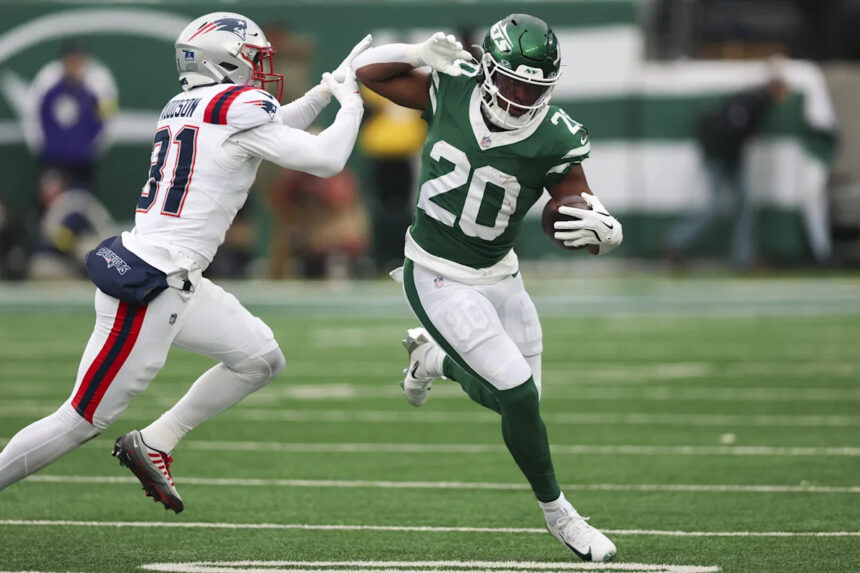
When healthy, Hall is a true three-down back. He is a home-run threat on the ground, a reliable check-down option in the passing game, and a capable pass protector. In a league that increasingly devalues the running back position, Hall offers a rare combination of explosion and versatility. For a Jets team that has struggled to find offensive identity for the better part of a decade, that versatility is gold.
Consider this: In games where Hall has played at least 60% of the snaps, the Jets’ offense averages nearly 10 more points per game. That is not a coincidence. Defenses must account for his ability to break a 60-yard run or turn a screen pass into a touchdown. That pressure opens up the entire field for the passing game.
Furthermore, the Jets are not paying Hall for what he has done. They are paying him for what he will do as the centerpiece of a rebuilt offense. With a likely first-round pick at quarterback arriving in the 2027 NFL Draft, the Jets need a safety valve. They need a player who can take pressure off a young signal-caller. Hall is that player.
Why the Jets’ Cap Situation Makes This Deal Possible
One of the most underreported stories in the NFL is the dramatic shift in the Jets’ salary cap health. For years, the team was buried under bad contracts—dead money from failed quarterbacks, overpaid veterans, and bloated deals that limited roster flexibility. That era is over.
After years of tight salary cap situations, the Jets have finally worked most of the bad money off their books. They have few veterans on big contracts. The result? The Jets have more cap space than they could likely spend over the last couple of seasons.
This is a luxury most teams do not enjoy. The Jets have the financial firepower to overpay for talent without crippling their future. And that is exactly what they are doing with Hall.
- Cap flexibility: The Jets can structure Hall’s extension with a manageable signing bonus and back-loaded base salaries, keeping the 2026 and 2027 cap hits low.
- No major QB contract: Unlike teams paying a franchise quarterback $50 million per year, the Jets have no such albatross. Their financial future is clean.
- Roster building phase: The team is in a “buy” mode. They need quality players, not cap savings. Overpaying a running back is a strategic choice when you have the room.
This is not reckless spending. It is calculated aggression. The Jets are using their temporary financial advantage to lock in a proven weapon before the cap eventually tightens again.
What This Means for the Jets’ 2027 Quarterback Plan
The elephant in the room is the 2027 NFL Draft. The Jets are widely expected to select a quarterback with their first-round pick. Whether it is a top prospect like a future Heisman winner or a developmental project, that rookie will need support.
What the Jets need are quality players. They particularly want quality on offense where they are looking to build a solid infrastructure around that young quarterback. A rookie QB’s best friend is a running back who can catch the ball out of the backfield, create yards after contact, and keep the defense honest.
By extending Hall now, the Jets are telling their future quarterback: “You will not have to do it all alone.” That is a powerful message. It also buys the rookie time to develop. Hall can be the engine of the offense in 2027, allowing the quarterback to take a game-manager role early on.
Prediction: Hall will post his best receiving numbers of his career in 2027. With a rookie QB under center, expect offensive coordinator Todd Downing to design heavy doses of quick passes and screens to Hall. He could easily top 70 receptions and 800 receiving yards that season.
The Risk: Is Hall Worth the Money?
Let’s address the elephant in the room. Is Breece Hall truly a top-three running back in the NFL? Based on his resume, the answer is no. He has never rushed for 1,500 yards in a season. He has missed significant time with a torn ACL (2023) and a hamstring injury (2025). His yards-per-carry average has dipped slightly over the last two years.
There is a legitimate argument that the Jets are overpaying based on potential rather than production. In a vacuum, paying a running back this much is a poor financial decision. The position has a short shelf life, and the NFL has proven that you can find productive backs in the middle rounds of the draft.
But the Jets are not operating in a vacuum. They are operating in a specific window. The risk is real, but it is mitigated by the cap situation. Even if Hall’s production declines in Year 2 or 3 of the deal, the Jets can absorb the hit. They are not sacrificing other key positions because they have the space.
Also, consider the alternative. If the Jets let Hall walk, they would need to find a replacement via the draft or free agency. That replacement would likely cost a second-round pick and come with no guarantee of success. Hall is a known commodity within the system. That has real value.
Final Analysis: A Win-Win for Both Sides
From Hall’s perspective, this is a life-changing contract. He gets financial security and a chance to be the focal point of an offense for three more years. He also bet on himself and won. The franchise tag was a temporary measure; the extension is a statement of belief.
From the Jets’ perspective, this is a bet on continuity and culture. They are rewarding a homegrown player who has battled through adversity and produced when healthy. They are also signaling to the locker room that loyalty and performance are rewarded.
The bottom line? This deal makes sense from the Jets’ perspective. It is not a perfect contract. It is a calculated gamble. But in a league where teams often play it too safe and miss out on talent, the Jets are taking a swing. With a young quarterback on the horizon and a clean cap sheet, now is the time to be aggressive.
Breece Hall is not the best running back in the NFL. But he might be the most important player on the Jets’ roster. That is why he just got paid.
Prediction for 2027: Hall rushes for 1,200 yards and 10 touchdowns, catches 65 passes for 650 yards, and makes the Pro Bowl. The Jets’ rookie quarterback benefits immensely from his presence, and the team finishes 9-8—enough to be in the playoff hunt until Week 18.
The Jets just made a bold statement. They are not rebuilding. They are reloading. And Breece Hall is the engine driving that bus.
Source: Based on news from Yahoo Sports.