Jets’ Season of Turmoil Hits New Low: Wilks Fired, Williams Traded in Stunning 24-Hour Purge
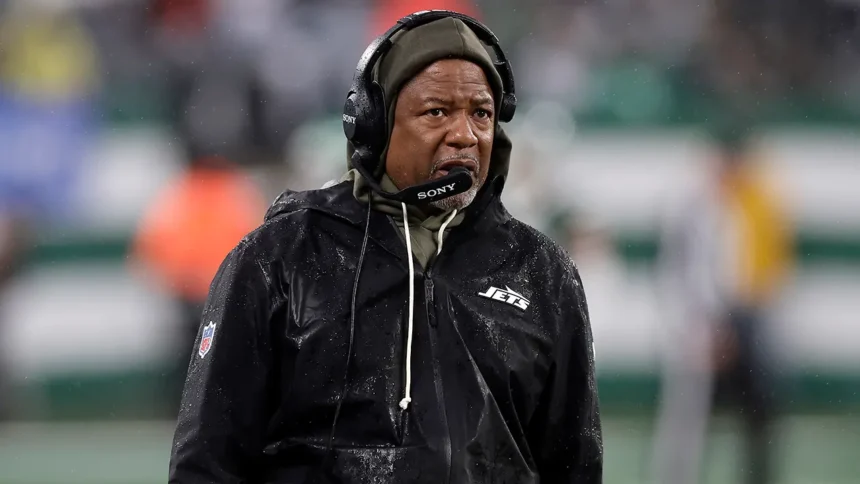
The New York Jets’ 2025 season, already a cascading disaster, has entered a phase of brutal, self-inflicted reconstruction. In a stunning 24-hour period that has reshaped the franchise’s immediate future, the Jets executed a one-two punch of desperation and concession, firing defensive coordinator Steve Wilks and trading away their best defensive player, All-Pro defensive tackle Quinnen Williams. This dual seismic event signals an organization in full panic mode, scrambling for answers after a humiliating 48-point surrender to the Jacksonville Jaguars and waving a white flag on the current campaign.
A Defensive Collapse Leads to a Coordinator’s Demise
The immediate catalyst for the upheaval was a defensive performance so putrid it forced first-year head coach Aaron Glenn’s hand. Despite his defensive pedigree and previous public backing of Wilks’ system, Glenn could not survive the fallout from Sunday’s debacle. Trevor Lawrence and the Jaguars’ offense sliced through the Jets’ defense with ease, a fitting climax to a season-long trend of failure.
Steve Wilks, a veteran coach with a respected resume, simply could not make it work in New York. The numbers tell a damning story:
- Points Allowed Per Game: 28.4 (Ranking in the bottom three of the NFL)
- Latest Atrocity: 48 points to the Jaguars, the highest single-game total surrendered this season.
- Scheme Disconnect: Persistent reports of players struggling with complex calls and being out of position.
“I believe in the players in that room, and I believe we need a new voice leading them for these final three games,” Glenn stated in a terse Monday announcement, a stark reversal from his earlier vote of confidence. The promotion of defensive backs coach Chris Harris to interim coordinator is a clear attempt to simplify the message. Harris, a former player and rising coaching mind, is tasked with the impossible: instilling pride and basic competency into a unit that has been stripped of its cornerstone.
The Quinnen Williams Blockbuster: Jets Wave the White Flag
If the Wilks firing was a reaction to on-field failure, the trade of Quinnen Williams is a franchise-altering decision that screams of a painful rebuild. Sending a 25-year-old, homegrown, elite talent to the Dallas Cowboys for a single first-round pick is a move that will define the Jets’ front office for years to come.
For the Jets, this is a pure asset play. Williams is in the heart of a massive contract, and on a team now clearly looking beyond 2025, his value as a trade chip outweighed his value as a player for a non-contender. It is a sobering admission that the roster, as constructed, is hopelessly far away. The return—a future first-rounder—gives General Manager Joe Douglas ammunition, but it leaves a gaping, unmatchable hole in the defensive line.
For the Dallas Cowboys, the calculus is win-now aggression. As noted by FOX Sports analyst Colin Cowherd, “This is Jerry Jones seeing a window and kicking it in. You don’t acquire a player like Quinnen Williams to get marginally better; you do it to transform your defense from good to dominant for a Super Bowl run.” Williams immediately becomes the most disruptive interior force the Cowboys have had in a generation, a game-wrecker who demands double teams and will free up Micah Parsons in terrifying new ways. The price of a first-round pick is steep, but for a contender in “all-in” mode, it’s a justifiable cost for a proven, young superstar.
Expert Analysis: A Franchise at a Crossroads
This twin decision reveals a schism in the Jets’ short-term planning. Firing Wilks is, theoretically, an attempt to salvage something—pride, evaluation, culture—from the final three games. It’s a move for the locker room. Trading Williams, however, is a move for the draft board and the 2026 ledger. The conflicting signals create a fog of uncertainty.
Aaron Glenn’s credibility is now on the line. Coming from a defensive background, hiring Wilks was his signature staff decision. Firing him mid-season admits a major miscalculation. Can Glenn, who must now oversee a stripped-down defense led by his positional coach, truly command the room? Or does this sequence of events suggest his own seat is warming rapidly?
The promotion of Chris Harris is an intriguing subplot. These final three games are an extended audition. If the defense shows even modest improvement with simplified schemes and energized play, Harris could very well remove the “interim” tag. He represents a potential new direction: a younger, communicator-style coach for a unit that will be rebuilt with youth.
Predictions and the Road Ahead for New York
The immediate future for the Jets is bleak. The defense, already struggling, has lost its best player. The offense remains anemic. The final three games of 2025 risk becoming a weekly embarrassment, a parade of opponents running up the score on a demoralized and talent-depleted squad.
- Short-Term (Final 3 Games): Expect continued struggles. Harris will try to establish fundamentals, but the talent drain is real. The focus shifts entirely to evaluating young players for 2026.
- Offseason: The Jets will be major players in free agency and the draft, armed with extra capital. Every move will be scrutinized through the lens of the “Post-Williams Era.” The pressure on Joe Douglas to hit on that acquired first-round pick is immense.
- For Aaron Glenn: 2026 becomes a prove-it year. He must identify a permanent DC, likely Harris, and show tangible progress. The goodwill from his hiring is evaporating.
- For Dallas: The Cowboys are unequivocally better today. The NFC should be on high alert. This trade makes them a more complete and fearsome contender, validating their “go for it” mentality.
Conclusion: The Price of Failure
The New York Jets’ 2025 season will be remembered not for wins, but for the day the dam broke. Steve Wilks taking the fall for a systemic defensive failure was predictable. Trading Quinnen Williams was not. Together, they paint a picture of an organization so shaken by its own ineptitude that it is willing to tear down its strongest pillar.
This is the high price of chronic failure. It leads to rash in-season firings and painful, franchise-altering trades. While the Dallas Cowboys celebrate acquiring a defensive centerpiece for a championship push, the Jets are left sifting through the rubble, hoping the draft picks and cap savings from this dark day will someday lead them out of a darkness they have, yet again, deepened themselves. The message is clear: in the NFL, if you are not progressing, you are not just losing games—you are dismantling your own foundation.
Source: Based on news from Fox Sports.