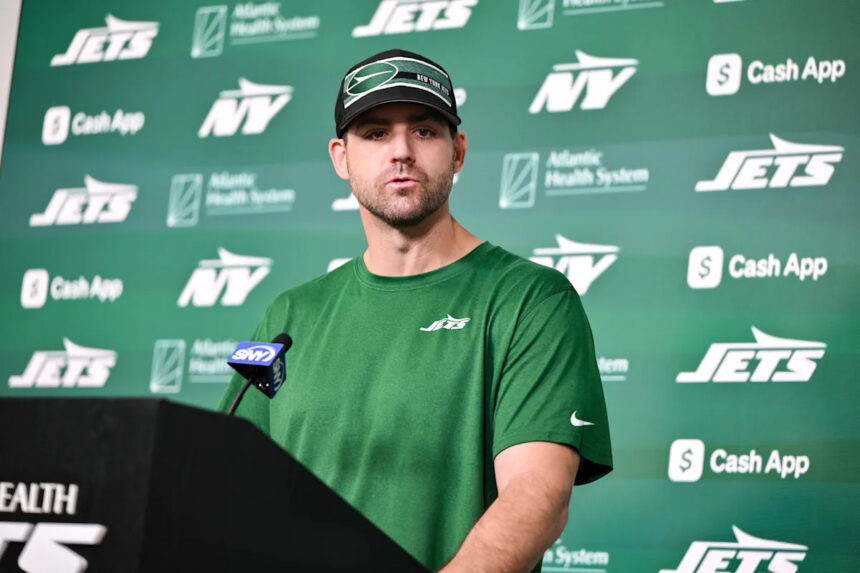
Jets Clean House: Offensive Coordinator Tanner Engstrand Dismissed After Disastrous Season
The winds of change are howling through One Jets Drive with a familiar, bitter chill. In the wake of a catastrophic 3-14 season—tying the mark for the worst record in franchise history—the New York Jets have initiated a painful but necessary reckoning. The first major domino to fall is offensive coordinator Tanner Engstrand, who was relieved of his duties on Tuesday after just one season. This move signals the start of another offensive rebuild for a franchise that has become synonymous with quarterback purgatory and offensive ineptitude, a 15-year playoff drought hanging over every decision.
A Statistical Nightmare: The Engstrand Offense by the Numbers
The decision to part ways with Tanner Engstrand, while abrupt, is underscored by a body of work that ranked among the league’s most anemic. Hired to modernize and energize a unit that has long been the team’s Achilles’ heel, Engstrand’s scheme instead produced a product that was not only ineffective but historically bad in key areas. The statistics paint a bleak picture of an offense that failed to function in the modern NFL.
The passing attack was nothing short of a disaster. The Jets finished dead last in the NFL in passing yards, a stunning indictment of the entire aerial operation. They were also 31st in passing touchdowns and 26th in pass attempts, suggesting an offense that couldn’t throw effectively and, at times, seemed hesitant to even try. This left the Jets one-dimensional and predictable, a fatal flaw in today’s pass-happy league.
- 32nd in Passing Yards (League Worst)
- 31st in Passing Touchdowns
- 26th in Pass Attempts
- Consistently poor on third down and in situational football
While the ground game, spearheaded by the relentless Breece Hall and his 1,065-yard season, provided a glimmer of competency, it was a band-aid on a gaping wound. The offense’s inability to sustain drives through the air ultimately rendered the run game a complementary piece in a system with nothing to complement.
Beyond the Coordinator: A Perfect Storm of Failure
To place the entirety of the Jets’ offensive collapse at the feet of Tanner Engstrand would be an oversimplification. His dismissal is a symptom of a broader, systemic failure that has plagued this organization for years. The 2025 season represented a perfect storm of misguided personnel decisions, poor performance, and perhaps, flawed vision.
The most glaring issue was the Justin Fields experiment. Signed to a two-year, $40 million “prove-it” deal in free agency, Fields was brought in to be the dynamic dual-threat answer at quarterback. Instead, his struggles with processing, accuracy, and consistency from his days in Chicago followed him to Florham Park. Fields failed to elevate the offense, locking onto reads and missing opportunities, which exacerbated the shortcomings of the scheme and the supporting cast. The offensive line, a perennial trouble spot, again failed to provide a stable foundation, dealing with injuries and inconsistent play.
This context is crucial. An offensive coordinator can only work with the tools he is given, and the Jets’ tools were demonstrably flawed. However, the role of a coach is also to scheme around weaknesses and maximize strengths—a task at which Engstrand’s offense clearly failed. Reports from SNY’s Connor Hughes indicate the organization debated keeping Engstrand in a reduced role before deciding a clean break was essential, highlighting the internal conflict over where exactly the blame should lie.
The Road Ahead: What’s Next for the Jets’ Offense?
With Engstrand out, the Jets now embark on their most critical offseason mission: finding an offensive coordinator who can break a curse. This hire is arguably more important than any draft pick or free-agent signing. The candidate must possess a clear, adaptable philosophy and a proven track record of developing quarterbacks, because whoever is under center in 2026 will need significant guidance.
The new OC will inherit some pieces. Breece Hall is a bona fide star. The offensive line has young talent that needs development. The second overall pick in the 2026 NFL Draft presents a monumental opportunity. The Jets are positioned to select a blue-chip quarterback prospect or trade the pick for a haul to build the roster more comprehensively. This decision will directly shape the offensive coordinator search.
Potential candidates will likely include experienced play-callers with a history of QB development, as well as innovative minds from the collegiate ranks. The Jets must ask: Do we hire a coordinator to tailor a system to a rookie QB, or do we find a visionary and then draft the QB that fits his mold? There is no margin for error.
A Franchise at a Crossroads
The firing of Tanner Engstrand is more than a simple coaching change; it is the first admission of a failed season and a failed plan. It represents the Jets’ perpetual cycle of hope, disappointment, and reboot. For a fanbase weary of promises, this move will be judged not on its own, but by what follows.
The 2026 offseason is the franchise’s most pivotal in over a decade. Armed with the No. 2 pick, significant cap space, and a defensive core that remains formidable, the foundation for a turnaround exists. However, that foundation crumbles without a functional offense. The next offensive coordinator must be a home run hire. He must install a system that is both creative and fundamentally sound, one that can protect a young quarterback or optimize a veteran, and one that can finally, after years of darkness, score points in the AFC East.
The Jets have torn down the latest failed blueprint. The pressure is now on the front office to architect a new one that can finally withstand the pressure of New York expectations and end the longest active playoff drought in the NFL. The search for an offensive identity, and for relevance, begins anew.
Source: Based on news from Yahoo Sports.