Gold Medals and Political Divides: Olbermann’s Critique Ignites Debate Over Sports and State
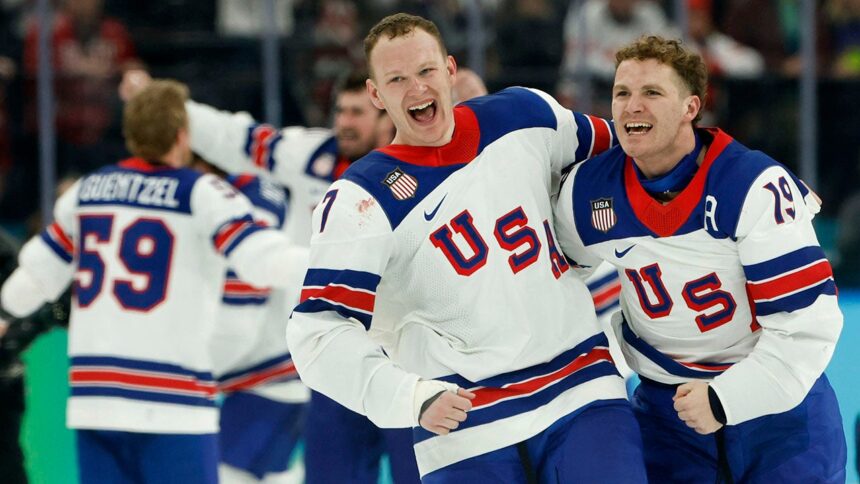
The final buzzer in Beijing echoed with a historic triumph for USA Hockey. For the first time since the “Miracle on Ice” in 1980, the U.S. Men’s National Team stood atop the Olympic podium, gold medals around their necks after a thrilling victory over rival Canada. Yet, in a stark reflection of modern America, the celebration of pure athletic achievement was swiftly overshadowed by a political firestorm. The catalyst? An invitation to the State of the Union address and the scathing criticism from veteran broadcaster Keith Olbermann, who drew a sharp line between the men’s and women’s teams based on their responses to President Donald Trump.
From Olympic Glory to Political Arena
The narrative was supposed to be simple: dual golds, a resurgence for American hockey. Both the men’s and women’s teams secured their victories in dramatic fashion, with Jack Hughes scoring the overtime winner for the men and Megan Keller doing the same for the women, each defeating Canada. In a traditional gesture of recognition, President Trump extended invitations to both champion teams to attend his State of the Union address.
The responses, however, diverged. The U.S. Women’s Hockey Team, through USA Hockey, respectfully declined, citing “previously scheduled academic and professional commitments.” The statement emphasized gratitude but offered a clear, logistical reason for their absence. The men’s team, conversely, indicated a willingness to accept the honor. This divergence became the kindling for a broader cultural debate.
Sports media personality Colin Cowherd immediately framed the men’s win within the iconic shadow of 1980, asking how America should contextualize this new victory. But it was Keith Olbermann who shifted the conversation entirely from the ice to the ideological battleground.
Olbermann’s Broadside: “Moral Compass” vs. “Photo Op”
Never one to mince words, Olbermann launched a pointed critique aimed squarely at the men’s team. He applauded the women’s team for their decision, implicitly framing it as a principled stand, while ridiculing the men for their desire to attend. His commentary suggested a stark contrast in values:
- Women’s Team Principled Decline: Olbermann portrayed their cited commitments as a dignified refusal, aligning with a perception of the team’s longstanding advocacy for equity and social consciousness.
- Men’s Team Eager Acceptance: He framed their willingness to go as a quest for a “photo op,” lacking the same moral fiber, and inherently endorsing the Trump administration.
This analysis, while compelling to his audience, oversimplifies a complex situation. It presumes political motive in the women’s polite, schedule-focused decline and assigns a monolithic political endorsement to the men’s acceptance of a presidential invitation—an honor historically extended to championship teams by administrations of both parties. Olbermann’s take transforms athletic recognition into a political litmus test, a move that is both his brand and a sign of the times.
Deconstructing the Dual Narratives
To understand the full scope of this controversy, one must separate the threads of sportsmanship, protocol, and politics.
The Historical Precedent: Championship teams visiting the White House or being recognized at the State of the Union is a long-standing, bipartisan tradition. It is designed to honor national achievement, not necessarily to signal the athletes’ political alignment. The politicization of this tradition is a relatively recent phenomenon.
The Practical Reality: The women’s team reference to academic and professional commitments is highly credible. Many players are in college or have urgent obligations with their professional clubs overseas. The men, primarily NHL prospects or veterans, may have had more flexible immediate schedules post-Olympics.
The Unspoken Context: The U.S. Women’s Hockey Team has a storied history of activism, most notably their 2017 boycott for equitable support and wages from USA Hockey. Their collective identity is intertwined with advocacy. The men’s team, a quickly assembled Olympic roster, lacks that same unified activist history. Olbermann’s critique leverages this contextual difference to make a political point, implying the women’s decline is an extension of their advocacy, while the men’s acceptance is a betrayal of it.
The Media’s Role: Figures like Olbermann and Cowherd operate as narrative engines. Cowherd sought to place the win in historical sports lore. Olbermann placed it in the contemporary culture war. Both generate engagement, but Olbermann’s approach directly injects partisan division into the heart of a sporting achievement.
Expert Analysis: The New Playing Field for Athletes
The Olbermann incident is not an outlier; it is the new normal. Sports journalists and analysts now operate in an environment where political commentary is expected, and audience loyalty is often built on shared ideological perspectives. The athlete’s role has also evolved. They are no longer just competitors; they are brands and, increasingly, social voices.
“What we are witnessing is the complete erosion of the neutral zone between sports and politics,” says Dr. Elena Harris, a sociologist specializing in sports media. “The invitation from the President is now a Rorschach test. Where some see an honor for the nation, others see an implicit endorsement of a political figure. The athletes, often unprepared for this dimension, are caught in the crossfire. Olbermann’s reaction is a performative enforcement of a political expectation onto athletes.”
This places teams in an impossible bind. Any decision—to attend, to decline politely, to decline loudly—is parsed for hidden meaning and amplified by media figures with large platforms. The pure celebration of a gold medal victory over Canada becomes secondary.
Predictions: The Lasting Impact on Sports Culture
This event is a harbinger of trends that will define sports media and fandom for the foreseeable future:
- Hyper-Politicization of Honors: The tradition of White House visits will continue to be a point of contention, forcing teams to make calculated PR decisions rather than simply accepting communal recognition.
- Audience Fragmentation: Fans will increasingly gravitate to media personalities like Olbermann or Cowherd who reflect their worldview, further entrenching political divides within sports discourse.
- Athlete Preparedness: Teams and agencies will likely implement more media and PR training for athletes, not just for on-field performance but for navigating the political implications of their public appearances.
- Legacy of the 2022 Golds: Sadly, the conversation around these hard-fought victories may be permanently tinged with this political controversy, overshadowing the on-ice heroics of Hughes, Keller, and their teammates.
Conclusion: A Victory Sidelined
The U.S. men’s and women’s hockey teams achieved identical, magnificent feats in Beijing. They both ended gold medal droughts, both defeated their archrival in overtime, and both represented their country with excellence. Yet, the aftermath reveals an America where common ground is as elusive as a breakaway against a locked-in goalie.
Keith Olbermann’s ridicule of the men’s team, while championing the women, is a potent symbol of this division. It frames a presidential invitation, once a unifying civic ritual, as a partisan act. It assigns motive where there may be none and creates heroes and villains out of athletes who simply wanted to win a hockey game.
The true loss here is for the athletes and the fans. The shimmer of the Olympic gold medal is dimmed by the glare of the political spotlight. The question posed by Colin Cowherd—”How should America feel about their team?”—has been answered in the discord. We feel divided. And until the final buzzer sounds on this era of hyper-partisanship, even the purest sporting achievements will be forced to skate through a gauntlet of political interpretation.
Source: Based on news from Fox Sports.