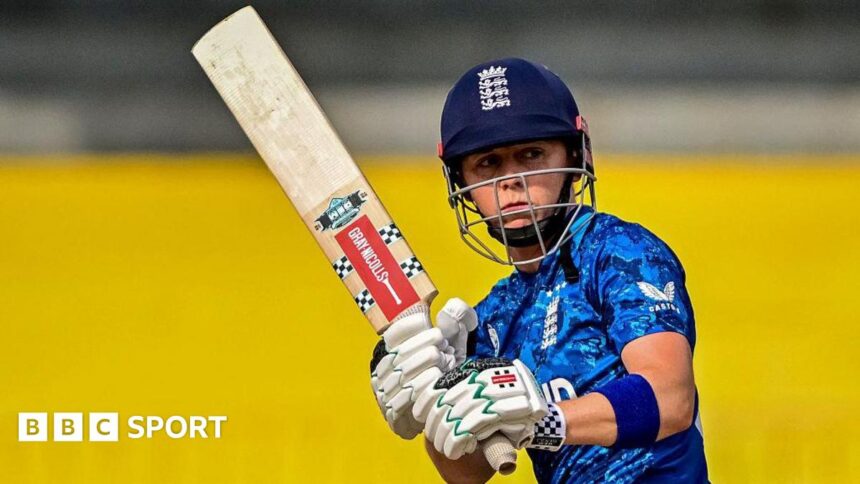
Knight’s New Dawn: Why England’s T20 World Cup Legacy Must Eclipse the 2017 Glory
Heather Knight has never been one to rest on her laurels. As she prepares to lead England into a historic home T20 World Cup, the 35-year-old captain is carrying more than just the weight of a trophy. She is carrying the weight of a legacy that, by her own admission, was left partially unfinished. Seven years after she hoisted the 50-over World Cup trophy at a sun-drenched Lord’s, Knight is demanding that this summer’s tournament does not just repeat history—it must fundamentally transform it.
The countdown is officially on. In just 50 days, England will open their campaign against Sri Lanka at Edgbaston. But for Knight, who made her 300th international appearance during last year’s tournament in India, this is more than a milestone. It is a second chance to write a defining chapter for women’s cricket in the UK.
The 2017 Hangover: A Triumph That Wasn’t Capitalised
Let’s be clear: England’s 2017 World Cup win was a seismic moment. A sold-out Lord’s, a dramatic victory over India, and a surge of public interest that felt like a watershed. Yet, looking back, Knight is brutally honest about what followed. “I think there probably wasn’t the structure in place to really maximise it in 2017,” she told BBC Sport. “Obviously domestic cricket in this country wasn’t professional.”
That lack of infrastructure meant the momentum was fleeting. The 2017 triumph was a brilliant explosion of talent, but the fuse wasn’t long enough to sustain the fire. The domestic game remained semi-professional, pathways were narrow, and visibility waned. Knight watched as other nations, particularly Australia, built professional ecosystems that turned their World Cup success into a dynasty. England, by contrast, had the trophy but not the scaffolding.
Fast forward to 2025, and the landscape is unrecognisable. The introduction of The Hundred, the fully professional domestic regional structure, and record-breaking broadcast deals have created what Knight calls “real scaffolding.” The challenge now is to ensure the World Cup is the catalyst that turns scaffolding into a permanent structure.
The Home Soil Advantage: More Than Just Crowds
Playing a World Cup on home soil is a double-edged sword. The pressure is immense, but the potential reward is exponential. Knight’s side will play in front of packed houses at Edgbaston, The Oval, and Lord’s. But the captain knows that crowd noise does not win titles—execution does.
England’s recent form has been a mixed bag. They reached the semi-finals of the 2023 T20 World Cup in South Africa but were outclassed by Australia. However, the squad now boasts a blend of seasoned warriors and explosive youth. Players like Alice Capsey, Sophie Ecclestone, and Nat Sciver-Brunt provide the firepower, while Knight’s own leadership provides the composure.
The key difference this time? Depth. In 2017, England relied heavily on a core group. Today, Knight can rotate a squad where the 11th player is a genuine match-winner. The professionalism of the domestic game has raised the floor and the ceiling. “We’re in a completely different place now,” Knight said. “It’s a lot more normal to be a woman in sport, which is really exciting.”
Expert Analysis: Where England Must Dominate
As a journalist covering the women’s game for over a decade, I see three critical areas where England must excel if Knight’s legacy prediction is to come true.
- Spin Dominance: Sophie Ecclestone is the best T20 bowler in the world, male or female. But she needs support. Sarah Glenn and Charlie Dean must control the middle overs. On home pitches, which may offer turn, England’s spin trio can strangle opposition batting line-ups.
- Power-Hitting Depth: The days of 140 being a winning score are over. England need to consistently post 170+. With Danni Wyatt at the top and Sciver-Brunt in the middle, the firepower is there. The question is whether the lower order can accelerate in the final five overs.
- Fielding Intensity: Australia set the standard. England have improved dramatically, but dropped catches in knockout games are fatal. Knight will demand relentless athleticism in the ring and a high catch success rate.
My prediction? England will reach the semi-finals without much trouble. The group stage, featuring Sri Lanka, South Africa, and a qualifier, is navigable. The real test comes in the knockout rounds, likely against India or Australia. If England can beat Australia on home soil, the legacy will be secured.
The Legacy Equation: Beyond the Trophy
Knight is clear that the 2025 World Cup must be measured by more than just the final scoreboard. “Hopefully we can capitalise on it a little bit more,” she said. That means grassroots participation spikes, increased sponsorship for the domestic game, and a permanent shift in media coverage.
The numbers are already promising. The ECB has invested heavily in girls’ cricket in schools, and the professional regional teams now have dedicated fan bases. But a home World Cup win would supercharge this growth. It would turn casual viewers into lifelong fans and convince sponsors that women’s cricket is not a niche product but a mainstream entertainment property.
Knight, who made her 300th international appearance during last year’s World Cup in India, understands the weight of history. She is no longer just a player; she is a symbol of the sport’s evolution. “There is that real scaffolding,” she said. “It’s a lot more normal to be a woman in sport.”
That normality is the ultimate prize. In 2017, England won the World Cup but lost the opportunity to normalise women’s cricket. In 2025, Knight has the chance to ensure that the trophy is just the beginning. The scaffolding is in place. Now, it is time to build a legacy that outlasts any single tournament.
Strong Conclusion: The Knight Era’s Defining Moment
Heather Knight is a captain who has seen the game change in front of her eyes. From semi-professional struggles to sold-out stadiums, she has been the constant. But this summer is different. It is not just about defending a title or adding another medal to her collection. It is about ensuring that the 2017 hangover is replaced by a 2025 awakening.
When England walk out at Edgbaston in 50 days, they will carry the hopes of a nation that now knows women’s cricket is not a novelty—it is a necessity. The legacy of this World Cup will not be written in the final over of the final match. It will be written in the number of girls who pick up a bat the next day, the number of broadcasters who bid for rights, and the number of young players who believe they can be the next Heather Knight.
If she wins, it will be the greatest achievement of her career. Not because of the trophy, but because of what it represents: a sport that finally has the structure to match its ambition. The 2017 triumph was a moment. The 2025 triumph must be a movement. And Heather Knight is ready to lead it.
Source: Based on news from BBC Sport.