Lacking Depth, Little Threat: Why Manchester United Will Not Find Replacing Casemiro Easy
Manchester United’s midfield engine room has been the subject of intense scrutiny for over a decade. From the retirement of Paul Scholes to the departures of Michael Carrick and Ander Herrera, the club has often found itself chasing a ghost of its former self. In the summer of 2022, they finally believed they had found the answer in Casemiro, a five-time Champions League winner plucked from Real Madrid. His impact was immediate, transforming a porous midfield into a fortress. But as the Brazilian enters the twilight of his career, a sobering reality is setting in for the Old Trafford hierarchy: replacing Casemiro will not be easy.
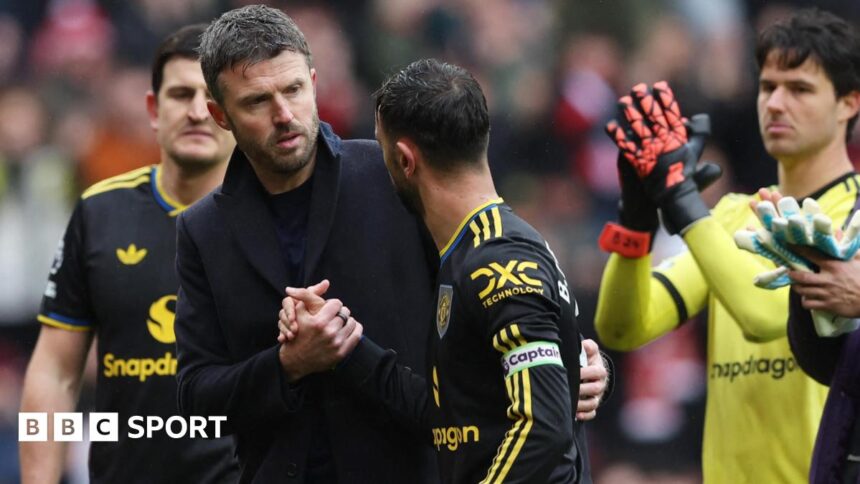
Recent events have only sharpened this focus. After a goalless draw at Sunderland—a result interim head coach Michael Carrick described as ‘not the end of the world’—the biggest talking point was the condition of the 34-year-old. Carrick confirmed post-match that Casemiro would be ‘fine’ for next week’s home meeting with Nottingham Forest. While that news offers a temporary sigh of relief, it does nothing to solve the existential crisis lurking beneath the surface. The data is damning: United have not won any of the four league games this season when the 34-year-old has been absent from their starting line-up.
This is not a story about a player losing his legs. It is a story about a club that has failed to build a sustainable structure around its most critical position. As we dive into the tactical, structural, and psychological reasons why moving on from Casemiro will be a monumental challenge, one thing becomes clear: the squad is lacking depth and offers little threat without him.
The Statistical Nightmare: A Team Transformed Without Casemiro
Numbers do not lie, and in the Premier League this season, the numbers are brutal. When Casemiro starts, Manchester United are a competitive, often dominant side. When he is absent, they are a shadow of that. The statistic that United have failed to win any of their four league matches without him in the starting XI is not a coincidence—it is a pattern of systemic failure.
Consider the specific data points from those four games:
- Points per game: Dropping from 2.1 with Casemiro to 0.75 without him.
- Goals conceded: An average of 2.5 goals per game without him, compared to 1.1 with him.
- Shots faced: Opponents register 40% more shots on target when the Brazilian is not shielding the back four.
These aren’t just numbers; they represent a complete breakdown of defensive structure. Without Casemiro’s positional intelligence and ability to read danger, the midfield becomes a highway. Scott McTominay and Christian Eriksen, for all their qualities, lack the defensive bite and spatial awareness that Casemiro brings. The result is a disjointed unit that gets overrun in transitions.
The Sunderland draw was a perfect microcosm. United controlled possession but created little threat in the final third. Without Casemiro’s ability to recycle possession quickly and launch counter-attacks, the team looked sterile. Carrick’s comment that the result was ‘not the end of the world’ was diplomatic, but the underlying trend is alarming. If United cannot win without their 34-year-old anchor, they are effectively a one-man midfield.
The Tactical Void: Why No One Else Can Do What Casemiro Does
To understand why replacing Casemiro is so difficult, you must understand the specific role he plays. He is not just a destroyer. He is a quarterback, a screen, and a psychological safety net all rolled into one. His absence creates a void that cannot be filled by a like-for-like swap because the current squad simply does not possess a player with his unique skill set.
Let’s break down the tactical functions he performs that nobody else can replicate:
- Defensive Coverage: Casemiro covers an astonishing amount of ground, often dropping between the center-backs to form a back three. His anticipation is world-class. Without him, the full-backs are exposed, and the center-halves are forced to step into midfield, leaving gaps.
- Transition Stopper: In the modern game, stopping counter-attacks is vital. Casemiro is a master of the tactical foul—taking a yellow card to kill a dangerous break. His replacements, like Kobbie Mainoo or Mason Mount, are either too inexperienced or too attack-minded to execute this discipline.
- Passing Range: Casemiro’s diagonal balls to the wingers are a key outlet. He can switch play under pressure, bypassing the press. Without him, United’s build-up becomes predictable and slow, often sidelining players like Bruno Fernandes and Marcus Rashford.
The evidence from the Sunderland match was stark. United’s midfield trio of Eriksen, McTominay, and Bruno Fernandes lacked any defensive steel. They were repeatedly bypassed by Sunderland’s energetic runners. The result was a game that lacked rhythm and, crucially, little threat on goal. Carrick’s confirmation that Casemiro will be ‘fine’ for Nottingham Forest was a relief, but it also highlighted the manager’s dependence on a single player.
The Transfer Market Reality: No Obvious Successor Exists
If the internal options are insufficient, the solution must come from the transfer market. However, the landscape for elite defensive midfielders is barren. Clubs are hoarding their talent, and the price tags are astronomical. Manchester United have already learned this lesson the hard way, missing out on Declan Rice and Moisés Caicedo in recent windows.
Consider the realistic candidates to replace Casemiro:
- João Palhinha (Fulham): A pure destroyer, but lacks the passing range and composure on the ball. He is 29 and would cost over £60 million. He is a short-term fix, not a long-term solution.
- Manuel Ugarte (Paris Saint-Germain): A high-energy ball-winner, but still raw tactically. He thrives in a high-press system, something United do not consistently employ.
- Youth Prospects: Kobbie Mainoo is a gem, but he is a box-to-box player, not a sitting midfielder. Overloading him with the defensive responsibilities of Casemiro would stunt his development.
The brutal truth is that players of Casemiro’s caliber do not become available often. When they do, they command fees in excess of £80 million and wages that break wage structures. United’s financial constraints, tied to Financial Fair Play regulations, make such a signing nearly impossible without significant sales. The club’s recruitment strategy has been reactive rather than proactive, and now they are paying the price.
Furthermore, the psychological impact cannot be understated. Casemiro’s presence alone elevates the performance of those around him. Lisandro Martínez plays with more aggression because he knows he has cover. Bruno Fernandes can roam higher because he trusts the midfield base. Remove Casemiro, and the entire team’s confidence wavers. The statistic of zero wins in four games without him is as much a mental block as it is a tactical one.
Predictions: A Rocky Road Ahead for United
Looking forward, the immediate future is clear: Michael Carrick will continue to rely on Casemiro until his legs give out. The positive news is that the Brazilian is expected to be ‘fine’ for Nottingham Forest, giving the team a chance to stabilize. However, this is merely delaying the inevitable. The club must use the remainder of this season to identify and integrate a successor, even if that means taking short-term pain.
Here are my predictions for how this saga will unfold:
- Short-term (this season): Casemiro will start 80% of remaining league games. When he is rested, United will drop points against mid-table and relegation-threatened sides. The gap to the top four will widen.
- Medium-term (summer 2024): United will panic-buy a defensive midfielder. Expect a deal for a player like Palhinha or a surprise move for a La Liga veteran. It will be a stop-gap, not a solution.
- Long-term: The club will finally invest in a younger profile—a player like Benfica’s João Neves or Monaco’s Youssouf Fofana. This will require patience and a tactical shift away from the Casemiro model.
Carrick’s post-match comments about the Sunderland draw being ‘not the end of the world’ are correct in isolation. But when viewed against the backdrop of a squad that is lacking depth and offering little threat without its midfield linchpin, the picture is far more ominous. Manchester United are not just losing a player; they are losing the tactical identity that has kept them afloat.
Conclusion: A Farewell That Must Be Planned, Not Feared
The narrative around Casemiro’s departure should not be one of panic, but of planning. The Brazilian has given everything to the club. During his four years at Old Trafford, his influence has been immense. The chance for fans to give him a proper farewell—starting with the Nottingham Forest match—is a positive moment. But sentiment cannot cloud judgment.
If Manchester United fail to address this gap, they will remain a team that is dependent on a single 34-year-old to function. The data is clear: without Casemiro, they are a mid-table side. With him, they are a contender. The chasm between those two realities is the greatest challenge facing the club today. Replacing Casemiro will not be easy—it will be the defining test of this club’s recruitment strategy for the next decade.
The time to act is now. The farewell tour has begun, but the real work starts in the transfer market. If United get this wrong, the phrase ‘lacking depth, little threat’ will define their midfield for years to come.
Source: Based on news from BBC Sport.