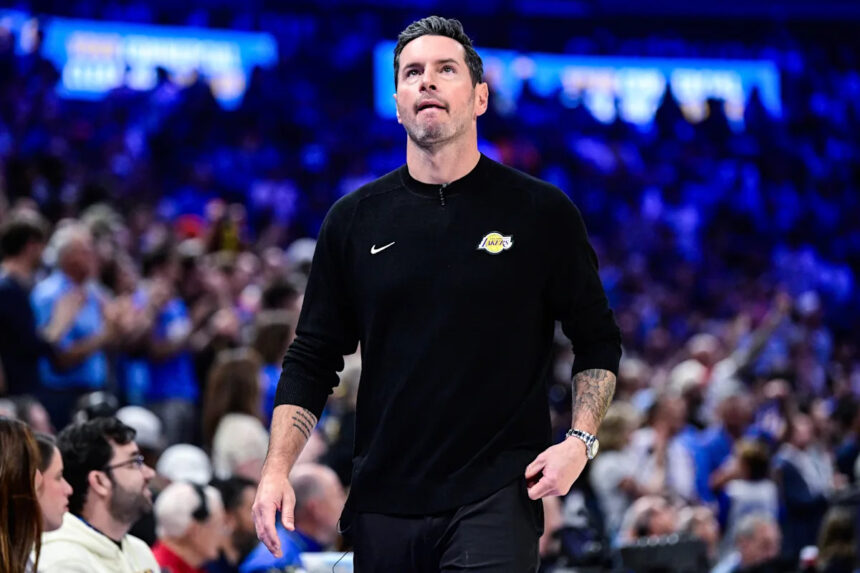
Lakers’ Sideline Sparks: JJ Redick, Jarred Vanderbilt Clash Highlights Team’s Pressure Cooker
The Los Angeles Lakers’ season, a turbulent quest for consistency, produced another viral moment Tuesday night. In a flash of raw emotion, rookie head coach JJ Redick and forward Jarred Vanderbilt engaged in a heated, mid-game shouting match, a confrontation that required intervention from teammates and staff. While the clip instantly ignited social media speculation about locker room fractures, Redick swiftly moved to douse the flames, framing the incident as standard NBA fare. But in the high-stakes crucible of Hollywood, where every misstep is magnified, the question remains: was this truly “normal stuff,” or a symptom of deeper pressures engulfing the fledgling Redick era?
A Tense Timeout: Breaking Down the Confrontation
The incident erupted with startling speed during the Lakers’ game against the Oklahoma City Thunder. Just 16 seconds into the second quarter, Redick signaled for a timeout and immediately removed Vanderbilt from the contest. Clearly frustrated, Vanderbilt approached his coach on the floor as the teams headed to their benches. The exchange escalated quickly, with both men becoming demonstrative. The situation grew tense enough that injured guard Austin Reaves and veteran assistant coach Nate McMillan physically stepped between the two, a rare visual of on-court mediation.
This wasn’t a quiet disagreement. It was a visible, vocal argument, capturing the attention of fans, cameras, and opponents alike. In the moment, it represented a stark break from the typical stoicism of an NBA sideline. For a team already battling significant injury woes and fighting to stay in the Western Conference play-in picture, the timing seemed particularly inopportune.
Redick’s Rationale: “Normal Stuff” or Necessary Discipline?
In his post-game remarks, JJ Redick was deliberate in his downplaying of the event. He attributed the clash to a “confluence of things,” refusing to publicly air the specific basketball mistake that triggered Vanderbilt’s removal. His central message was one of normalization and context.
“Nothing personal with him,” Redick stated. “Normal stuff from my end. I think for all of us, being undermanned, we’ve got to scrap and claw. We’ve got to all be on the same page.”
This defense is a fascinating glimpse into Redick’s coaching philosophy. By calling it “normal,” he accomplishes several things:
- Establishes Authority: It reinforces that his decisions, even unpopular ones, are non-negotiable.
- Deflects Drama: It refuses to feed the media narrative of internal discord.
- Contextualizes Pressure: It ties the emotion directly to the stressful circumstances of an injury-depleted team fighting for its season.
However, the very need for intervention from Reaves and McMillan suggests the emotional temperature exceeded that of a typical coach-player correction. It walks a fine line between intense accountability and combustible friction.
Expert Analysis: The Subtext Behind the Shouting
To understand this incident, one must look beyond the shouting. Several critical factors are at play. First, JJ Redick is not a typical rookie coach. He arrived with zero professional coaching experience, armed with a renowned basketball IQ and a direct communication style honed on his podcast. His relationship with star LeBron James is well-documented, but managing a full roster, particularly veterans and role players, is a different challenge. This incident tests his ability to navigate in-game emotional management with players beyond the superstar core.
Second, Jarred Vanderbilt is a quintessential “energy and effort” player. His value is not in plays called for him, but in defensive disruption, rebounding, and hustle. Being pulled just 16 seconds into a quarter likely felt like a critique of his effort or understanding—the core of his identity on the floor. For a player of his style, that can be a particularly potent trigger.
Finally, the Lakers’ precarious position cannot be overstated. Every game carries immense weight. For a coach trying to instill a new system and culture, the margin for error—both in play and player focus—is vanishingly thin. Redick’s quick hook and forceful reaction may have been a calculated message to the entire team: lapses, mental or physical, will not be tolerated, regardless of the opponent or the score.
Predictions: How This Moment Impacts the Lakers’ Trajectory
The long-term impact of this confrontation will be determined not by the argument itself, but by what follows. History shows these moments can catalyze a team in two diametrically opposed ways.
Scenario 1: A Rallying Point. If handled with maturity in the locker room, this could serve as a pressure-release valve and a demonstration of Redick’s passionate standards. It could galvanize the undermanned Lakers to “scrap and claw” with a renewed, unified purpose. The public resolution—a handshake, a cleared-air film session—could strengthen trust, showing that intense conflict can exist within a professional framework without becoming personal.
Scenario 2: A Fracture Line. If the discontent simmers, it could begin to erode Redick’s credibility with the roster, particularly with role players. It may feed a narrative of a coach still learning on the job during a win-now season. The key will be Vanderbilt’s integration moving forward. If his minutes diminish or his engagement wavers, it will signal that the rift was deeper than advertised.
Our prediction leans toward the first scenario. The immediate, public downplaying by Redick was a smart first step. The presence of leaders like Reaves and McMillan intervening shows a protective infrastructure within the team. In the grueling NBA grind, especially for a team in the Lakers’ stressful position, emotional eruptions are, as Redick claimed, more normal than fans realize. The true test is the response.
Conclusion: Passion Under the Microscope
The shouting match between JJ Redick and Jarred Vanderbilt was a 30-second snapshot of a season-long pressure cooker. While Redick’s label of “normal stuff” may seem dismissive to outsiders, it reflects the high-stakes, high-emotion reality of professional sports. This incident is less about personal animosity and more about the immense stress on an injury-depleted team and a first-year coach determined to establish his standards in real-time.
For the Lakers, the path forward is clear. They must channel this raw passion into their collective “scrap and claw.” The confrontation has laid bare the intensity of the moment. Now, it must be forged into a tool for unity, not a wedge for division. In the relentless spotlight of Los Angeles, where every gesture is analyzed, Redick’s ability to transform this heated exchange into a footnote of a resilient playoff push will be one of the defining challenges of his nascent coaching career. The argument was perhaps normal. The response to it will be everything.
Source: Based on news from Yahoo Sports.