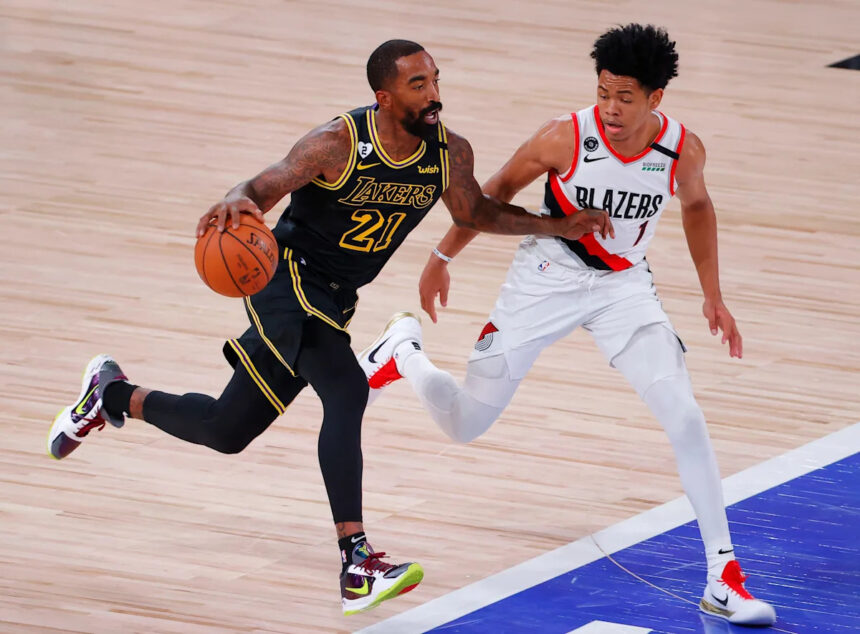
The Enigmatic Legacy: J.R. Smith and the Lakers’ No. 21 Jersey
In the sprawling, star-studded history of the Los Angeles Lakers, a franchise that boasts 506 players across eight decades, certain jersey numbers resonate with immortality. The No. 21, however, tells a different kind of story. It is a number of transient tenants, a digit worn by role players and brief stops. And in the 2020 NBA bubble, it found its most improbable and unforgettable resident: J.R. Smith. His tenure in purple and gold was a postscript to a chaotic career, a final, surreal chapter that perfectly encapsulated the enigma that was J.R. Smith—a fleeting Laker who arrived late, contributed little in the box score, yet walked away with everything.
From Prep School Phenom to Bubble Mercenary
J.R. Smith’s journey to the Lakers was anything but linear. Drafted 18th overall in 2004 straight from Saint Benedict’s Preparatory School, Smith embodied raw, unrefined athleticism and a shooter’s fearless mentality. His early years with the New Orleans Hornets and Denver Nuggets established his reputation as a prolific scoring spark plug, a human heat check capable of electrifying runs and confounding lapses in equal measure. In Denver, alongside Carmelo Anthony, he was part of offensive juggernauts that thrilled fans but fell short of the ultimate prize. His career pinnacle came in 2013 when he was named the NBA Sixth Man of the Year with the New York Knicks, validating his role as the ultimate high-risk, high-reward bench weapon.
Yet, Smith’s legacy was permanently altered in Cleveland. His infamous blunder in Game 1 of the 2018 NBA Finals threatened to define him, but it was his redemption arc and crucial shooting alongside LeBron James in the 2016 championship run that cemented his complex basketball narrative. By 2020, he was out of the league, a veteran waiting for one last call. That call came from the most storied franchise of all, under the most bizarre circumstances imaginable.
The Bubble Experiment: A Veteran’s Final Act
When the NBA created its isolation bubble at Walt Disney World to salvage the 2019-20 season, the Lakers faced a critical roster hole. Starting guard Avery Bradley opted out, leaving a need for veteran depth and shooting. The Lakers turned to Smith, reuniting him with LeBron James. The move was met with curiosity and skepticism. What could the 34-year-old Smith, who hadn’t played professionally in over a year, possibly offer a championship contender?
The on-court answer, statistically, was minimal. Smith’s regular season and playoff numbers with Los Angeles were modest, to say the least:
- Playoff Averages: 2.0 points in 7.5 minutes per game.
- Bubble Role: A deep-bench presence and situational shooter.
- Primary Contribution: Veteran savvy, locker room presence, and a known chemistry with LeBron James.
Smith appeared in only 10 playoff games, often in garbage time. His most memorable bubble moment wasn’t a shot, but a humorous press conference where he discussed the absence of fans. Yet, his presence was strategic. In a sequestered environment, the Lakers valued his playoff experience, his fearlessness, and his existing trust with James. He was a low-risk insurance policy who understood the magnitude of the moment, even if his athletic prime had passed.
Analysis: The Paradox of J.R. Smith’s Lakers Tenure
Evaluating J.R. Smith’s place in Lakers history requires looking beyond the stat sheet. He is a fascinating paradox: one of the least statistically impactful players to ever wear the uniform during a championship run, yet his chapter is rich with symbolic meaning.
Expert analysis suggests his signing was a masterclass in roster construction psychology. The 2020 bubble was an unprecedented mental grind. Adding a player who had weathered the extreme pressures of multiple NBA Finals, especially with LeBron, provided an intangible stabilizer. He was a living reminder that composure, even for a player known for lapses, can be regained. Furthermore, Smith’s journey from draft prospect to champion to pariah and back to champion is a uniquely NBA tale of resilience. His Lakers stint served as the final, quiet calibration of his career—no longer the gunner, but the grounded veteran.
In the context of the Lakers’ No. 21, Smith’s story fits a pattern. The number lacks a definitive legend. It has been worn by solid contributors like Michael Cooper (early in his career) and others like Larry Spriggs. Smith’s legacy with the number is not of sustained excellence, but of perfect timing and surreal narrative closure. He didn’t add to the Lakers’ legacy; the Lakers provided the final, glittering frame for his own chaotic highlight reel.
Legacy and Lasting Impression
J.R. Smith retired after the 2020 championship, exiting the stage as a two-time NBA champion. His Lakers episode, while brief, completed a profound personal and professional circle. He bookended his career with LeBron James, proving that their partnership, forged in fire and error in Cleveland, still held value in the most unusual of settings.
For the Lakers organization, the 2020 title is remembered for the dominance of LeBron and Anthony Davis, and the cohesive performance of the supporting cast. Smith exists on the fringe of that memory, a curious footnote. Yet, his story enhances the mythology of the bubble championship. It was a season where everything was atypical, so why not have J.R. Smith, in Lakers No. 21, celebrating on the confetti-strewn floor?
His legacy in the pantheon of Lakers is not one of greatness, but of perfect situational fit and ultimate success. He represents the myriad of players who pass through a franchise, their jerseys barely worn in, yet still become part of its tapestry. In the grand, 80-season history of the Lakers, J.R. Smith’s chapter is a short, strange, and ultimately victorious sentence. It is a testament to the fact that in the NBA, contributions come in many forms, and sometimes, just being ready for your final, unexpected call is enough to etch your name—however faintly—into history.
Source: Based on news from Yahoo Sports.