The Curious Case of No. 55: Dwayne Schintzius and His Boston Celtics Footnote
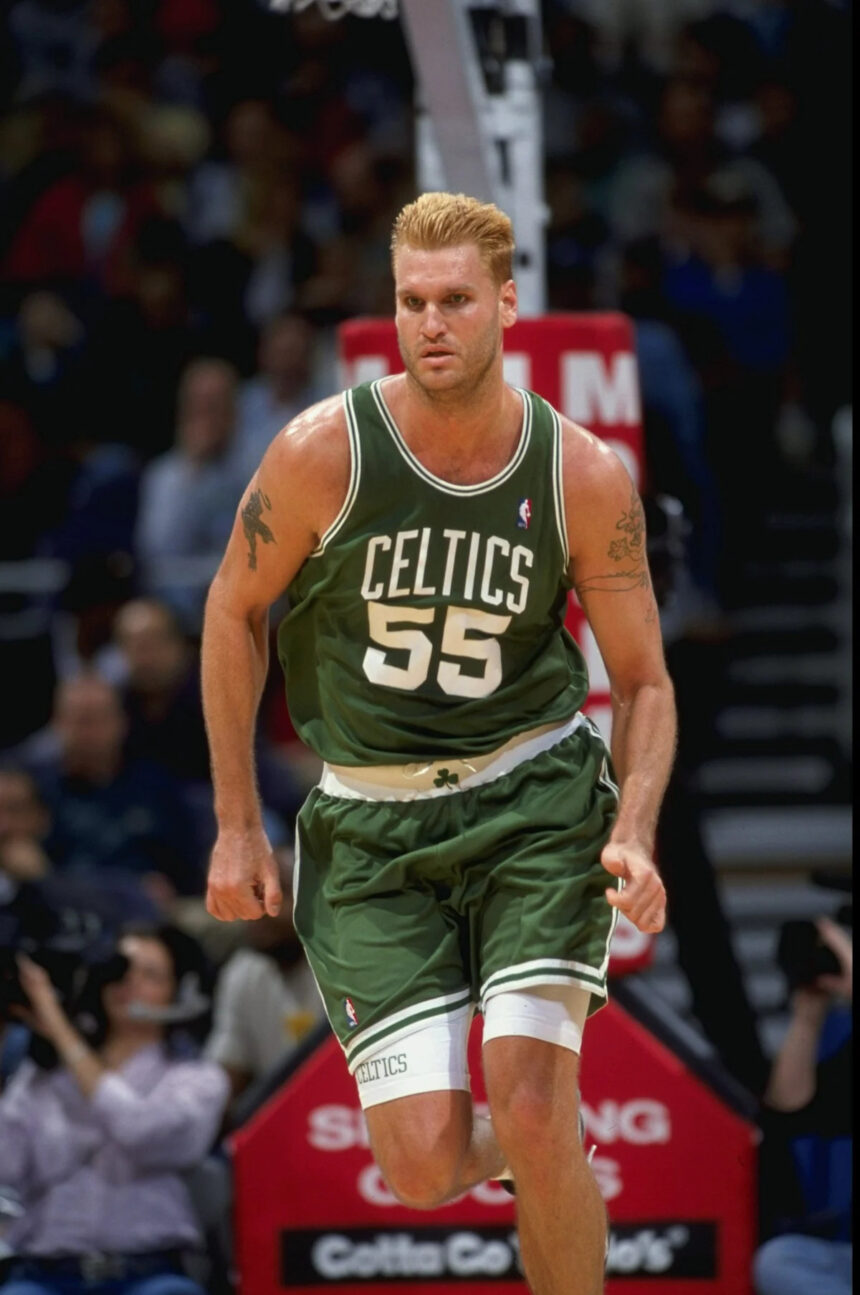
In the storied annals of the Boston Celtics, a franchise defined by its 17 championship banners and a pantheon of legends from Russell to Bird, the journey of a jersey number can be as revealing as the tale of a retired one. With 68 different jersey numbers worn by over 500 players, each digit carries a unique lineage. While 25 hang in the rafters of TD Garden, immortalizing the gods of the parquet, others weave a more human, transient tapestry of the NBA life. Today, we trace the path of one such number—No. 55—to its unexpected, and final, stop in Boston with a player whose career was as distinctive as his signature hairstyle: Dwayne Schintzius.
A Towering Talent and the Mullet That Made Headlines
Before he was a Celtic, Dwayne Schintzius was a college basketball phenomenon. At the University of Florida, the 7-foot-2 center was a force, leaving as the program’s all-time leader in blocked shots. His on-court skill was matched only by his off-court notoriety, chiefly due to his celebrated “Schintzius Mullet“—a business-in-the-front, party-in-the-back hairstyle that became his trademark. Drafted 24th overall by the San Antonio Spurs in 1990, his professional journey was a winding one. Stops in Sacramento, New Jersey, Indiana, and Los Angeles followed, each chapter marked by flashes of his soft shooting touch and passing ability for a man his size, but also by the challenges of fitting into specific systems and maintaining consistent health and focus. By the end of the 1998-99 season, Schintzius was a veteran big man looking for a final opportunity.
The Final Chapter: Schintzius Dons Celtic Green in 1999
In the lockout-shortened 1999 season, the Boston Celtics, under the new leadership of General Manager/Coach Rick Pitino, were in a state of aggressive rebuild. The roster was a mix of young prospects and veteran placeholders. On March 16, 1999, Boston signed Dwayne Schintzius as a free agent, adding size and experience to a frontcourt that included Antoine Walker and rookie Paul Pierce. Schintzius’ tenure in Boston was brief but cemented his place in the numerical history of the franchise. He became the fifth of 14 players to ever wear No. 55 for the Celtics, a number previously associated with names like Xavier McDaniel and later worn by players like Evan Turner.
His impact was minimal in the box score—appearing in just 11 games, averaging 1.5 points and 1.5 rebounds in limited minutes. But his role was archetypal of end-of-bench veterans: providing practice depth, occasional spot minutes, and a professional presence for a young team. The 1999 Celtics finished 19-31, and for Schintzius, the season marked the end of an eight-year NBA career. His legacy in Boston isn’t found in statistics or playoff heroics, but as a unique character who, for a fleeting moment, was part of the vast continuum of players who have comprised the Celtics’ ecosystem.
- Unique Distinction: Schintzius is the only player in Celtics history to wear No. 55 whose career both began and ended in the 1990s, making him a specific timestamp in team lore.
- Jersey Number Journey: No. 55, while never retired, has been worn by a fascinating array of Celtics, from enforcers to scorers, with Schintzius representing its journeyman era.
- The Pitino Era Signifier: His signing was a hallmark of the constantly churning roster of the Pitino years, a period defined by searching for the right mix to return to glory.
Expert Analysis: The Importance of the Footnote in Franchise History
Why devote attention to a player with 11 games in green? The answer lies in understanding a franchise’s full identity. Teams are not built solely on superstars; they are constructed, day by day, season by season, by the collective of all who pass through. Players like Dwayne Schintzius are essential footnotes. They represent the reality of professional sports: for every Hall of Famer, there are dozens of talented individuals who carve out careers through perseverance, adapting to roles, and seizing brief opportunities.
Schintzius’ game, at its peak, was ahead of its time. A 7-footer with three-point range and adept passing vision, he possessed the prototype skills of the modern “stretch-five” center. In today’s NBA, his skill set would be highly valued and systematically developed. His career trajectory also offers a case study in the challenges of transitioning from college stardom to the professional grind, where personality and fit become as crucial as pure talent.
Predictions: The Future Legacy of Celtics Jersey No. 55
The story of Celtics jersey No. 55 is still being written. While it will almost certainly never be hoisted to the Garden rafters, it remains an active digit in the team’s numerical rotation. Its history, including the Schintzius chapter, adds layers of texture. Future players who choose 55 will inherit a number with a quiet, eclectic history—a number of transition players, role players, and unique characters.
As the Celtics continue their pursuit of championship 18, the role players who wear numbers like 55 will be as crucial as the stars. They are the injury replacements, the defensive specialists, the locker room voices. The legacy of a number is built not just by its most famous occupant, but by the sum of its parts. Dwayne Schintzius, with his distinctive style and brief tenure, is an integral part of that sum for No. 55, a reminder that every jersey tells a story, even if it’s just for 11 games.
Conclusion: More Than a Number, A Narrative
The Boston Celtics’ history is a grand novel, with chapters dedicated to dynasties and epic battles. But the richness of that history is found in the margins, in the brief passages about the players who passed through quietly. Dwayne Schintzius’ 1999 season with the Celtics is one such passage. His time in green closes the book on an intriguing NBA career and adds a specific, human detail to the tapestry of jersey No. 55. In commemorating every player and every number, we don’t just celebrate greatness; we honor the entirety of the journey—the trials, the transitions, and the tangible connection to an era, however brief. The Schintzius saga, mullet and all, is now forever a small, original, and essential stitch in the fabric of Celtics lore.
Source: Based on news from Yahoo Sports.