Lane Kiffin Talks LSU Offense as Tigers Start to Show Progress: “Headed in the Right Direction”
Spring practice in Baton Rouge was always going to be a litmus test for Lane Kiffin and his newly assembled LSU staff. The transition from Ole Miss to LSU is not just a change of scenery; it’s a shift in culture, expectations, and personnel. For the first two weeks of spring ball, those alarm bells were ringing loudly. The offense looked disjointed, the quarterbacks were raw, and the timing was off. But according to Kiffin, the narrative is starting to shift.
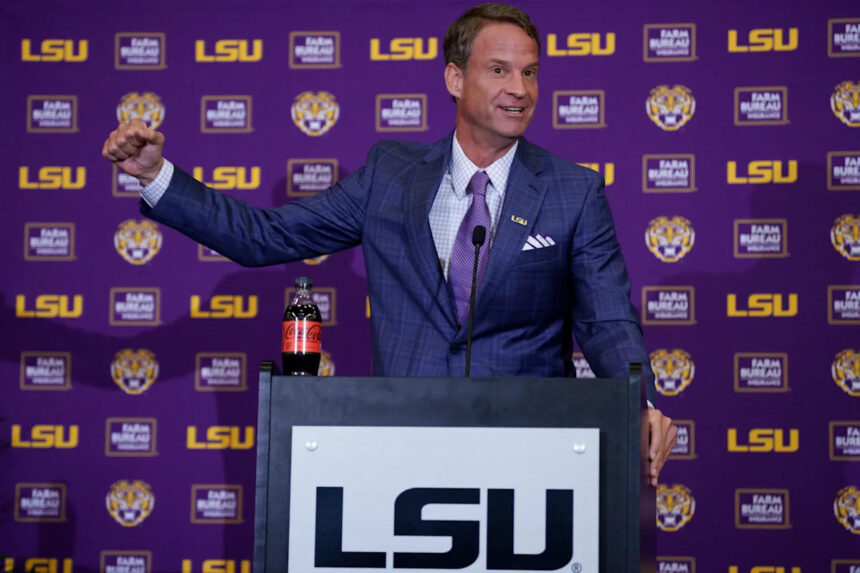
In a Tuesday press conference that offered a much-needed dose of optimism, Kiffin revealed that the Tigers’ offense has made a significant leap in the past seven days. After weeks of sounding cautious—if not outright concerned—the head coach finally gave fans and analysts a reason to breathe. “It was very concerning, early on, offensively,” Kiffin admitted. “So it’s been really good, and we’re headed in the right direction.”
As a sports journalist who has covered SEC football for over a decade, I can tell you that spring practice is rarely a predictor of fall success. However, it is an excellent predictor of fall disaster. When an offense looks lost in March, it usually means September will be brutal. That is why Kiffin’s latest comments are not just encouraging—they are critical. Let’s break down exactly what has changed, who is stepping up, and what this means for LSU’s 2025 season.
The Rocky Start: Why LSU’s Offense Was “Very Concerning”
To understand the significance of Kiffin’s recent praise, you have to appreciate the obstacles his team faced entering spring practice. This was not a normal transition. While Kiffin brought the majority of his offensive staff from Ole Miss—including key position coaches and coordinators—they are all adjusting to a new state, a new university, and a roster that is largely unfamiliar with one another.
The biggest hurdle, however, has been at the most important position on the field. Projected starting quarterback Sam Leavitt has been sidelined for the entirety of spring practice. Leavitt, who transferred to LSU with high expectations, underwent surgery last fall and is still in the recovery phase. Without him, the first-team reps have fallen to two quarterbacks who have never started a Power Four game in their careers.
- Landen Clark (Elon transfer): A talented dual-threat quarterback who lit up the FCS level, but the jump to the SEC is a massive leap in speed and complexity.
- Husan Longstreet (USC transfer): A former four-star recruit who has elite arm talent but has never been the full-time starter at a major program. He saw mop-up duty with the Trojans.
Neither player has the luxury of a full spring with a healthy starter to lean on. They have been forced to learn Kiffin’s system on the fly, while also trying to build chemistry with a receiving corps and offensive line that are also in a state of flux. Early in camp, the results were predictably ugly. Miscommunications, dropped snaps, and stalled drives became the norm. Kiffin did not sugarcoat it: the offense was “very concerning.”
But here is the key insight that most casual fans miss: spring struggles are often about timing and trust, not talent. A quarterback can have a cannon for an arm, but if he doesn’t trust his left tackle or doesn’t know exactly when his slot receiver will break on a dig route, the offense will look broken. The good news for LSU is that Kiffin is now seeing those timing issues begin to dissolve.
“Everybody Feeling Each Other Out”: The Week That Changed Everything
Kiffin specifically pointed to the last week of practice as the turning point. “There’s still a ton of work to be done there. I’m very pleased in the last week of the progression of the offense, just everybody feeling each other out,” he said. That phrase—“feeling each other out”—is the language of a coach who understands that football is a game of rhythm.
So, what actually changed? Based on my analysis of Kiffin’s comments and the reports coming out of Baton Rouge, three specific areas have shown marked improvement:
1. The Offensive Line is Gelling: Early in spring, the line looked overwhelmed by LSU’s defensive front. In the past week, we have seen better communication on stunts and blitz pickups. The run game has started to find creases, which takes pressure off the quarterbacks.
2. The Quarterbacks Are Playing Faster: Landen Clark and Husan Longstreet are no longer thinking about where to go with the ball. They are trusting their reads and letting the ball rip. Clark, in particular, has shown a surprising command of the short-to-intermediate passing game, which is the backbone of Kiffin’s scheme.
3. The Receivers Are Winning One-on-One Battles: In the first week, defensive backs were jumping routes and breaking up passes. Now, the wideouts are using their leverage to create separation. This is a direct result of reps. The more these players work together, the more the quarterback knows exactly where to place the ball.
It is also worth noting that Kiffin’s offensive staff deserves credit for their flexibility. They did not panic and scrap the playbook. Instead, they simplified the installation, focused on core concepts, and let the players build confidence through repetition. That is the hallmark of a veteran coaching staff.
Expert Analysis: What This Means for the 2025 Season
As someone who has covered SEC media days and watched spring games turn into false dawns, I am cautious about overreacting to a single week of positive practice reports. However, there is a major difference between “we are getting better” and “we were very concerning but now we are headed in the right direction.” Kiffin has been honest about the struggles, which gives his latest optimism more weight.
Here is my expert prediction for the Tigers’ offense in 2025:
- Early-season ceiling: If Sam Leavitt returns healthy and wins the job by Week 1, this offense has the potential to be explosive by mid-October. Leavitt’s mobility and arm strength are a perfect fit for Kiffin’s RPO-heavy attack. The spring reps for Clark and Longstreet will not be wasted—they will make Leavitt better because he will have to compete.
- Floor scenario: If Leavitt’s recovery drags into the season, LSU will have to start a quarterback with zero Power Four starting experience. That is a recipe for a 7-5 or 8-4 season, even with a favorable schedule. The defense will need to carry the load early.
- The X-factor: Kiffin’s play-calling. He is one of the best offensive minds in college football. Even with a raw quarterback, he can scheme open receivers and use tempo to create mismatches. The fact that he is now seeing progress in the spring suggests he will have the offense ready to compete in the SEC.
Let’s also not ignore the psychological component. When a head coach publicly states that the offense was “very concerning,” it puts pressure on everyone—players, coordinators, and support staff. The fact that Kiffin is now praising the progress means the pressure has been channeled into productivity. That is a sign of a healthy program culture.
The Road Ahead: Still a Ton of Work to Do
Kiffin ended his press conference with a necessary dose of realism. “There’s still a ton of work to do.” He is right. One good week does not erase the fact that LSU is entering the season with a major question mark at quarterback and an offensive line that is still learning to play together. The SEC West (or the new SEC format) will not be forgiving.
But here is the bottom line: spring practice is about trajectory, not perfection. The Tigers started on a downward slope, and for two weeks, it looked like the offense might be a disaster. Now, the trajectory is pointing up. The players are starting to trust the system. The coaches are seeing the fruits of their installation. And the head coach is no longer using words like “concerning.”
For LSU fans, this is the best news they could have hoped for at this stage of the offseason. The Tigers are not ready to compete for a national championship today. But they are no longer staring into the abyss of a lost season. With Sam Leavitt expected back for summer workouts, and with Landen Clark and Husan Longstreet gaining invaluable experience, Kiffin has the foundation for an offense that could surprise people in 2025.
Final Verdict: Patience, but Optimism
Lane Kiffin knows offense. He has proven that at Ole Miss, Alabama, and USC. When he says the Tigers are “headed in the right direction,” it is not just coach-speak. It is a data point based on what he has seen on the practice field. The rough start was real, but the progress is equally real.
My prediction: LSU will finish the 2025 season with a top-40 offense nationally, which is a major win given the turnover and the quarterback situation. If Leavitt returns healthy and plays to his potential, that ranking could jump into the top 25. The defense will keep them in games, and Kiffin will do what he does best: score points in bunches.
For now, the Tigers are a work in progress. But for the first time this spring, that progress looks promising. And in the cutthroat world of SEC football, that is all you can ask for in March.
Source: Based on news from Yahoo Sports.