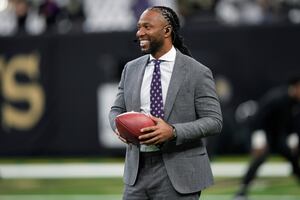
Larry Fitzgerald’s Canton Enshrinement: The Quiet Dominance Behind the NFL’s Unbreakable Records
The call to Canton is the ultimate validation, a permanent stamp on a football life well-lived. For Larry Fitzgerald, that call came in his first year of eligibility, a formality that felt less like news and more like the final, inevitable chapter of a story written over 17 brilliant seasons. His inclusion in the Pro Football Hall of Fame’s Class of 2026, alongside luminaries like Drew Brees and Luke Kuechly, officially seals his legacy. Yet, to view Fitzgerald merely as a Hall of Famer is to undersell the profound, almost silent, statistical earthquake he authored. His career wasn’t just great; it was a masterclass in sustained, physical excellence that redefined what was possible for a wide receiver, leaving a cluster of records that stand not as mere numbers, but as monuments to a unique brand of greatness.
The Ironman Aesthetic: Durability as a Superpower
In an era where the wide receiver position is increasingly defined by explosive speed and diva antics, Larry Fitzgerald built his empire on a foundation of granite. His records are not just about peak performance, but about an almost supernatural durability and consistency. To grasp the scale of his achievements, one must first understand the sheer volume of time and punishment he endured at the highest level.
Drafted third overall by the Arizona Cardinals in 2004, Fitzgerald became the face of a franchise and the steady heartbeat of its offense for nearly two decades. He played through multiple quarterback eras, offensive schemes, and coaching regimes, yet his production never wavered. His 1,432 career receptions, second only to the mythical Jerry Rice, weren’t accumulated by accident. They are the product of 17 seasons of meticulous route-running, fearless work over the middle, and an uncanny ability to maintain his body. Consider this: to reach that number, Fitzgerald averaged a remarkable 84 catches per season for his entire career. This wasn’t a flash-in-the-pan star; this was a planetary body with a constant, gravitational pull on the football.
This ironman ethos extends to his consecutive games streak and his playoff heroics, but it is crystallized in his reception total. In today’s NFL, with its increased focus on load management and passing-game volatility, the question must be asked: Is 1,432 catches an unbreakable record? Given the physical toll and the league’s constant roster churn, Fitzgerald’s mark, like Rice’s, may stand for generations as a testament to a bygone era of one-city, every-Sunday warriors.
Beyond the Volume: The Art of the Contested Catch
While the reception total speaks to volume, his 17,492 career receiving yards (also second all-time) reveal the quality and significance of each catch. Fitzgerald wasn’t just a chain-mover; he was a field-tilter. His yards were often hard-fought, coming in critical moments and against the tightest coverage. This is where Fitzgerald’s artistry separated him from his peers.
He possessed arguably the best hands in NFL history, a combination of vice-grip strength and ballet-soft touch. But his signature skill was his contested catch ability. At 6’3″ and 218 pounds, with a basketball player’s vertical leap and timing, Fitzgerald owned the airspace. He perfected the art of high-pointing the football, using his body to shield defenders and plucking balls that seemed destined for incompletion or interception. This made him the ultimate security blanket for quarterbacks from Kurt Warner to Carson Palmer. They knew that even in double coverage, throwing the ball in Fitzgerald’s general vicinity gave them a fighting chance.
- Legendary Playoff Run: This skill was never more evident than in the Cardinals’ iconic 2008-09 playoff run. Fitzgerald was utterly unstoppable, setting a single-postseason record with 546 receiving yards and 7 touchdowns, a performance capped by his iconic 64-yard touchdown in Super Bowl XLIII.
- Sixth All-Time in Touchdowns: His 121 career touchdown receptions, ranking sixth all-time, further prove he wasn’t just accumulating empty stats. He finished drives. He was the red-zone nightmare, the player you needed when the field shortened and the margin for error vanished.
A Legacy in Context: The Cardinal for Life
Fitzgerald’s Hall of Fame enshrinement is inseparable from his identity as an Arizona Cardinal. In the modern age of free agency and player movement, his 17-year tenure with a single franchise is as remarkable as his statistics. He didn’t chase rings in super-teams; he committed to building a winner in the desert, ultimately leading the Cardinals to their first Super Bowl appearance and fostering a culture of professionalism. This loyalty amplifies his records. Every catch, every yard, every touchdown was for one team, one community. He didn’t just break records; he built a legacy brick by brick in a place not traditionally known for football success.
His first-ballot selection was “largely expected,” as reports noted, precisely because his case was built on this rare trifecta: historic production, iconic playoff moments, and profound franchise impact. He wasn’t just a great player; he was the Arizona Cardinals for an entire generation of fans.
The Unbreakable Code: Which Fitzgerald Records Will Stand the Test of Time?
As we project into the NFL’s future, Fitzgerald’s record book presents a fascinating challenge for the next wave of stars. The evolution of the pass-happy league suggests receiving records are made to be broken. However, a closer look at Fitzgerald’s portfolio reveals why several of his marks may prove incredibly resilient.
Most Likely to Endure:
The Reception and Yardage Totals (2nd all-time): While Justin Jefferson or Ja’Marr Chase may start at a blistering pace, maintaining Fitzgerald’s health and production into a late-30s twilight is a Herculean task. The physical style of play that defined his game is increasingly rare, and the career longevity he exhibited is the true outlier.
The Contested Catch Legacy: This isn’t a quantifiable record, but as an element of his game, it may be his most unique contribution. In an offense-first league that often penalizes physical defense, the pure, technical, physical battle he won on so many plays is becoming a lost art.
Vulnerable to the Modern Era:
Playoff Receiving Records: With an expanded playoff field, a superstar on a dominant team could potentially make more postseason runs and challenge his single-postseason yardage mark. However, the sheer dominance of his 2009 run—30 catches, 546 yards, 7 TDs in 4 games—remains a towering benchmark.
Conclusion: The Gentleman Assassin Takes His Place
Larry Fitzgerald’s Hall of Fame enshrinement is not the beginning of his recognition, but the final, formal coronation of a career that was already legendary. His records—the 1,432 catches, the 17,492 yards, the 121 touchdowns—are more than just entries in a ledger. They are the quantitative proof of a qualitative truth: that greatness can be achieved with quiet grace, physical courage, and unwavering loyalty. In an era of loud celebrations and personal branding, Fitzgerald let his game scream for him. He was the gentleman assassin, the technician who dominated with force, the superstar who never wanted the spotlight except when the ball was in the air.
As his bronze head finds its permanent home in Canton, it will forever symbolize the player who caught everything, played forever, and in doing so, crafted a statistical and spiritual legacy that will define the wide receiver position for decades to come. The records mean he was, quite simply, one of the two or three most productive to ever do it. The Hall of Fame means the football world will never, ever forget it.
Source: Based on news from Yahoo Sports.