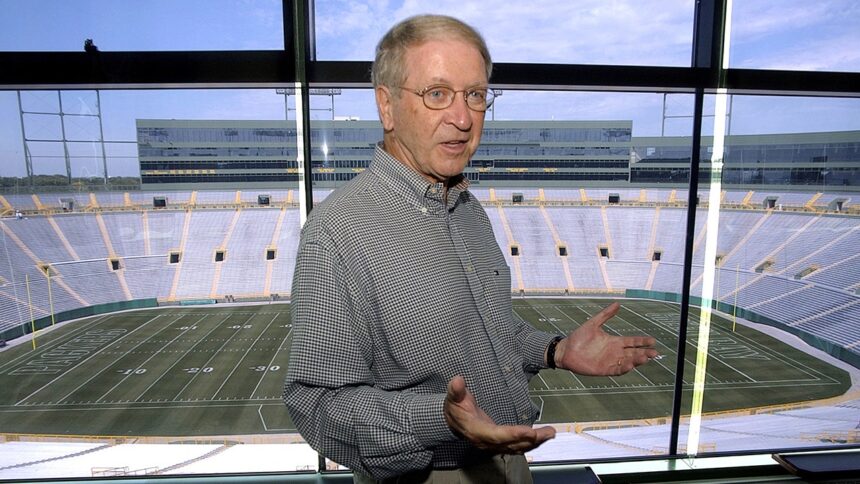
Legendary Packers Architect Bob Harlan, Who Resurrected a Franchise, Dies at 89
The Green Bay Packers, a community-owned franchise where history is measured in generations, lost a foundational pillar. Bob Harlan, the transformative President and CEO who engineered the Packers’ return to glory and safeguarded its small-town future, died Thursday at 89. The team announced his passing after a brief illness, noting he had recently been hospitalized with pneumonia. Harlan’s death marks the end of an era for one of professional sports’ most iconic institutions, a man whose vision pulled the Packers from mediocrity and built the foundation for a modern dynasty.
The Humble Executive Who Dreamed in Green and Gold
Bob Harlan was not a flashy executive. He was a midwesterner with a calm demeanor and an unshakable belief in the Packers’ unique place in American sports. Hired as an assistant general manager in 1971, he ascended to the role of President and CEO in 1989, taking over a franchise that had lost its way. The Lombardi era was a distant memory, and the team was known more for its storied past than its present potential. Harlan’s genius lay in understanding that to honor that past, he had to radically change the future. His philosophy was simple yet revolutionary for the time: hire the best football minds and let them do their jobs.
This approach led to his most consequential decision. In 1991, Harlan boldly hired Ron Wolf as General Manager, granting him full autonomy over football operations—a power previously held by the president. Wolf, in turn, traded for a young quarterback named Brett Favre and hired coach Mike Holmgren. This football operations trifecta ignited a renaissance. Within four years, the Packers were back in the Super Bowl, winning it all in 1996 for the first time in 29 years. Harlan’s willingness to cede control, to trust expertise over ego, is a case study in transformative sports leadership.
Building Lambeau: The Stadium Savior
While the team’s on-field success was paramount, Harlan simultaneously faced a monumental off-field challenge: securing the Packers’ future in Green Bay. In the 1990s, the economic realities of the NFL threatened to overwhelm small-market teams. Lambeau Field, the sport’s hallowed ground, was aging and lacked the revenue-generating amenities of newer stadiums. Harlan spearheaded the Lambeau Field renovation, a $295 million project that was anything but a sure bet.
He took the proposal directly to the people, championing a groundbreaking 0.5% county sales tax referendum to fund the public portion of the renovation. It was a risky political move, but Harlan’s credibility and transparent communication won the day. The referendum passed in 2000. The resulting renovation, completed in 2003, preserved the stadium’s iconic bowl and aura while adding the suites, atrium, and commercial spaces necessary for financial survival. This achievement was perhaps his most vital. He didn’t just build a stadium; he fortified the franchise’s economic foundation, ensuring the Packers could compete for generations to come in the world’s richest sports league.
- Visionary Leadership: Understood that football decisions were best left to football experts.
- Franchise-Defining Hire: Brought in Ron Wolf, leading to the acquisitions of Brett Favre and Reggie White.
- Financial Stewardship: Championed the Lambeau Field renovation, securing the team’s economic future.
- Community Connection: Never lost sight of the team’s unique, fan-owned identity.
A Legacy of Stability and Succession
Current Packers President and CEO Ed Policy, who now sits in the chair Harlan occupied for 19 years, released a statement capturing the man’s essence. “Bob Harlan was the embodiment of the Green Bay Packers,” Policy said. “His humility, his grace, and his unwavering commitment to this community and organization built a championship culture that endures today.” Harlan’s legacy is one of profound stability. He established a clear organizational structure—with a strong GM and head coach reporting to a president who handled business—that remains in place. This structure directly enabled the seamless transition from the Favre era to the Aaron Rodgers era under GM Ted Thompson and coach Mike McCarthy, keeping the Packers in perennial contention.
In an age of volatile sports ownership and impatient fan bases, Harlan’s Packers were a model of consistency and class. He was a bridge from the days of Vince Lombardi to the era of Super Bowl XLV, a custodian of tradition who was never afraid of innovation. His tenure proves that in sports, the most powerful leadership isn’t about headlines; it’s about organizational clarity, empowering talent, and making bold, long-term decisions for the health of the institution.
Contrasting Eras: Packers’ Stability vs. League-Wide “Hangovers”
The news of Harlan’s passing offers a stark contrast to the typical cycles of modern NFL discourse. As analysts like Nick Wright, Kevin Wildes, Chris Broussard, and Danny Parkins might debate the potential for a “Super Bowl hangover” for a team’s fanbase—a topic of fleeting concern—Harlan’s work addressed something far more permanent. He immunized the Packers against the existential hangovers of irrelevance and relocation. While fans of other franchises ride rollercoasters of boom and bust based on a single player or season, the culture Harlan instilled in Green Bay is designed for sustained excellence.
This is the ultimate testament to his impact. The conversation around the Packers is rarely about whether they will be competitive; it’s about how deep their playoff run will be. That expectation, that standard, is Harlan’s doing. He built an organization where the “hangover” is merely the disappointment of an early playoff exit, not decades of despair. In a league where dynasties are fleeting, he architected a dynasty of operations, a model that consistently reloads rather than rebuilds.
The Final Whistle for a Green Bay Giant
Bob Harlan’s life was the Packers. From the moment he joined the organization, his mission was to restore its luster and guarantee its future. He succeeded on every conceivable level. He delivered a Super Bowl trophy, a transformed stadium, and a football operations blueprint that became the envy of the league. More than that, he honored the trust of the thousands of shareholders who own the team, treating the Packers not as a commodity but as a sacred community trust.
As the flags at Lambeau Field fly at half-staff, the NFL mourns a quiet giant. In an era of celebrity owners and corporate branding, Bob Harlan remained a steward, a fan who got to lead his team, and who did so with unparalleled wisdom and integrity. The roar on game day, the glow of the renovated Lambeau, and the very presence of the Packers in Titletown are his enduring eulogy. He didn’t just run a football team; he secured a legacy, ensuring the Green Bay Packers would forever remain, defiantly and proudly, Green Bay’s Packers.
Source: Based on news from Fox Sports.