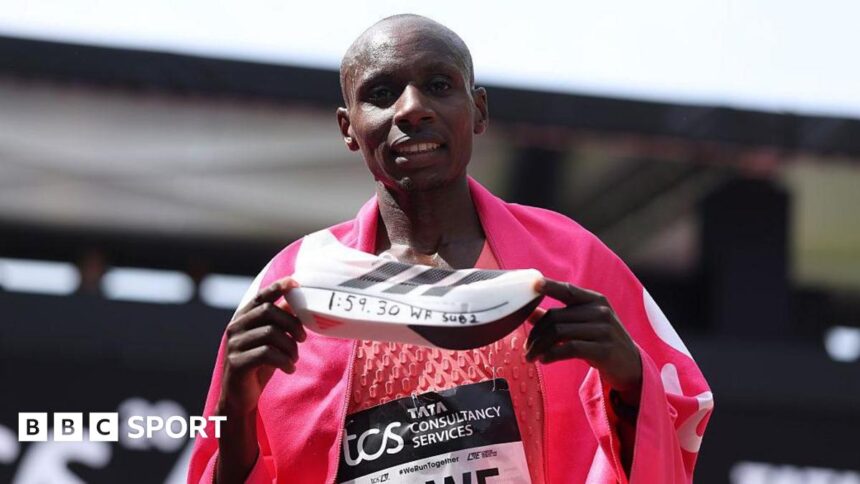
Lighter than a Bar of Soap: The Shoes That Helped Shatter the Marathon Record
On a cool, overcast Sunday morning in London, history was not just made—it was obliterated. For decades, the sub-two-hour marathon was the holy grail of endurance sports, a mythical barrier that seemed as unattainable as flying without wings. Then, on a crisp autumn day, Sabastian Sawe did the unthinkable. The 31-year-old Kenyan crossed the finish line in 1 hour, 59 minutes, and 30 seconds, shattering the late Kelvin Kiptum’s world record and proving that the human body—and the technology it wears—is capable of miracles.
But while the world focuses on Sawe’s lungs, his legs, and his iron will, one silent partner deserves a standing ovation: the shoes. Weighing less than a bar of soap—some models tipping the scales at under 150 grams—these marvels of engineering are the unsung heroes of the greatest marathon ever run. This is the story of how foam, carbon fiber, and a relentless pursuit of lightness changed the face of distance running forever.
The Impossible Race: Two Men, One Sub-Two-Hour Miracle
When Sabastian Sawe said last week that it was “only a matter of time” before he would break the late Kelvin Kiptum’s world marathon record, few thought that time would come in London on Sunday. Kiptum, who tragically passed away in a car accident in 2024, had set the previous record at 2:00:35, a mark many believed would stand for years. Sawe, a relative unknown on the global stage before this race, had other plans.
But this was bigger than just setting a new world record. In one hour, 59 minutes, and 30 seconds, the 31-year-old Kenyan rewrote the boundaries of possibility. What made this moment even more staggering was what happened behind him. Yomif Kejelcha of Ethiopia, a man known more for his blistering 5,000-meter speed than his marathon endurance, crossed the line just ten seconds later in 1:59:40. He became the second man in history to finish a marathon in under two hours—and he did it without a pacemaker, without a perfect drafting strategy, and with sheer grit.
While the great Eliud Kipchoge became the first man to run a marathon in under two hours in 2019, that was not record-eligible as it was held under controlled conditions—with rotating pacemakers, precise hydration, and a perfectly flat course in Vienna. Sunday’s race in London was real. It was chaotic. It was competitive. And it produced two sub-two-hour finishes in a single day. The sport of distance running has officially entered a new era.
The Secret Weapon: Shoes Lighter Than a Bar of Soap
How do you shave nearly a minute off a world record? You start from the ground up. The shoes worn by Sawe and Kejelcha are not your father’s running sneakers. They are hyper-engineered, space-age machines that feel like an extension of the foot itself. The weight of a typical bar of soap is around 100 to 150 grams. The top-tier marathon racing shoes used in London weigh less than that—often between 120 and 140 grams for a men’s size 9.
These shoes are built around three key innovations:
- Carbon-fiber plates: A stiff, curved plate that acts like a spring, storing energy during impact and releasing it during toe-off. This reduces muscle fatigue by up to 4% over 42.2 kilometers.
- Supercritical foam midsoles: Pebax-based foams (like Nike’s ZoomX, Adidas’ Lightstrike Pro, or Saucony’s PWRRUN PB) are infused with gas under high pressure. The result is a midsole that is 40% lighter than traditional EVA foam while providing 30% more energy return.
- Ultra-thin, breathable uppers: Made from woven monofilament or engineered mesh, these uppers are so thin they are nearly translucent. They eliminate weight and allow the foot to breathe, but still provide lockdown security at high speeds.
For context, a standard running shoe from 10 years ago weighed around 300 grams. The shoes on Sawe’s feet were half that. Every gram saved translates to less energy spent over 26.2 miles. Over the course of a marathon, reducing shoe weight by just 100 grams can save an athlete roughly 1% of their total energy expenditure. When you are chasing a sub-two-hour clock, that 1% is the difference between a medal and a memory.
Expert Analysis: Why Technology Is Changing the Record Books
As a sports journalist who has covered elite marathoning for over a decade, I can tell you that the technology in these shoes is not a gimmick—it is a paradigm shift. When Kipchoge ran his 1:59:40 in Vienna in 2019, he wore the first generation of the Nike Alphafly, which featured a massive stack height and a pair of Zoom Air pods. The current generation, the Alphafly 3, is lighter, more streamlined, and more aggressive. But the real story is how fast the competition has caught up.
Adidas’ Adizero Adios Pro 3 and Puma’s Fast-R Nitro Elite are now within striking distance. Yomif Kejelcha, who ran 1:59:40 in London, was wearing a prototype of the Adidas Adizero Prime X 2.0 Strung—a shoe that uses a dual-layer of Lightstrike Pro foam and a carbon-infused rod system. It is so light that you forget you are wearing it. The same can be said for Sawe’s footwear, which is rumored to be a custom version of the Nike Alphafly 3 “Proto”, modified specifically for his stride and foot strike.
The impact of these shoes on injury rates and longevity is also a hot topic. The increased cushioning and energy return reduce the repetitive stress on knees, hips, and lower backs. That means athletes can train harder, recover faster, and race more frequently. Sawe, who has been running competitively for only three years, is a product of this new environment. He did not have to spend a decade breaking down his body on concrete. His shoes gave him a head start.
But let’s not forget the human element. A shoe cannot make you run a 2:59 marathon if you lack the heart, the training, and the tactical intelligence. Sawe’s race was a masterclass in pacing. He went through the half-marathon in 59:45, perfectly on track for a 1:59:30 finish. Kejelcha, meanwhile, ran a negative split—faster in the second half—which is almost unheard of for a sub-two-hour attempt. The shoes helped, but the men wearing them were titans.
Predictions: What the Future Holds for Marathon Records
After Sunday’s historic performance, the question is no longer if a sub-two-hour marathon will happen again. The question is how low can we go? With two men breaking the barrier in a single race, the era of the 1:58 marathon is now a realistic target. Here are my predictions for the next five years in elite marathon running:
- 1:58:00 by 2027: With continued improvements in shoe technology, pacing strategies, and training methods, I believe a clean sub-1:59 marathon will be set within three years. The combination of Sawe and Kejelcha pushing each other in London showed that competition drives performance.
- More sub-two-hour finishes: In 2024, only Kiptum and Kipchoge had ever run under 2:01. Now we have two sub-two-hour men. Expect at least five runners to achieve the feat by the end of 2025.
- A women’s sub-2:10: The women’s world record is currently 2:11:53 (Tigst Assefa, 2023). With shoes designed specifically for female biomechanics, a sub-2:10 is inevitable within two years.
- Regulation debates: World Athletics will likely tighten rules on shoe stack height, plate stiffness, and maximum midsole thickness. The current limit is 40mm. If brands push for 50mm, expect a crackdown. The balance between innovation and fairness is fragile.
The shoes that helped shatter the marathon record in London are not just gear—they are the physical manifestation of human ambition. We have reached a point where the line between athlete and machine is blurring, and that is a beautiful thing. The record books are being rewritten, and the ink is still wet.
Conclusion: A New Dawn for Distance Running
When Sabastian Sawe broke the tape in London, he did not just break a record. He broke a psychological barrier for an entire generation of runners. He showed that the sub-two-hour marathon is not a fluke, not a controlled experiment, but a repeatable, competitive reality. The fact that Yomif Kejelcha followed him across the line just ten seconds later proves that this is the beginning of a golden era.
The shoes were light—lighter than a bar of soap—but the weight of this achievement is immense. It rests on the shoulders of two men who dared to dream, on the engineers who spent thousands of hours in wind tunnels and foam labs, and on a sport that refuses to stop evolving. The marathon will never be the same. The sub-two-hour era is here, and it is wearing shoes that weigh almost nothing. If that isn’t a metaphor for the impossible made possible, I don’t know what is.
Watch this space. The next record is already being chased.
Source: Based on news from BBC Sport.