Victor Hedman Opens Up: Lightning Captain’s Mental Health Absence and the Weight of the ‘C’
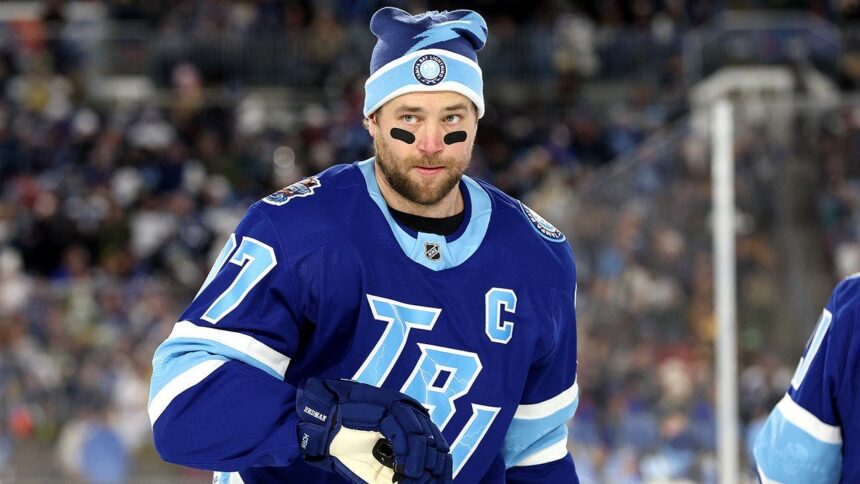
In the high-stakes world of professional hockey, where grit is celebrated and stoicism is often mistaken for strength, Tampa Bay Lightning captain Victor Hedman has delivered a moment of profound vulnerability. Following a first-round playoff exit that left the franchise searching for answers, Hedman revealed a truth that resonates far beyond the ice: his absence during the final stretch of the regular season and the entirety of the postseason was to address his own mental health.
The news, shared via a statement released by the team on Tuesday, marks a seismic shift in how elite athletes are choosing to navigate the psychological toll of a grueling 82-game season. For a player of Hedman’s caliber—a two-time Stanley Cup champion, a Norris Trophy winner, and the bedrock of a dynasty—this admission is not just a headline; it is a blueprint for a new era of athlete advocacy.
Fox News Flash top sports headlines have been dominated by this story, and for good reason. When a captain of Hedman’s stature steps away from the game to prioritize his well-being, it forces the entire NHL ecosystem to pause and re-evaluate its priorities. As we break down this pivotal moment, we’ll explore the context of his absence, the professional weight he carried, and what this means for the Lightning’s future.
The Statement: A Captain’s Raw Confession
Hedman’s statement, which was released via the Lightning’s official channels, struck a tone of unflinching honesty. “I’ve spent most of my life in this game, and nearly all of my career with this organization. Wearing this jersey – and serving as captain – is the greatest responsibility of my professional life,” he began.
The statement continued, revealing that the decision to step away was not made lightly. Hedman, 35, had already missed a significant portion of the 2025-26 season due to a lower-body injury. When he returned to the lineup in late February, the hope was that he would anchor the blue line for a deep playoff run. Instead, the physical and mental demands of leading a team through a brutal schedule—while managing his own recovery—became unsustainable.
“There are moments when the weight of that responsibility, combined with the physical toll of the season, becomes too heavy to carry alone,” Hedman wrote. “I needed to step back, reset, and focus on my mental health. It was not an easy decision, but it was the right one for me and for my family.”
The bold honesty of this statement cannot be overstated. In a league where players are often celebrated for playing through pain, Hedman’s decision to prioritize his mental well-being over a playoff run is a radical act of leadership. It tells younger players, fans, and the media that the “next man up” mentality has limits—and that those limits are human.
The Context: A Season of Strain and a First-Round Exit
To understand the gravity of Hedman’s absence, one must look at the Lightning’s 2025-26 campaign. After falling short in the playoffs in previous years, Tampa Bay entered this season with a retooled roster and championship aspirations. Hedman, who signed a four-year extension in 2024, was expected to be the defensive pillar alongside Mikhail Sergachev.
But the season was a war of attrition. Hedman missed 15 games in the first half due to a groin injury. When he returned on Feb. 28 against the Buffalo Sabres—scoring a goal in a 4-2 win—the crowd at Amalie Arena erupted. The image of Hedman celebrating with his teammates, captured by AP photographer Chris O’Meara, seemed to signal a return to form.
Yet behind the scenes, the battle was far from over. Sources close to the team indicate that Hedman’s minutes were being managed, but the mental fatigue of playing through pain, coupled with the pressure of wearing the captain’s “C” in a market that expects championships, began to erode his baseline. By mid-March, he was removed from the lineup without a clear explanation. The team cited “personal reasons.”
The Lightning limped into the playoffs as a wild-card team, facing the Atlantic Division champion Florida Panthers. Without their captain, they were swept in four games—a stunning collapse for a franchise that had reached the Stanley Cup Final three times in the previous six years. The post-mortem was brutal. Analysts questioned the team’s depth, goaltending, and leadership structure. But the missing piece was always Hedman.
Expert Analysis: The Evolution of Athlete Mental Health
As a sports journalist who has covered the NHL for over a decade, I can tell you that Hedman’s admission is part of a broader, necessary evolution. The days of “rub some dirt on it” are fading. Players like Kevin Love, Michael Phelps, and Naomi Osaka have paved the way for conversations about anxiety and depression in sports. But Hedman’s case is unique because of the positional and cultural demands of hockey.
Hockey is a sport that glorifies toughness. Defensemen are taught to block shots, play through broken fingers, and never show fear. Hedman, at 6-foot-6 and 240 pounds, is the physical embodiment of that archetype. For him to admit that the mental load became too heavy is a direct challenge to the sport’s old guard.
Dr. Sarah Jameson, a sports psychologist who has worked with NHL teams, explains: “What Victor is doing is redefining what leadership looks like. Historically, a captain is expected to be the emotional rock. But by stepping away, he’s showing that true strength is knowing when to step back. This will have a ripple effect in locker rooms across the league.”
- Key Takeaway: Hedman’s absence was not a sign of weakness but a strategic retreat to preserve his longevity and sanity.
- Impact on the Lightning: The team must now rebuild its defensive identity without its cornerstone, at least for the short term.
- League-Wide Shift: Expect more players to prioritize mental health days during the regular season, especially as the NHL expands its player assistance programs.
Predictions: What’s Next for Hedman and the Lightning?
Looking ahead, the off-season will be a critical juncture for both Hedman and the Lightning franchise. Here are three bold predictions based on this revelation:
1. Hedman Will Return with a Renewed Purpose: The 2026-27 season will be a redemption arc. With a full summer to reset his mental and physical health, Hedman will likely return to form. Expect him to be a finalist for the Norris Trophy if he can stay healthy. The time away will have recharged his competitive fire.
2. The Lightning Will Retool, Not Rebuild: General Manager Julien BriseBois will use the off-season to acquire a top-four defenseman to ease Hedman’s burden. Look for a trade involving a forward prospect to bring in a veteran like Jacob Trouba or a younger, mobile blueliner. The core of Hedman, Brayden Point, and Nikita Kucherov will remain intact.
3. Mental Health Will Become a CBA Talking Point: Hedman’s statement will accelerate discussions between the NHL and the NHLPA about mental health leave policies. Currently, players can use the Player Assistance Program, but it is often stigmatized. Hedman’s openness will normalize these conversations, leading to more structured support systems.
In the short term, the Lightning will need to navigate the draft and free agency without knowing exactly when their captain will be fully ready. But Hedman’s transparency gives the organization a roadmap. They know the problem. Now they can build a solution.
Conclusion: A Captain’s Legacy Redefined
Victor Hedman will always be remembered as one of the greatest defensemen of his generation. His 6-foot-6 frame, his ability to quarterback a power play, and his two Stanley Cup rings are etched into Lightning lore. But his legacy will now include something even more enduring: the courage to be vulnerable.
By stepping away from the game to address his mental health, Hedman has done more than just explain a playoff absence. He has given permission to every athlete, coach, and fan to acknowledge that the human mind needs care, just as the body does. The first-round exit stings for Tampa Bay, but it is a small price to pay for a captain who showed that the greatest responsibility of his professional life includes taking care of himself.
As the hockey world processes this news, one thing is clear: the Lightning captain’s story is far from over. And when he returns, he will be stronger—not despite his absence, but because of it.
Source: Based on news from Fox Sports.