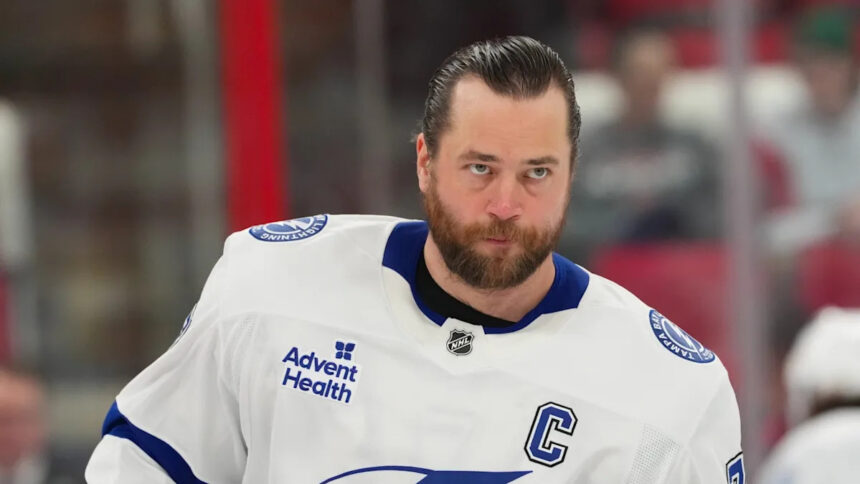
Victor Hedman’s Courageous Confession: Why the Lightning Captain’s Mental Health Leave Redefines Leadership in the NHL
TAMPA, Fla. — For months, the hockey world speculated. Was it a lingering injury? A family emergency? A contract dispute behind closed doors? When Tampa Bay Lightning captain Victor Hedman vanished from the lineup for the final 22 games of the season—including a heartbreaking first-round playoff exit against the Montreal Canadiens—the silence was deafening. Now, the 35-year-old defenseman has broken that silence with a revelation that is far more profound than any trade rumor or injury report. Hedman’s personal leave was to address his mental health. In a sport that has historically prized stoicism over vulnerability, this admission is not just brave; it is a seismic shift in how we define leadership in the NHL.
The statement, released by the Lightning organization, is succinct but powerful. Hedman did not disclose the specifics of his struggle, nor does he need to. What he did share is a blueprint for a new kind of captaincy. “Over the past couple of months, I made the decision to step away and focus on my mental health,” Hedman said. “It was not an easy decision, but it was the right one.” For a player who has been the bedrock of a franchise that won back-to-back Stanley Cups and reached three consecutive finals, stepping away was arguably the hardest check he has ever taken. But as we analyze this moment, it becomes clear: this is not a story of absence. It is a story of presence—of being present for the future.
The Weight of the ‘C’: Why Hedman’s Leave Was a Leadership Masterstroke
Let’s be clear: Victor Hedman is not just any player. He is a Norris Trophy winner, a Conn Smythe Trophy winner, and the longest-tenured captain in Lightning history. When he skated off the ice in mid-March, he carried the weight of a franchise on his shoulders. The Lightning were fighting for playoff positioning, and the defense corps—already missing Mikhail Sergachev for large chunks of the season—looked thin. Conventional wisdom would have demanded Hedman gut it out. But Hedman, who has been around the team in recent weeks even participating in some skates, recognized a deeper truth.
“I’ve always believed that being a leader means doing what’s best for the team,” Hedman said. “In this case, it also meant doing what was necessary to take care of myself, so I can be the best player, teammate, husband and father I expect to be.” This is the kind of leadership that doesn’t show up on a stat sheet. It’s the kind that builds a culture. By prioritizing his mental health, Hedman sent an undeniable message to his younger teammates—players like Nick Perbix and Darren Raddysh—that their well-being matters more than any single game. In a league where the average career is just over five years, and where the pressure to perform is relentless, Hedman’s decision to step away is a masterclass in long-term thinking.
The timing is also critical. The Lightning’s first-round loss to the Canadiens was a bitter pill. They were swept in four games, and the absence of their captain was glaring. But without Hedman’s clarity of mind, would he have been effective? Likely not. A compromised Hedman—one battling internal demons—would have been a liability. By stepping away, he preserved his legacy and, more importantly, his future. This is not a retirement tour. This is a reset.
The Mental Health Revolution in Hockey: Breaking the Last Taboo
Hedman’s announcement is the latest—and perhaps most significant—chapter in the NHL’s slow but steady embrace of mental health awareness. For decades, the league’s culture was defined by the “code”: play through pain, don’t show weakness, and keep your problems off the ice. That code has been cracking. Players like Robin Lehner, Carey Price, and Kevin Love (in the NBA) have bravely shared their battles with mental illness and addiction. But Hedman is different. He is a sitting captain of a flagship franchise, a player who has never been linked to off-ice controversy. His admission normalizes what was once considered abnormal.
The NHL has made strides in recent years. The Player Assistance Program and the NHL/NHLPA Behavioral Health Committee provide resources, but the stigma remains. Hedman’s statement is a hammer against that stigma. He didn’t say he was “taking a break” or “dealing with a personal matter.” He said the words: mental health. That specificity matters. For young fans watching in Tampa, for aspiring defensemen in Sweden, for veterans grinding in the AHL—this is permission to speak up.
It’s also worth noting that Hedman’s leave came at a moment of extreme professional pressure. The Lightning are transitioning. After years of dominance, the core is aging. Steven Stamkos is 35. Nikita Kucherov is 31. Hedman himself turns 36 in December. The window is closing, and the weight of that expectation can be crushing. Add the demands of being a husband and father to two young children, and the equation becomes volatile. Hedman did what few captains have done: he put the oxygen mask on himself first.
Expert Analysis: What This Means for the Lightning’s 2025-26 Season
So, where does this leave the Tampa Bay Lightning? The immediate future is filled with questions. Hedman has one year remaining on his current contract at a cap hit of $7.875 million. The team is in a precarious cap situation, with Anthony Cirelli and Erik Cernak already signed to long-term extensions that kick in. General manager Julien BriseBois faces a summer of tough decisions. But Hedman’s return to mental clarity is the wild card that could tilt the balance.
Prediction: Look for a revitalized Victor Hedman in training camp. The fact that he was skating with the team in recent weeks, even as they were eliminated, suggests he is already on the mend. The off-season will be crucial. Without the grind of a playoff run, Hedman will have nearly four months to rest, recover, and recalibrate. I expect him to come back with a renewed sense of purpose. The Lightning will likely move on from some depth pieces to create cap space, but Hedman remains the anchor. If he can rediscover the form that made him a Norris finalist in 2022, Tampa Bay remains a threat in the Atlantic Division.
However, the organization must also adapt. The Lightning need to build a support system around their captain. This means hiring a dedicated mental health coach, something several NFL teams already employ. It means normalizing days off for mental reset. It means BriseBois and head coach Jon Cooper must publicly affirm that Hedman’s health is the top priority. The days of “just shake it off” are over.
For the NHL, Hedman’s story is a cautionary tale and a beacon of hope. The 2025-26 season will be a litmus test for how the league handles these situations. Will other players feel empowered to speak up? Will teams invest in proactive mental wellness? If Hedman’s legacy is that he helped save even one player’s career—or life—it will be more valuable than any Stanley Cup.
The Final Word: A Legacy Beyond the Ice
Victor Hedman will one day be inducted into the Hockey Hall of Fame. His resume is impeccable: 1,100+ games, a Norris Trophy, a Conn Smythe, and two championships. But his most enduring impact may be this moment. In a sport that worships toughness, he showed that true strength is knowing when to step back. He showed that the “C” on his chest is not a badge of invincibility, but a symbol of responsibility—to himself, to his family, and to his team.
As the Lightning prepare for next season, they do so with a captain who has faced his darkness and emerged with a clearer head. The fans in Tampa should be excited, not worried. The playoffs loss stings, but it was a necessary sacrifice for the long game. Hedman’s return will not be measured in goals or assists, but in presence. In focus. In the quiet confidence of a man who knows he made the right call.
“It was not an easy decision, but it was the right one,” Hedman said. For the Lightning, for the NHL, and for everyone who has ever struggled in silence, it was the only one.
Final Prediction: Victor Hedman plays at least 70 games next season, posts 45+ points, and leads the Lightning back to the second round of the playoffs. More importantly, he becomes the league’s most vocal advocate for mental health resources. Watch for a landmark partnership between the NHLPA and a mental health organization this summer. The ripple effects of this announcement will be felt for years.
The captain is back. And he’s stronger than ever.
Source: Based on news from Yahoo Sports.