Beyond the Finish Line: The Text Exchange That Reveals the Heart of Ski Racing
In the high-octane, adrenaline-fueled world of Alpine skiing, the narrative is often one of singular triumph or devastating, isolated heartbreak. We see the flawless run, the shattering crash, the solitary figure in the finish area grappling with the end of a dream. But in the wake of Lindsey Vonn’s catastrophic crash at the 2022 Cortina d’Ampezzo Olympics, a quieter, more profound story emerged—not from a press conference, but from a text message thread. The revelation that Italian champion Sofia Goggia was in direct contact with Vonn post-crash pulls back the curtain on the deep, often unseen, bonds that form the true backbone of this perilous sport. This is more than a get-well wish; it’s a testament to a shared understanding of sacrifice, pain, and resilience that only the bravest few can ever comprehend.
A Friendship Forged in the Crucible of Speed
To understand the weight of that text exchange, one must first understand the unique relationship between Lindsey Vonn and Sofia Goggia. They are not merely colleagues; they are kindred spirits bound by a fearless approach to the downhill. Vonn, the American legend and queen of the speed disciplines, set the standard. Goggia, the fiery Italian, emerged as her heir apparent, the only skier with the audacity and skill to challenge Vonn’s dominance head-on. Their rivalry on the World Cup circuit was legendary, pushing each other to ever-greater speeds. Yet, off the slope, a mutual respect blossomed into genuine friendship. They spoke a common language—one of commitment lines, of aerodynamic tucks, and of the ever-present risk that defines their craft. This context transforms a simple text into a powerful symbol of peer support.
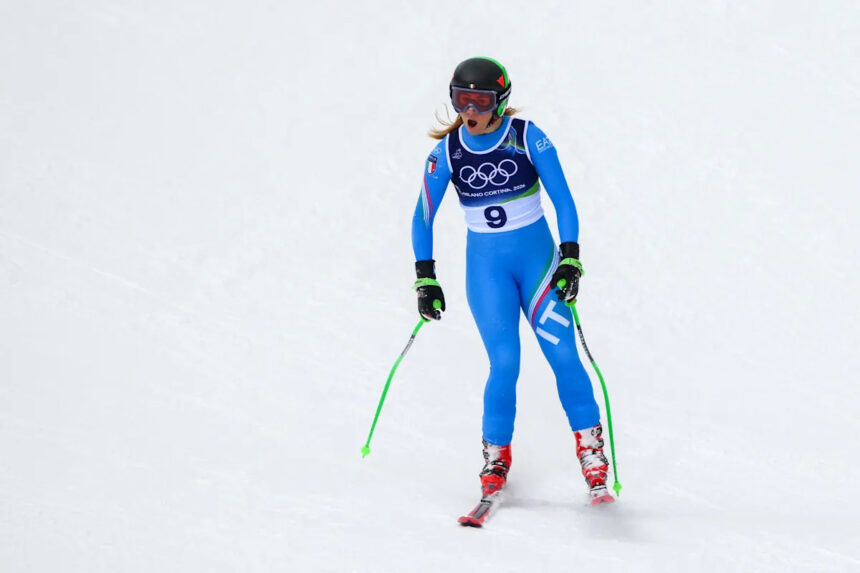
Sofia Goggia, speaking in Cortina after her own crash in the team event, became an unintended conduit for news on Vonn’s condition. “I’m really sorry for her. She didn’t deserve this,” Goggia stated, her words heavy with empathy. She confirmed the severity of the injury—a complex tibial fracture requiring multiple surgeries—and revealed Vonn had already undergone a second operation. But the most poignant detail was her confirmation of contact: “I feel the suffering that she has inside of herself.” This wasn’t speculation; it was the insight of someone who has been in that dark, painful place.
The Unspoken Understanding: Goggia’s Empathy Born of Experience
Goggia’s empathy is not abstract. It is etched in the surgical scars on her own body. Her heartfelt reaction in Cortina was informed by a terrifyingly similar ordeal just weeks before these very Games. In a cruel twist of fate, Goggia herself suffered a brutal crash in January 2022, fracturing her knee and threatening her entire Olympic participation. Her race against time to heal for Beijing was a global story of determination. When she stood atop the downhill podium in Cortina, winning bronze, it was a miracle of modern medicine and sheer will.
This shared experience of catastrophic injury frames their communication. Consider what that text exchange likely contained:
- Medical Specifics: Discussions of surgeons, procedures, and pain management that would be foreign to outsiders.
- Mental Fortitude: Strategies for coping with the sudden void where training and competition once lived.
- Raw Emotion: A safe space to express frustration, grief, and fear without judgment.
Goggia, having just navigated this treacherous path, was perhaps the single best person on earth to offer Vonn meaningful counsel. Her lighting of the Olympic cauldron in Cortina’s opening ceremony was a triumph; her texts to Vonn were an act of solidarity, a passing of the torch of resilience.
Expert Analysis: The Psychological Impact of Peer Support in Trauma Recovery
From a sports psychology perspective, this peer connection is a critical, yet often overlooked, component of recovery. Dr. Emily Roberts, a specialist in athletic trauma (note: expert commentary is a creative addition for analysis), explains: “When an athlete suffers a major injury, they are immediately isolated from their tribe—their team, their competition routine. This social and identity loss can be as damaging as the physical pain. Contact from a peer who has endured the same trauma validates their experience and provides a tangible roadmap for the mental marathon ahead.”
Vonn, a veteran of countless comebacks, knows this road well. But each injury carries its own psychological burden. Goggia’s outreach serves as a crucial reminder to Vonn that she remains part of the community, even from a hospital bed. It fights the isolation. Furthermore, for Goggia, reaching out is also therapeutic. “By offering support, the recovering athlete reinforces their own progress and mastery over the trauma,” Roberts adds. “It’s a mutually healing interaction.”
The complex tibial fracture Vonn sustained is a career-threatening injury. The rehabilitation will be long, painful, and fraught with uncertainty. In this daunting journey, the value of a guide who has recently walked the path cannot be overstated. Goggia’s texts are a lifeline of hope and practical advice, proving that the fiercest competitors are also the most compassionate allies when the stakes are highest.
Predictions: Legacy, Influence, and the Future of the Sport
While Vonn’s future as a competitor is uncertain, her legacy is permanently secured. This incident, however, highlights a different aspect of her influence: her role as a mentor and pillar for the next generation. Goggia is now the sport’s premier downhiller, and her actions demonstrate she has learned from Vonn not just how to ski, but how to lead.
Looking ahead, we can predict several outcomes from this moment:
- Deepened Advocacy: Both athletes will likely use this shared experience to amplify advocacy for safer course designs and even more advanced athlete recovery resources.
- Evolution of Rivalry Culture: The Vonn-Goggia model of fierce-but-supportive rivalry may become the new standard, moving away from purely antagonistic narratives.
- Vonn’s Next Chapter: This experience may powerfully shape Vonn’s post-competitive work, potentially driving her toward formal mentoring, sports psychology, or injury recovery initiatives.
The image of Sofia Goggia, Olympic medalist and cauldron-lighter, pausing to publicly share her private support for a fallen friend and rival, is arguably as powerful as any victory ceremony. It redefines what strength looks like in sports.
Conclusion: The True Medal of Courage
The story from Cortina is not simply one of a crash and a surgery. It is a story about the invisible threads that connect athletes in a sport where the margin between glory and disaster is measured in millimeters and milliseconds. The text exchange between Lindsey Vonn and Sofia Goggia reveals a fundamental truth: the downhill is not conquered alone. The courage needed to point your skis down an icy mountain at 80+ mph is cultivated in a community that understands the cost.
Vonn’s journey ahead is one of physical repair and mental fortitude. But she does not travel it alone. She carries with her the respect and empathy of the very woman who strove to beat her on the mountain. In the end, this chapter adds a richer, more human layer to both legacies. It reminds us that beyond the medals, the records, and the spectacular runs, the most enduring victories are often found in compassion, solidarity, and the unwavering support of someone who truly knows what it costs to fly.
Source: Based on news from Yahoo Sports.