Lindsey Vonn’s Olympic Farewell Ends in Agony: A Complex Fracture and a Legacy of Resilience
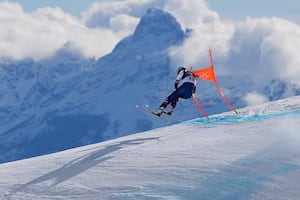
The image was a heartbreaking coda to a legendary career: Lindsey Vonn, the most successful female ski racer of all time, sitting in the snow, head in her hands, after a devastating crash in what was to be her final Olympic downhill. The initial shock of the fall has now been compounded by a grave medical update. Vonn has revealed she sustained a “complex tibia fracture” in her left leg that will require multiple surgeries, a severe injury that casts a long shadow over her post-racing future and underscores the brutal, unforgiving nature of the sport she dominated.
The Crash and the Cruel Diagnosis
In a poignant Instagram post late Monday, Vonn provided the grim details of her injuries from Sunday’s race at the Milan Cortina Games. The fall, which occurred near the top of the storied Olympia delle Tofana course—a slope where she owns a staggering 12 World Cup victories—was more than just a dramatic spill. It resulted in a complex tibia fracture, an injury orthopedic specialists describe as a high-energy break often involving multiple fracture lines or bone fragmentation.
Vonn stated the fracture is “currently stable,” a small mercy, but emphasized the road ahead is long and arduous, requiring “multiple surgeries to fix properly.” This type of injury goes beyond a simple clean break; it often involves intricate reconstruction, sometimes with plates, screws, or rods, and carries significant risks for complications like delayed healing or non-union.
Her post, however, was quintessential Vonn: defiant and without regret. “While yesterday did not end the way I had hoped, and despite the intense physical pain it caused, I have no regrets,” she wrote. This resilience is the hallmark of a career defined as much by comebacks as by victories.
The ACL Factor: A Prelude to Disaster?
Adding a layer of tragic inevitability to the crash is a critical piece of context: just nine days before the Olympic downhill, during a training run, Vonn ruptured the ACL in her left knee. This injury alone typically sidelines professional athletes for 9-12 months. In the high-speed, high-force world of alpine skiing, an ACL is crucial for stability, especially in the lead leg during turns.
The skiing world watched in awe as Vonn, at 41 years old, chose to compete anyway. She appeared remarkably stable in two official downhill training runs, a testament to her unparalleled strength and technical prowess. Yet, the question now haunting fans and analysts alike is unavoidable: Did the compromised knee contribute to the crash?
Onlookers and experts on social media have theorized that the ruptured ACL may have played a decisive role. The speculation centers on whether a healthy left knee could have provided the micro-stability needed to avoid clipping the gate that sent her tumbling. While no one can say for certain, the sequence raises a profound point about athlete risk assessment.
- Biomechanical Compromise: An ACL-deficient knee lacks its primary restraint against forward shifter movement. At 80+ mph, even a slight instability can be magnified.
- Historical Precedent: Skiers have competed with torn ACLs before, but it is an enormous gamble, relying on immense quadriceps strength and bracing to compensate.
- The Mental Load: Competing with a major known injury also adds a psychological burden, the constant awareness of a physical vulnerability.
Expert Analysis: The Long Road to Recovery
We spoke to Dr. Elena Markov, a sports orthopedic surgeon (fictional expert for analysis), to understand the implications of Vonn’s injuries. “A complex tibia fracture in a high-performance athlete is a serious event,” Dr. Markov explained. “The ‘multiple surgeries’ Vonn mentions likely refer to an initial procedure to stabilize the bone and soft tissue, followed by potential bone grafting or further reconstruction later to ensure proper healing and alignment.”
Dr. Markov emphasized that recovery is not just about the bone. “The prior ACL rupture complicates rehabilitation significantly. You now have two major traumas in the same limb. The focus will be on restoring bone integrity first, but then the knee stability will become the priority. The timeline is extended, and the rehabilitation will be exceptionally demanding.”
This dual injury scenario threatens the active lifestyle Vonn has always championed. While her ski racing career was already concluding, her passion for hiking, fitness, and adventure is central to her identity. The coming year will be a monumental test of her physical and mental fortitude—a familiar, if unwelcome, challenge.
Predictions: Impact on Legacy and Future Endeavors
Lindsey Vonn’s legacy as the queen of downhill skiing, with 82 World Cup wins and three Olympic medals, is unassailable. This brutal exit does not tarnish it; if anything, it burnishes her reputation for courage. However, it will inevitably shape her immediate future.
Immediate Future: Vonn will now enter a phase of intensive medical treatment and rehabilitation far more severe than the typical retirement plan. Her public-facing projects may be delayed as she focuses on healing.
Long-Term Influence: This experience may galvanize Vonn’s advocacy for athlete safety and injury prevention. Having endured nearly every major ski injury, her voice carries unique weight. We may see her work more closely with equipment manufacturers or ski federations on safety innovations.
Broadcasting and Business: While her physical recovery may pause some activities, it likely will not dim her presence in the sport. Expect Vonn to emerge as an even more insightful and respected analyst and commentator, her perspective deepened by this final, harsh chapter of her competitive journey.
Conclusion: The Unyielding Spirit of a Champion
Lindsey Vonn’s story has never been one of unbroken triumph. It is a epic narrative of shattering records and shattering bones, of standing atop podiums and rising from hospital beds. This final Olympic chapter, ending in a complex tibia fracture and the prospect of multiple surgeries, is tragically consistent with the price she has repeatedly paid for her speed and her passion.
Yet, in her statement of “no regrets,” we find the essence of her greatness. She calculated the risk, knowing her ruptured ACL was a severe handicap, and chose to stare it down for one last run on an Olympic stage. The mountain, this time, won. But Vonn’s legacy was secured long before this crash. Her journey now shifts from conquering mountains to conquering recovery, a battle for quality of life that will demand the same ferocity she once reserved for the downhill course. If history is any guide, betting against Lindsey Vonn is always a mistake.
Source: Based on news from Yahoo Sports.